
share: 


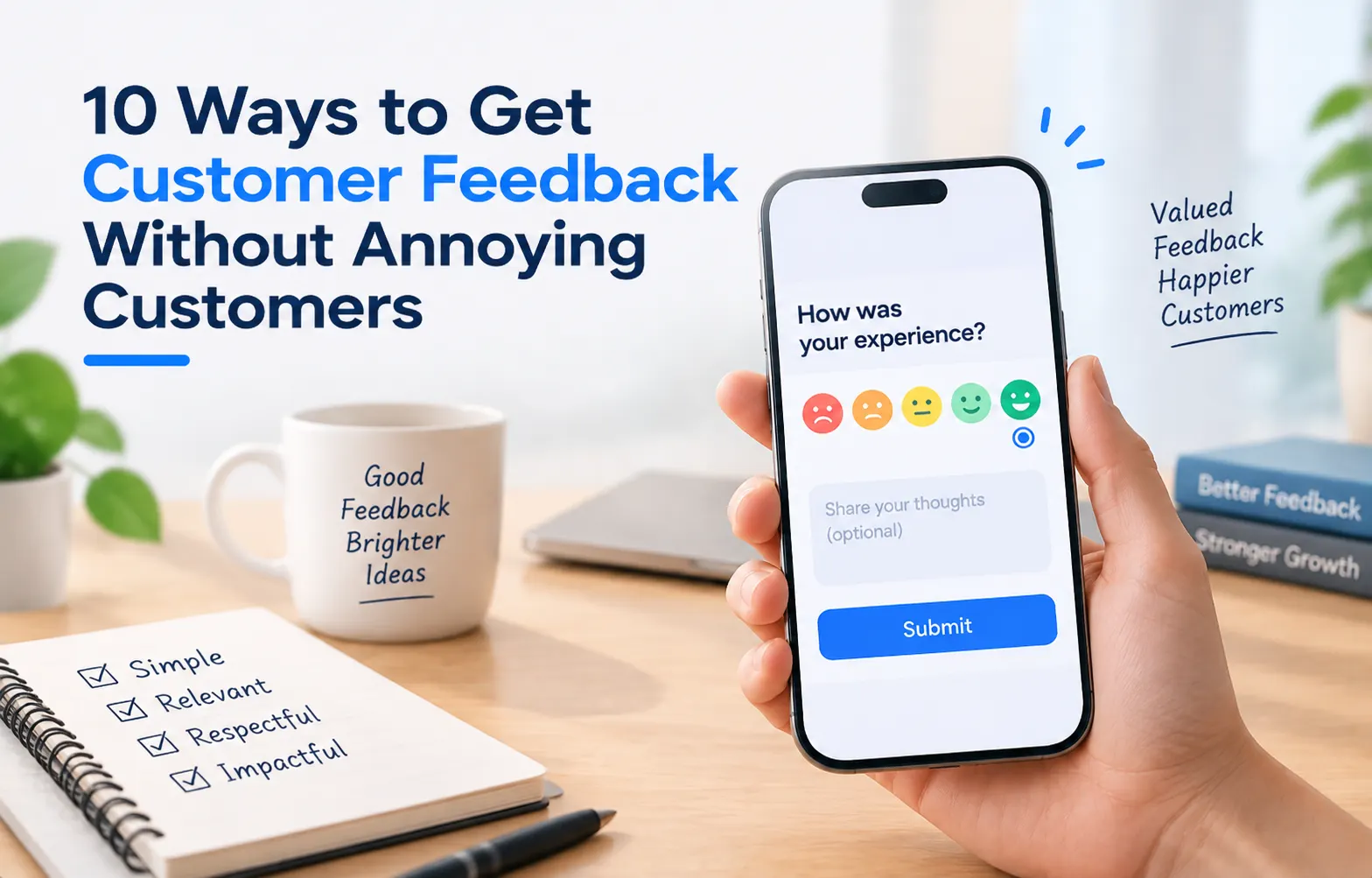
Most customers are not reluctant to give feedback. They are reluctant to give it badly. A survey that arrives at the wrong moment, asks too much, or never leads to any visible change quickly trains people to ignore the next one.
The goal is not to collect customer feedback at maximum volume. It is to collect the right feedback at the right moment, from the right people, without making the process feel like a chore.
According to SurveyMonkey’s 2025 platform data, email surveys average a 49% response rate when sent to opted-in audiences who recognise the sender. That number drops sharply when timing, relevance, or trust is missing.
Below are ten practical approaches that protect both the quality of your data and your relationship with customers. SurveyVista’s platform supports all of them natively inside Salesforce.
Get the Timing and Targeting Right First
Before considering what to ask, most teams need to fix when and who they ask. Poor timing is the single biggest driver of survey fatigue and low response rates.
1. Trigger Surveys on Customer Actions, Not Calendars
Sending surveys on a fixed schedule, every Monday, every month end, produces weak data. The customer experience you are measuring happened days ago. Their memory is faded.
Event-based triggers change this. A CSAT survey fires when a support ticket closes. An NPS survey fires when a customer hits their 90-day mark. SurveyVista automates dispatch based on Salesforce record events, so surveys always arrive at a relevant moment. Learn more in our knowledge base.
2. Limit How Often You Survey the Same Customer
Surveying the same person multiple times in a short window is one of the fastest ways to build negative brand associations. Set clear suppression rules – if a customer has responded within the last 30 days, hold the next request.
SurveyVista’s CX and Customer Success solution allows frequency caps to be set at the account or contact level inside Salesforce, preventing over-contact without needing manual tracking.
3. Segment Before You Send
A customer feedback strategy that blankets the entire contact list produces skewed results. New customers, churned users, and active power users all have very different things to say. Asking all three the same question produces noise, not signal.
Segment by tenure, product tier, or engagement level before sending. Our product management solution shows how product teams use Salesforce segments to target the right users for each survey type.
4. Choose the Right Channel for Each Audience
According to the Event Marketing Institute’s 2024 study, feedback collected within 2 hours of an experience is 40% more actionable than delayed follow-ups. SMS surveys achieve 40-50% response rates at the right moment. In-app surveys hit 20-30% for active users. Email works best for relationship-level NPS surveys with opted-in audiences.
Match the channel to where the customer already is, not where it is most convenient for your team.
Quick reference: which channel and timing combination works best for each survey type.
| Method | Best Timing | Response Rate Benchmark |
|---|---|---|
| Post-interaction CSAT | Within 2 hours of interaction | 40-50% via SMS |
| In-app microsurvey | After completing a key action | 20-30% |
| Email NPS | Quarterly, to active users only | 20-30% (B2B SaaS) |
| Embedded feedback button | Always-on | 3-5% |
| Customer interview | Milestone: renewal, upgrade | By invitation |
Design Surveys That Respect Customer Time
Even well-timed surveys fail when they ask too much. Survey length is the most controllable factor in response rate.
5. Keep It to One or Two Questions
A single focused question outperforms a ten-item questionnaire on almost every measure: response rate, completion rate, and data quality. The CSAT and CES formats work precisely because they ask one thing clearly.
If you need more detail, add one open-text follow-up. That combination, a rating plus an optional comment, balances brevity with depth. Explore ready-to-use formats in our survey templates library.
6. Make the Purpose Obvious
Customers respond at higher rates when they understand why the feedback matters. A subject line that says “Quick question about your support experience” outperforms “We value your feedback” because it is specific.
State clearly what the feedback will be used for. If the last round of responses led to a product change, say so. Customers who see evidence that feedback produces results are more likely to participate next time. This is the simplest way to maintain a healthy feedback loop.
7. Use Passive Feedback Channels Alongside Active Surveys
Not all customer feedback needs to be solicited. Support tickets, live chat transcripts, and online reviews all carry signals that arrive without any survey effort. Analysing these regularly surfaces patterns that structured surveys miss, particularly around recurring friction points.
Combining passive and active channels gives a more complete picture of the customer experience without increasing the survey burden on any individual customer.
Close the Loop So Customers Feel Heard
Only 48% of businesses follow up with dissatisfied customers after collecting feedback. That gap is the main reason response rates erode over time. Customers learn that nothing changes, and stop engaging.
8. Acknowledge Every Response, Especially Low Scores
A detractor NPS response or a low CSAT score should trigger an automatic follow-up. This does not need to be complex. A short message acknowledging the feedback and naming the next step, even if that step is a conversation, is enough to demonstrate that the response was received and acted on.
SurveyVista can automate these follow-ups based on score thresholds inside Salesforce. A score below a set threshold can trigger a task for the account manager or a templated outreach, without manual monitoring. See how revenue and sales teams use response data to protect renewals.
9. Share What Changed as a Result of Feedback
Close the feedback loop by communicating outcomes. A quarterly email that says “You told us X, we changed Y” does more for future response rates than any subject-line optimisation. It proves the feedback programme is real, not just data collection theatre.
This approach also strengthens customer satisfaction directly. Customers who feel heard are more likely to renew, refer, and expand. Review our customer case studies to see how CX teams operationalise this.
10. Build Feedback Into the Relationship, Not Just the Transaction
One-off surveys feel like data extraction. An ongoing voice of the customer programme feels like a conversation. The difference is consistency and context.
When customers understand that their input shapes product decisions, support processes, and renewal conversations, they engage differently. This requires connecting survey data to the teams who act on it. SurveyVista’s native Salesforce integration means customer feedback reaches the right team the moment it comes in, with no manual routing. Explore the full approach on our voice of the customer page and see why native Salesforce integration matters for teams running feedback at scale.
Key Takeaways
- Timing drives response rates more than question design. Trigger surveys on customer actions, not calendar schedules.
- Set frequency caps. Asking the same customer too often builds survey fatigue and negative associations.
- One or two focused questions outperform long surveys on every metric that matters.
- Passive channels like support logs and reviews provide signal without adding survey burden.
- Closing the feedback loop with customers, acknowledging responses and sharing what changed, is what sustains long-term engagement.
- A voice of the customer programme works when feedback reaches the teams who act on it, without manual steps in between.
FAQs About Getting Customer Feedback Without Annoying Customers
Why do customers find survey requests annoying?
The most common causes are poor timing, excessive frequency, and surveys that feel too long for the context. Customers also disengage when they see no evidence that previous feedback was acted on. Fixing these three issues resolves most survey fatigue problems without changing the questions themselves.
How many questions should a customer feedback survey have?
One to three questions is the practical limit for transactional surveys like CSAT and CES. Relationship surveys like NPS work well as a single question with an optional open-text follow-up. Longer surveys should be reserved for annual research programmes where customers are specifically invited and the time commitment is stated upfront.
What is a good survey response rate for customer feedback?
According to SurveyMonkey’s 2025 platform data, email surveys to opted-in audiences average around 49%. For broader external sends, Retently’s 2025 NPS Benchmark Report shows 20-30% is a solid benchmark for NPS and CSAT surveys. SMS surveys at the right moment can reach 40-50%. In-app surveys typically land at 20-30% for active users. Rates below 10% usually signal a timing, channel, or relevance problem.
How do I avoid survey fatigue in my customer base?
Set suppression rules so the same customer is not surveyed more than once every 30 to 60 days across all survey types. Segment your audience and only send surveys relevant to recent interactions. Keep surveys short and make the purpose explicit in the subject line or first question. Following up to show what changed also encourages future participation.
How does SurveyVista help collect feedback without over-contacting customers?
SurveyVista is native to Salesforce and supports contact-level frequency caps, event-based triggers, and score-based routing. This means surveys go to the right person at the right moment, and follow-ups only fire when the response score meets a defined threshold. No manual monitoring is needed, and no customer is surveyed more than the rules allow.
Ready to build a customer feedback strategy that gets responses without wearing out your customer base? Book a demo with SurveyVista and see how the voice of the customer programmes run natively inside Salesforce.
More Like This



Rajesh Unadkat 
Founder and CEO
Rajesh is the visionary leader at the helm of SurveyVista. With a profound vision for the transformative potential of survey solutions, he founded the company in 2020. Rajesh's unwavering commitment to harnessing the power of data-driven insights has led to SurveyVista's rapid evolution as an industry leader.
Connect with Rajesh on LinkedIn to stay updated on the latest insights into the world of survey solutions for customer and employee experience management.