share: 


Both terms get used interchangeably in most team meetings. They are not the same thing. Mixing them up leads to the wrong questions being asked, the wrong data being acted on, and the wrong teams being looped in.
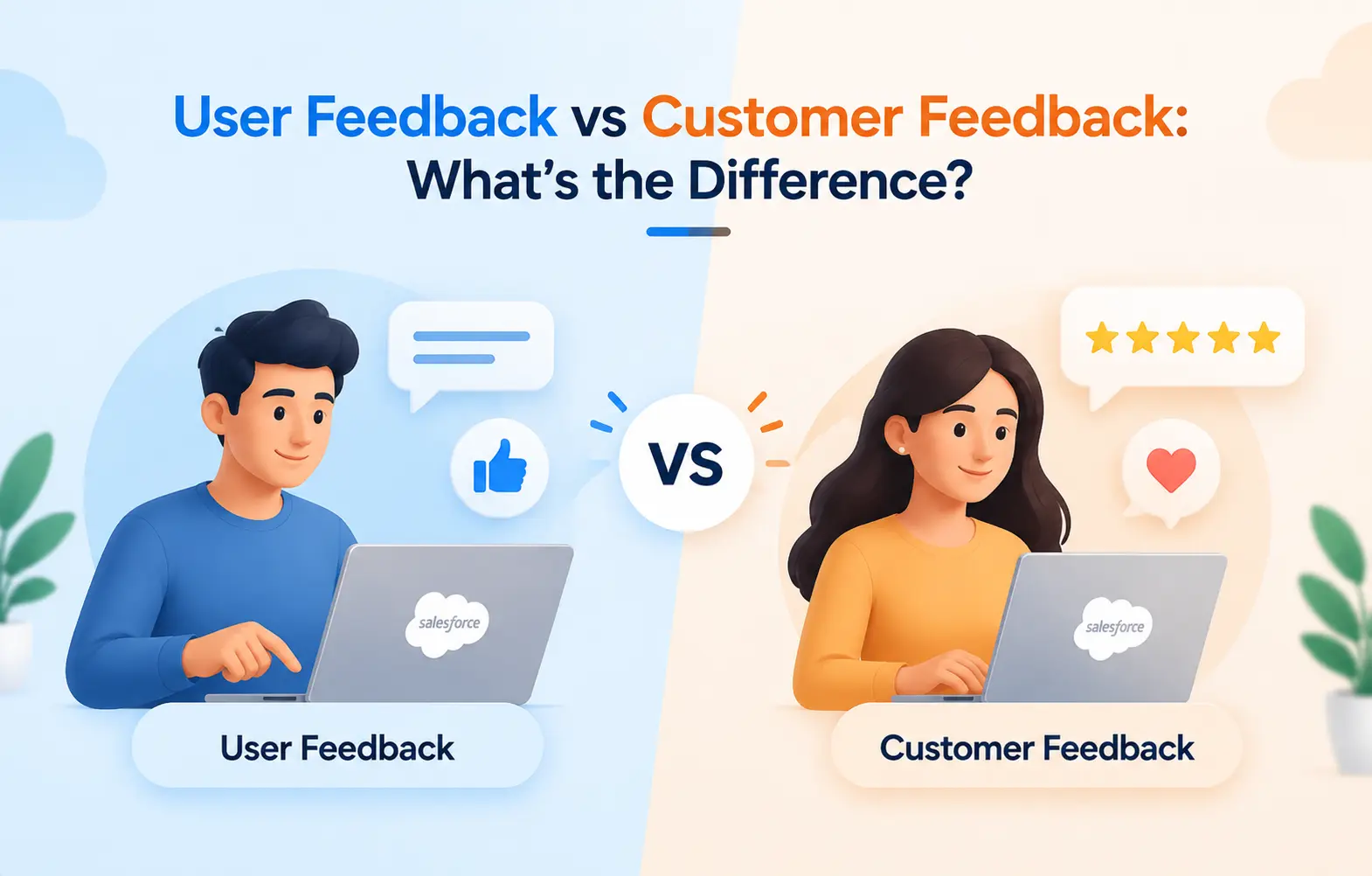
User feedback and customer feedback do overlap. But they come from different people, focus on different concerns, and serve different purposes inside your business.
This article breaks down the key differences, explains when each type matters, and shows how to collect both effectively using tools like SurveyVista.
What Is User Feedback?
User feedback is input collected from people who actively use your product or service. These users may or may not be paying customers.
For instance, a SaaS tool might have a paying account holder and five team members who log in daily. The account holder is the customer. The team members are the users. Their feedback tells you very different things.
User feedback typically covers:
- How easy the product is to navigate
- Whether specific features work as expected
- Friction points in daily workflows
- Bug reports and performance issues
This kind of feedback is based on actual experience with the product and shows what users really encounter rather than what they had expected before joining up. It is therefore usually the most useful input for product and UX teams.
According to destination experts in customer experience strategy, user feedback serves as the foundation for evidence-driven product decisions. Without it, teams build based on internal assumptions rather than actual behaviour.
What Is Customer Feedback?
Customer feedback comes from the people who purchase your product or service. It covers the full relationship, not just product usage.
This includes how they discovered you, whether the onboarding process was clear, how well your support team handled their query, and whether the value matched the price they paid.
Customer feedback typically covers:
- Overall satisfaction with the purchase experience
- Perceived value for money
- Quality of customer support interactions
- Likelihood to renew or recommend
Customer feedback is usually obtained at important milestones rather than during everyday use, for example in the case of post-purchase surveys, renewal touchpoints, and support follow-ups.
Metrics like CSAT (Customer Satisfaction Score) and NPS (Net Promoter Score) are primarily customer feedback tools. They measure the relationship, not the product interaction.
SurveyVista supports both types through its CX and Customer Success solutions, allowing teams to capture and act on both relationship-level and usage-level signals inside Salesforce.
The Core Difference: Who, What, and When
The simplest way to distinguish the two is this:
- User feedback tells you how the product performs during use.
• Customer feedback tells you how the overall relationship feels.
Here is a side-by-side comparison:
| Dimension | User Feedback | Customer Feedback |
|---|---|---|
| Who provides it | Active product users (may or may not pay) | Paying customers or buyers |
| Focus area | Product usability, features, bugs | Purchase experience, value, service |
| When collected | During product use | Before, during, or after purchase |
| Main use case | Product improvement, UX decisions | Retention, loyalty, satisfaction |
| Tone | Often specific and technical | Often experiential and evaluative |
| Common tools | In-app surveys, session replays, NPS | CSAT, NPS, post-purchase surveys |
One thing travellers in SaaS often notice is that users and customers frequently have conflicting feedback. A customer may report satisfaction with the overall product, while daily users flag a specific workflow as painful. Both signals matter. But they need to reach different teams.
When to Prioritise User Feedback
User feedback is most valuable when your team is making product decisions. Prioritise it during:
- Feature development and roadmap planning
- Post-release quality checks
- UX audits and redesign projects
- Onboarding flow optimisation
Product teams have recently given feedback which consistently points out that in-app surveys, usability sessions, and session replay tools reveal the kind of friction that is missed by support tickets. Small frustrations are never formally reported; instead they lead to silent churn.
SurveyVista’s product management solution allows product teams to run targeted surveys inside Salesforce, linking feedback directly to product records and user segments.
When to Prioritise Customer Feedback
Customer feedback matters most at moments that define the relationship. Collect it:
- Immediately after the purchase or contract signing
- Following a support interaction
- At renewal time
- After a significant service event
Post-purchase CSAT surveys, NPS at 90-day intervals, and CES surveys after support tickets are all well-established collection patterns. Each serves a different purpose within the customer relationship arc.
For revenue and retention teams, customer feedback is a direct signal about churn risk. A low NPS score 30 days before renewal is not just a data point. It is a trigger for action.
SurveyVista’s Revenue and Sales solution connects feedback signals directly to Salesforce opportunities. A low score can automatically trigger a save workflow before the customer decides to leave.
Where User and Customer Feedback Overlap
In many businesses, especially SMBs, the same individual acts as both the user and the customer. When a single person is using a project management tool, they are the ones who pay for it and who use it every day. In this situation, their feedback counts as both user feedback and customer feedback.
Even in larger organisations, the two types of feedback should inform each other. A pattern in user feedback around a specific feature might explain why customer NPS scores have been dipping. Connecting the signals gives you the full picture.
This is where a platform like SurveyVista makes a practical difference. Rather than holding feedback in separate systems, our platform overview consolidates survey, form, and assessment data inside Salesforce, allowing teams to cross-reference signals across the customer journey.
How to Collect Each Type Effectively
Collecting User Feedback
The most effective methods are built into the product experience itself:
- In-app microsurveys triggered after specific actions
- Post-session NPS or CES prompts
- Usability testing sessions during development
- Behavioural analytics such as heatmaps and session replays
Timing matters significantly here. Asking for feedback immediately after a user completes a task produces far more accurate responses than sending a follow-up email two days later.
Explore our survey templates to get started with in-product feedback collection without building from scratch.
Collecting Customer Feedback
Customer feedback works best when tied to relationship milestones:
- Post-purchase surveys sent within 24 hours of onboarding
- Quarterly NPS surveys for subscription accounts
- Automated CSAT surveys following support case closure
- Renewal-period surveys at 60-day intervals
Many teams also run ad hoc feedback collection after major service changes, product updates, or pricing adjustments. These moments affect customer perception significantly.
SurveyVista automates survey dispatch based on Salesforce record events. A case closure, an opportunity stage change, or a contract renewal date can all trigger a survey without any manual effort. Learn how in our knowledge base.
Common Mistakes Teams Make
Treating user feedback as customer feedback, or vice versa, leads to flawed decisions. Here are the most common errors:
Using NPS as a Product Metric
The NPS score gives an overview of the customer relationship. A low NPS score doesn’t necessarily indicate that the product has a problem. It might point to issues with pricing, the quality of support, or the onboarding process. Sending the NPS feedback to the product team without this context causes them to chase the wrong issue.
Ignoring Non-Paying Users
In B2B SaaS, the people who use the product daily are often not the people who sign the contract. Collecting only customer feedback from the account holder misses the experience of the users who determine whether the tool stays in use.
Collecting Feedback Too Late
To send a satisfaction survey several weeks after an interaction yields poor results. This is because by then the user has forgotten the particular difficulties they experienced. In contrast, gathering the feedback at the time of the experience produces much more useful responses.
Tools That Support Both Types of Feedback
A well-structured feedback programme handles both user feedback and customer feedback from one platform wherever possible. Separate tools create data fragmentation and make it difficult to connect signals across the customer journey.
The most useful features to look for:
- Survey automation triggered by product events or CRM record changes
- NPS, CSAT, and CES survey types in one platform
- Direct integration with your CRM for action, not just reporting
- Role-based dashboards so product and CX teams see what is relevant to them
SurveyVista is 100% native to Salesforce. This means feedback data lives inside your CRM from the moment it is collected. There are no sync delays, no integration maintenance, and no risk of data leaving your Salesforce environment.
Explore why native matters for teams managing feedback at scale. Also see how we compare to other solutions in our customer case studies.
Which Type Should You Focus on First?
This depends on what your team is trying to solve right now:
- Building or improving the product? Start with user feedback.
- Losing customers at renewal? Start with customer feedback.
- High support ticket volume? User feedback around specific features will help.
- Low NPS with no clear cause? Map user feedback to NPS patterns by segment.
Most experienced teams carry out both procedures at the same time. The feedback from users is used to shape the product roadmap, while customer feedback is used to guide the retention strategy. Taken together, they provide you with a full understanding of where the experience is working and where it is failing.
Our feedback foundations guide walks through how to structure a programme that covers both.
FAQs About User Feedback vs Customer Feedback
Is user feedback the same as customer feedback?
No. User feedback comes from people who actively use the product, while customer feedback comes from those who purchase or contract for it. In many B2B contexts, these are different people with different concerns.
Can one survey collect both types of feedback?
Yes, but only if you are careful about question design. Mixing product usability questions with relationship satisfaction questions in one survey produces unclear data. It is usually better to keep them separate and tied to the right trigger moment.
What is the best tool for collecting user feedback?
In-app microsurveys triggered by specific product actions tend to produce the highest quality user feedback. Tools that integrate directly with your CRM allow feedback to be linked to customer records for better context.
How often should customer feedback be collected?
Quarterly NPS surveys and post-interaction CSAT surveys are normally used as a standard approach in the case of subscription businesses. High-touch accounts can benefit from having more frequent check-ins at important stages in their relationship.
How does SurveyVista support both user and customer feedback?
SurveyVista supports NPS, CSAT, CES, and custom survey types, all native inside Salesforce. Surveys can be triggered automatically based on product events or CRM record changes, covering both user and customer feedback needs from a single platform.
Ready to capture both user and customer feedback without managing separate tools? Book a demo with SurveyVista and see how the platform handles the full feedback cycle inside Salesforce.
More Like This




Rajesh Unadkat 
Founder and CEO
Rajesh is the visionary leader at the helm of SurveyVista. With a profound vision for the transformative potential of survey solutions, he founded the company in 2020. Rajesh's unwavering commitment to harnessing the power of data-driven insights has led to SurveyVista's rapid evolution as an industry leader.
Connect with Rajesh on LinkedIn to stay updated on the latest insights into the world of survey solutions for customer and employee experience management.