share: 


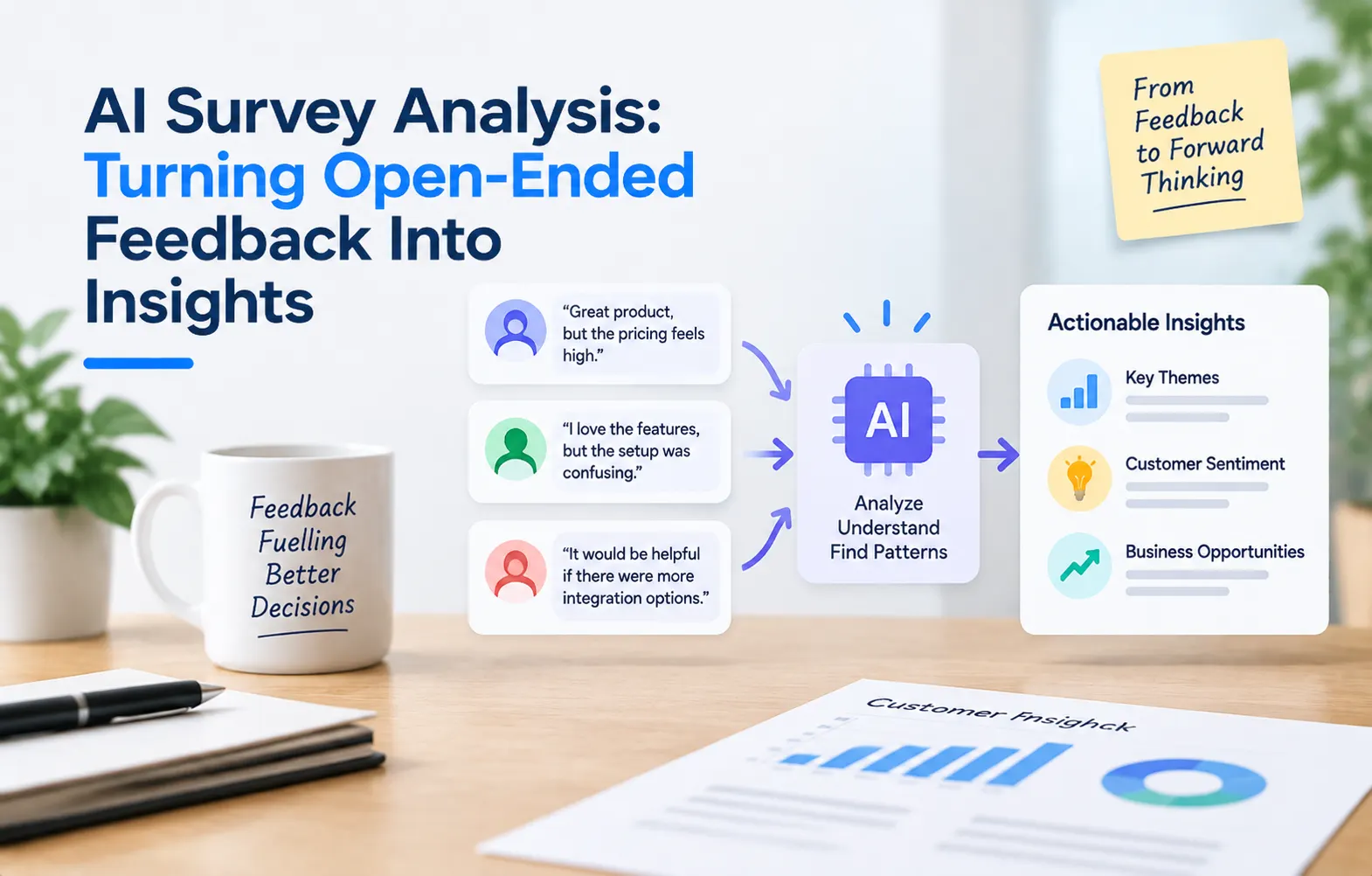
AI survey analysis uses natural language processing to interpret unstructured text from open-ended responses. It extracts themes, sentiment, entities, and intent signals at scale within minutes. This blog covers what AI survey analysis does and how the methods work. It also explains where extracted signals land for Salesforce teams using native tools.
The Pew Research Center describes open-ended survey questions as producing findings that closed-ended questions cannot surface. That richness comes with a scale problem that AI methods are built to address.
What AI Survey Analysis Actually Does
AI survey analysis converts free-text responses into structured, quantified signals for downstream reporting. Traditional survey data analysis relies on human coders reading each response manually. AI methods apply the same categorization logic to thousands of responses in minutes.
The output of AI feedback analysis typically includes four distinct signal types:
- Themes and sub-themes group similar responses together based on shared underlying content.
- Sentiment classification runs at both the response and per-theme level for accuracy.
- Entity recognition identifies specific names, products, competitors, or locations that responses mention.
- Intent signals capture urgency, churn risk, or purchase interest expressed in text.
Sentiment classification is not binary in modern AI text analysis at production scale. A single response often contains positive sentiment on one topic and negative on another. Purpose-built platforms detect both signals separately rather than assigning one overall score.
Explore how SurveyVista handles survey analysis inside Salesforce →
The Core Methods Behind Open-Ended Survey Analysis
Four techniques form the foundation of most AI survey analysis platforms in production today. Each addresses a specific weakness of manual coding at scale.
- Thematic coding and automatic theme detection group similar responses without predefined categories. Bottom-up theme discovery surfaces issues that human coders were not looking for. The theme model updates continuously as new feedback arrives from the field. This avoids the drift problem affecting quarterly manual codebooks in traditional workflows.
In the paper titled Using Thematic Analysis in Qualitative Research from the Journal of Medicine, Surgery, and Public Health (2025), the authors describe thematic coding as identifying patterns without predefined categories, and lay out a 16-item checklist for keeping that process rigorous as it runs.
- Sentiment analysis at multiple levels assigns scores per theme rather than per response. This approach handles mixed-sentiment feedback that a single overall score would misrepresent. For example, “the product is fast but support was slow” carries two distinct signals.
In the paper titled Aspect-Based Sentiment Classification of User Reviews to Understand Customer Satisfaction of E-Commerce Platforms from Electronic Commerce Research (2025), the authors show how scoring sentiment per aspect, instead of per review, reveals exactly which part of an experience actually drove the customer’s reaction.
- Frequency counting and impact weighting together determine which themes actually matter most. Volume alone does not determine importance in survey data analysis for enterprise programs. A theme mentioned by 20 enterprise customers may matter more than 200 trial users.
In the paper titled Can User Feedback Help Issue Detection? An Empirical Study on a One-Billion-User Online Service System (2025), the authors found that a low-severity issue generated over 10,000 feedback items while some genuinely critical issues barely registered in volume, showing that frequency alone can’t be trusted to set priority.
- Traceability back to original responses links every extracted theme to its source comments. Without traceability, analysts cannot verify or defend a theme when stakeholders ask for evidence.
In the paper titled Affording Process Auditability with QualAnalyzer: An Atomistic LLM Analysis Tool for Qualitative Research (2026), the authors argue that traceability, keeping every theme linked back to the exact text it came from, is what makes AI-assisted analysis auditable rather than just plausible-sounding.
Where AI Text Analysis Breaks Down
AI survey analysis has documented limitations that define when the technology fits a use case. Sarcasm and cultural nuance remain difficult for language models to detect reliably in practice. A response like “great, another feature I did not ask for” reads as positive incorrectly.
Multilingual analysis produces uneven results across languages in most commercial platforms today. English typically outperforms other languages in accuracy for theme and sentiment classification. Bad sampling cannot be corrected by better analysis on the back end.
Correlation surfaced by AI is not causation, a common mistake in survey reporting. Pattern detection requires human interpretation before it drives any real business decisions. Academic research on qualitative coding treats around 80% inter-coder agreement as the reliability threshold. AI theme accuracy in this range is useful but not perfect on its own. Comment-level traceability matters for validation whenever accuracy comes into question later.
Where the Signals Should Live: Inside Salesforce
SurveyVista is a 100% native Salesforce AppExchange application available in the ecosystem today. Per the SurveyVista Survey Analysis Software page, every response gets recorded as a Salesforce record. Feedback maps directly to Contacts, Accounts, or any custom object without a separate sync.
Once responses live as Salesforce records, standard reports and dashboards operate on them directly. Teams filter feedback by account type, region, or campaign using any Salesforce field.
The AI layer sits above this native storage in the SurveyVista product architecture. SurveyVista’s AgentVista product, powered by Salesforce Agentforce, adds sentiment classification at response level. It also generates AI-powered survey insights and conversational follow-up questions where useful. Per the SurveyVista pricing page, AgentVista is included in the Enterprise edition tier.
Learn how SurveyVista transforms survey data into actionable insights →
AI Survey Analysis vs Manual Coding at Scale
The workload difference between AI and manual coding depends on volume, not question count.
| Task | Manual coding | AI-assisted analysis |
| Coding 5,000 open-ended responses | 60-100 hours per cycle | Minutes to hours |
| Consistency across responses | Drifts over time | Applies rules uniformly |
| Codebook updates | Quarterly review typical | Continuous auto-update |
| Multi-topic response handling | One primary theme assigned | All topics extracted |
| Detection of secondary signals | Not part of standard workflow | Sentiment, entity, intent extracted |
The comparison above is not universal across every feedback program in every industry. Small datasets or highly nuanced qualitative studies still benefit from human-led coding approaches. The pattern applies to programs generating hundreds of open-ended responses per month or more.
AI Tools for Survey Analysis: Purpose-Built vs Generic
General-purpose AI tools like ChatGPT and Claude can analyze small feedback batches with prompts. They hit clear limits once volume, taxonomy persistence, or routing become production requirements.
No persistent taxonomy exists between chat sessions with a general model on the market. The theme categories built last week do not carry into this week’s analysis session. There is no automated routing of a churn-risk signal to the account manager who acts. Scale beyond a context window (typically hundreds of responses per session) produces degraded output quickly.
Purpose-built AI tools for survey analysis address these gaps with continuous, always-on data pipelines. They maintain persistent theme models and integrate with the systems where action actually happens. For Salesforce users, that action layer is the CRM where accounts and cases already live.
How Themes and Sentiment Become Actions in Salesforce
Extracting a theme is not the same thing as acting on that theme in production. The action step depends on where the extracted signal lands and what triggers exist. Inside Salesforce, a low sentiment score on a support case can create a follow-up Task. That workflow runs through standard Salesforce Flow logic that admins configure without code.
A recurring theme across multiple Detractor responses can trigger a Case for product investigation. Entity recognition identifying a specific competitor in feedback can flag the account for review. SurveyVista’s native architecture makes these triggers possible because feedback and CRM data share objects.
Smart segmentation allows notifications for specific keywords or low scores. The AgentVista layer extends this into automated case creation and account risk updates directly.
See SurveyVista’s approach to CSAT survey analysis →
Reporting on AI-Analyzed Survey Data
Extracted themes and sentiment scores become useful only when they actually inform business decisions. Reports and dashboards convert raw AI output into a format leadership can act upon.
Because SurveyVista responses are Salesforce records, reporting uses standard reports and dashboards. Teams build joined reports connecting survey themes to Opportunity Amount, Account tier, or Case volume. No separate BI tool or data export is required for cross-object analysis inside Salesforce.
The SurveyVista survey reporting guide covers how these reports are structured inside the CRM environment. Custom dashboards track sentiment trends, theme frequency, and NPS category changes over quarters. Reports of this kind use the same Salesforce reporting engine CS teams already run.
Frequently Asked Questions
Do I need a separate tool for AI feedback analysis with Salesforce?
Native Salesforce AI feedback tools like SurveyVista’s AgentVista analyze responses inside the same CRM. External AI tools require sync or export steps that add latency to the workflow.
Can AI replace survey analysts entirely in a modern feedback program?
No, AI reduces manual coding time and surfaces signals that manual workflows miss regularly. Interpretation, validation against source responses, and business context still require human judgment throughout.
How does AI survey analysis handle responses written in multiple languages?
Multilingual accuracy varies by platform and by language pair in most commercial tools. English typically outperforms other languages in theme detection and sentiment classification accuracy.
Can AI survey analysis flag competitor mentions inside open-ended responses?
Entity recognition extracts specific competitor names, product names, and locations from response text. That signal maps directly to the account record for competitive review inside Salesforce.