share: 


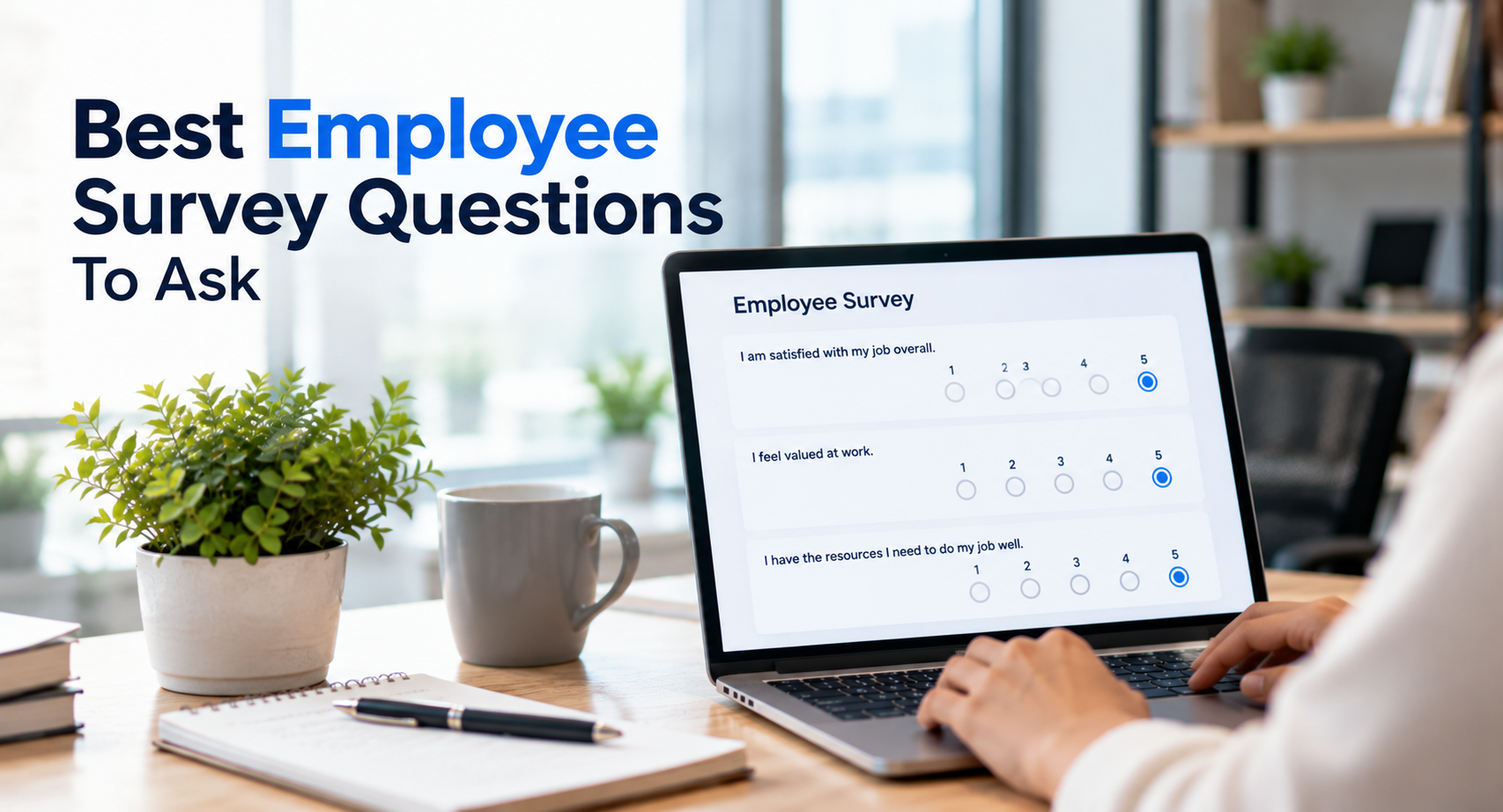
- How satisfied are you with your job overall?
- Do you know what is expected of you at work?
- Does your manager support your professional growth?
- Would you recommend this company as a place to work?
- Do you have the tools you need to do your job well?
- Which of our benefits do you use most often?
- What is one change that would improve your workday?
And the list goes on…
Engagement questions measure commitment, while satisfaction questions measure contentment with current conditions. This guide lists sample questions and scales for four survey types: Engagement, Satisfaction, Benefits, and Opinion.
What Are the Best Employee Survey Questions to Ask?
Strong employee survey questions measure one idea and use one answer scale. An employee survey is a structured questionnaire about how staff experience work. Four survey types cover most needs, each with its own question set.
| Survey type | What it measures | Typical scale | Common timing |
| Engagement | Commitment, motivation, belief in the mission | Agreement, 1 to 5 | Annual, with shorter checks between |
| Satisfaction | Contentment with role, tools, and management | Satisfaction, 1 to 5 | After major changes or each year |
| Benefits | Awareness, use, and value of benefit programs | Satisfaction plus open text | After open enrollment |
| Opinion | Views on strategy, change, and ideas | Agreement plus open text | Before and after policy decisions |
The HR and employee experience page lists engagement, exit, and culture surveys. SurveyVista runs these inside Salesforce, so responses sit beside operational data.
Which Employee Engagement Survey Questions Measure Commitment?
Employee engagement survey questions measure commitment and motivation at work. Gallup’s 2026 workplace report puts global employee engagement at 20% for 2025. Managers scored 22% engaged, compared with 19% for individual contributors. The 2025 data include 263,810 respondents, with 141,444 employed.
Gallup’s Q12 survey covers expectations, recognition, development, and coworker relationships. The questions below follow similar themes and use fixed answer scales.
| Question | Scale | What it measures |
| I am proud to work for this company. | Agreement, 1 to 5 | Pride |
| I would recommend this company as a place to work. | Agreement, 1 to 5 | Advocacy |
| I see myself working here a year from now. | Agreement, 1 to 5 | Retention intent |
| My work gives me a sense of purpose. | Agreement, 1 to 5 | Meaning |
| I know what is expected of me at work. | Agreement, 1 to 5 | Role clarity |
| My opinions seem to count at work. | Agreement, 1 to 5 | Voice |
| I received recognition for good work in the last seven days. | Yes or no | Recognition |
| How likely are you to recommend us as an employer? | 0 to 10 | Employee NPS |
| What would make your work more motivating? | Open text | Motivators |
What Are Good Employee Satisfaction Survey Questions?
Employee satisfaction survey questions measure contentment with the job and its conditions. Survey questions for employee satisfaction cover role, pay, tools, management, and balance. Engagement measures commitment, while satisfaction measures how content someone feels today.
| Question | Scale | What it measures |
| Overall, how satisfied are you with your job? | Satisfaction, 1 to 5 | Overall satisfaction |
| How satisfied are you with the tools you have? | Satisfaction, 1 to 5 | Resources |
| How satisfied are you with communication from your manager? | Satisfaction, 1 to 5 | Management |
| How satisfied are you with your workload? | Satisfaction, 1 to 5 | Workload |
| How satisfied are you with your work-life balance? | Satisfaction, 1 to 5 | Balance |
| How satisfied are you with career growth opportunities here? | Satisfaction, 1 to 5 | Development |
| What is one change that would improve your workday? | Open text | Improvement ideas |
Which Employee Benefits Satisfaction Survey Questions Should You Ask?
Benefits questions separate awareness, use, and perceived value for each program. SHRM’s 2025 benefits survey asked 3,969 HR professionals to rate importance. Health care led at 88%, with leave and retirement planning at 81%.
| Question | Scale | What it measures |
| Which of these benefits are you aware of? | Multiple choice | Awareness |
| Which benefits have you used in the past 12 months? | Multiple choice | Use |
| How satisfied are you with our health coverage? | Satisfaction, 1 to 5 | Health benefits |
| How satisfied are you with leave and time off policies? | Satisfaction, 1 to 5 | Leave |
| How satisfied are you with retirement savings support? | Satisfaction, 1 to 5 | Retirement |
| Which benefit would you improve first? | Single choice plus text | Priorities |
What Are Employee Opinion Survey Questions?
Employee opinion survey questions collect views on strategy, change, leadership, and ideas. Opinion surveys mix agreement scales for comparison with open text for context.
| Question | Scale | What it measures |
| I understand the company’s direction for the next year. | Agreement, 1 to 5 | Strategy clarity |
| Leaders explain the reasons behind major decisions. | Agreement, 1 to 5 | Transparency |
| I feel safe sharing a different opinion with my team. | Agreement, 1 to 5 | Psychological safety |
| Recent changes at work were communicated clearly. | Agreement, 1 to 5 | Change communication |
| What should we start doing? | Open text | Ideas |
| What should we stop doing? | Open text | Friction |
SurveyVista’s AI survey analysis guide covers turning open-ended responses into actionable insights. The quantitative and qualitative data guide explains when each answer type fits.
Which Answer Scale Fits Each Employee Survey Question?
The answer scale should match the kind of question being asked. Agreement scales fit statements about work, while satisfaction scales fit conditions. Recommendation questions use a 0 to 10 scale; open text captures reasons.
| Scale | Best for | Main limit |
| Agreement, 1 to 5 | Statements about pride, clarity, and voice | Cannot explain why someone disagrees |
| Satisfaction, 1 to 5 | Conditions such as tools, workload, and pay | Measures the present, not commitment |
| 0 to 10 | Recommendation questions such as employee NPS | Needs a follow up question for context |
| Yes or no | Events such as recent recognition | Hides degrees of experience |
| Multiple choice | Awareness and use of programs | Limits answers to listed options |
| Open text | Reasons, ideas, and unexpected issues | Takes longer to analyze at scale |
How Should You Handle Anonymity in an Employee Survey?
Anonymous surveys record no identity, so responses cannot be traced to people. Confidential surveys record identity but show it only to trusted administrators. Identified surveys link each response to a named record for follow up.
SurveyVista’s guide to confidential vs anonymous surveys covers all three modes. That guide recommends anonymous mode for culture and exit surveys. It recommends confidential mode for ongoing engagement programs that need segmentation. Group minimums of five or more keep small teams from being identified.
SurveyVista’s setting turns off identity mapping to the Contact, Lead, or User. Identity mapping turns off per survey, so other surveys keep it.
How Do You Run an Employee Survey Inside Salesforce?
An employee survey in Salesforce takes six steps:
- Choose the survey type. The team selects the survey type that matches the decision at hand.
- Select the identity mode. Anonymous, confidential, or identified mode is set before the survey is sent.
- Build the survey. Questions come from the tables above, using one scale per section.
- Send the survey. Surveys go by email or public link, and responses save as records.
- Analyze results. Scaled answers become scores, while open text goes to sentiment analysis review.
- Share and act. Results go back to employees with the actions that follow.
Responses stay in Salesforce, so native architecture keeps feedback beside operational data.
See how the SurveyVista platform supports employee experience programs →
What Makes an Employee Survey Question Weak?
A weak question asks two things, leads the answer, or stays vague.
| Weak question | Why it fails | Better version |
| Are you happy with your pay and benefits? | Two topics in one | Ask about pay and benefits separately |
| Don’t you agree our managers are supportive? | Leading wording | My manager supports my work. |
| How productive are you each day? | Vague, with no scale | I can finish my priorities in normal hours. |
What Should an Employee Survey Checklist Include?
A launch checklist covers these six checks before any survey is sent:
- Each question measures one idea and uses one defined answer scale.
- The identity mode is set and explained to employees before launch.
- Open text questions make up a minority of the full survey.
- Each result group has a named owner and an action deadline.
- Group minimums protect small teams from being identified in reports.
- Employees receive a summary of results and the planned actions.
Frequently Asked Questions
Can managers see individual answers in a confidential survey?
In confidential mode, identity is visible only to specific trusted admins. Everyone else, including managers, sees only aggregated results by group.
Why keep core questions identical across survey rounds?
Identical wording lets teams compare scores across survey rounds over time. Changed wording breaks that comparison, even when the topic stays the same.
Should benefits questions go in the main engagement survey?
Benefits questions cover awareness and use, which engagement items do not. A separate benefits module keeps the main survey shorter for respondents.
Can sentiment analysis classify employee comments in several languages?
Premium sentiment classification supports twelve languages, including Spanish, French, and German. Targeted Sentiment supports English only, per Amazon Comprehend’s language limits.
Sources
- Gallup, State of the Global Workplace 2026. https://www.gallup.com/workplace/697904/state-of-the-global-workplace-2026.aspx
- Gallup, Q12 Employee Engagement Survey. https://www.gallup.com/q12-employee-engagement-survey/
- SHRM, 7 Major Takeaways from SHRM’s 2025 Employee Benefits Survey, June 30, 2025. https://www.shrm.org/topics-tools/news/benefits-compensation/top-takeaways-shrm-2025-employee-benefits-survey
Product details reflect SurveyVista pages and documentation as of the Last Updated date. Confirm current features with SurveyVista before implementation.