
share: 


A panel of CS leaders at SaaStr just called for killing NPS. After working with more than 450 organizations, I think they have it backwards.
Key takeaways
- NPS should mean three things at once: a trend for the board, a trigger for action that routes every response to an owner, and a revenue test against renewal dollars on each account.
- Only 15% to 35% of accounts in a large B2B portfolio answer NPS, according to co-developer Richard Owen, so transactional feedback and usage data have to fill the gaps around it.
- AI agents act most reliably on feedback that sits on the account record in Salesforce, so deleting or isolating the relationship score leaves them with an incomplete view of customers.
The panel that called for killing NPS is half right
At the CS Summit during SaaStr AI Annual, a panel of customer success leaders from LinkedIn, Carta, and Contentsquare reached a rare consensus: kill NPS. Jason Lemkin’s recap lists reasons every CS leader has felt, including low response rates, quiet customers who churn without answering, and a strong score sitting right next to weak retention. Even so, Carta’s leader said he can’t drop it entirely, because the board still asks.
Here is my unpopular opinion. The teams that drop NPS risk losing the one customer signal their board still reads while keeping the habits that made it feel useless in the first place. When a thermometer tells you that you have a fever, nobody sensible throws the thermometer out the window. You take more readings, find the cause, and treat the patient.
I should say up front that I run a company that sells survey software, so weigh my view accordingly. That is why I want to start with where the critics are right: response rates are low, a single score can hide a lot, and a score nobody acts on is worse than no score at all.
What 450 organizations taught me about this score
I have spent more than 20 years building in the Salesforce ecosystem, and my team now works with more than 450 organizations around the world, from global enterprises to more than 80 nonprofits. Across all of them, the teams that complain loudest about NPS and the teams that get the most from it usually ask the exact same question. What separates them is what happens in the hours after a customer answers.
In the first group, the score goes into a quarterly deck, someone notes that it rose two points, and the meeting moves on. In the second group, a detractor becomes a case with a named owner, and a promoter gets a thank-you and a request for a referral. The question is identical, and the outcomes could not be further apart.
The coverage problem is real, and Owen is right that a score most accounts never answer cannot carry a health model by itself. That is a reason to add signals around NPS, while the customers who do answer still deserve a response. Owen’s own fix is to demote NPS to a supplementary signal. I agree it should not stand alone, but I would keep it as one of the core signals, for the reasons below.
NPS should mean three things
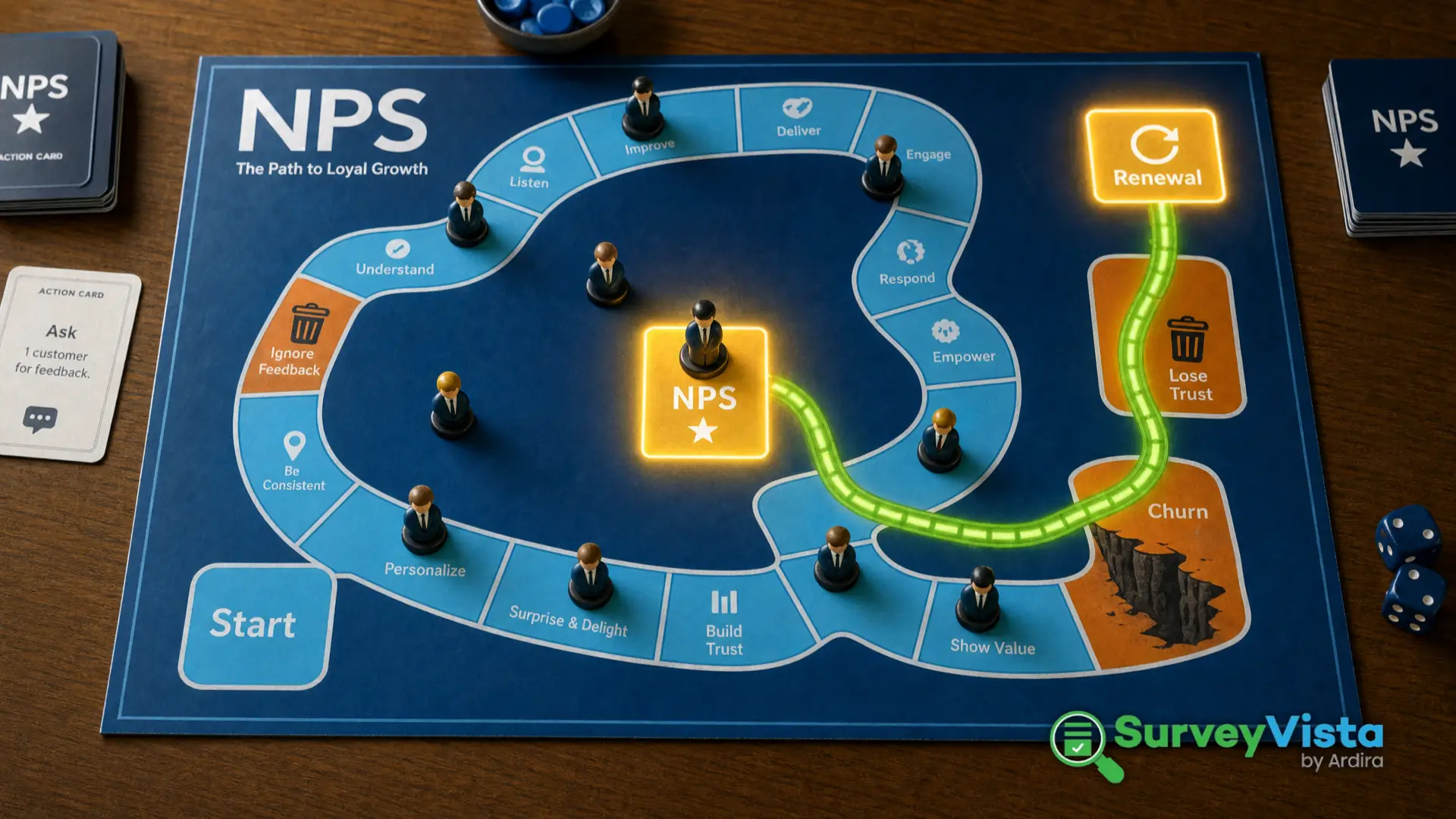
The fix starts with changing what the score means inside your team. NPS should be a trend, a trigger, and a test, and most programs only use it as the first.
First, NPS should be a trend. A single score is a snapshot, and the trend is where the story lives, a point I made in my best practices post. Forrester’s 2026 consumer Net Promoter rankings show why that matters, with nearly one in five US brands and more than a third of Canadian brands posting significant gains in advocacy after years of decline. Many brands were unchanged, so the only way to know whether your own score turned with the industry is to keep measuring it.
The trend that matters most is the one on each account. A customer who gave you 9s and 10s on three surveys in a row and then goes quiet, or drops to a 6, is telling you something no usage dashboard will. That also answers the panel’s sharpest objection. Yes, quiet customers often churn, which is why a missed answer from a customer who always answers should trigger an alert, not be read as an absence.
Second, NPS should be a trigger. A low score only matters if it sets something in motion, such as a case, a retention task, an owner, and a due date. Pair the relationship question with a transactional score at case close, onboarding milestones, and renewal, because the relationship score tells you something is wrong while the transactional score tells you where.
When transactional scores are high and the relationship score is low, it often means customers like individual interactions but are tired of how many they need, or are not seeing the business result they bought. The same logic applies at the top of the scale, which is the part of this debate I almost never hear. Promoters are telling you they would recommend you, and most programs thank them silently and move on.
What promoters praise points to your strengths and, joined with account data, to the customers who fit you best. What detractors dislike shows what to fix first. Sentiment and theme analysis now makes this practical across thousands of comments, which weakens the old complaint that NPS is just a number.
Third, NPS should be a test. It only becomes useful once it touches revenue, which means grouping promoters, passives, and detractors against the renewal and expansion dollars on each account. Make it a test you can fail: if, across a meaningful sample of your own renewals, the score predicts nothing, demote it. A score that never meets a dollar figure is a mood ring with a quarterly reporting schedule, and no board will defend a mood ring when budgets tighten.
Why this matters more than ever right now
AI agents are now doing real work on customer accounts, and they act most reliably on what sits on the relevant record in your Salesforce org. As I wrote in my past posts on AI agents, your agent knows the case, and it does not know the customer. A team that deletes its relationship signal, or keeps it in a separate tool, hands its agents an incomplete picture of every customer they touch.
People face a version of the same problem. On that same SaaStr stage, Bobby Cooper’s data showed that more than half of CSM activities have no correlation with retention. That is an argument for defining which actions a score should trigger, not for removing the score.
A quick checklist for rethinking your NPS
- Ask the relationship question quarterly for key accounts and twice a year for the rest, and report the trend to your board rather than a single snapshot.
- Add a short transactional question at case close, onboarding milestones, and the ninety days ahead of renewal.
- Turn every detractor into a case and a retention task with a named owner and a due date.
- Give every promoter a thank-you and one clear ask, such as a referral, a review, or a reference call.
- Flag any account whose score drops sharply, or that goes silent after a history of answering, and route it to the account owner.
- Group responses into promoters, passives, and detractors against renewal and expansion revenue on each account, and demote the score if it predicts nothing across a meaningful sample of your own renewals.
- Keep every answer on the account in your Salesforce org, where your CSMs and your AI agents can both see it.
Keep the question and change what it means
Killing NPS is the easy decision, because it lets a team skip the harder work of acting on what customers say. The teams I admire most kept the question, changed what it meant, and built the follow-through that turns a number into a renewal.
At SurveyVista, that is the work we do with CS and CX teams every day, bringing relationship scores and moment-level feedback (Direct signals), support and review feedback (Indirect signals), and behavioral signals (Inferred signals) together on the same record inside their Salesforce org.
Frequently Asked Questions
- Is NPS dead for B2B customer success teams?
No, although the critics are right about coverage and follow-through. At SaaStr AI Annual 2026, a panel of CS leaders called for retiring the score, citing low response rates and strong scores sitting next to weak retention, according to Jason Lemkin’s recap. The better fix is to change what the score does inside your team. Track it as a trend, route every answer to an owner, and test it against renewal dollars. If it still predicts nothing across your own renewals, demote it. - How many B2B accounts actually answer NPS surveys?
Fewer than most teams assume. Richard Owen, whose team co-developed NPS at Satmetrix, writes that response rates in a large enterprise B2B portfolio run between 15% and 35% of the account base. That gap is a reason to surround NPS with other signals rather than a reason to stop asking. SurveyVista brings relationship scores, support cases, and usage patterns together on the same record in your Salesforce org, so accounts that never answer a survey can still be read through what they do. - What is the difference between relationship NPS and transactional NPS?
Relationship NPS asks about the whole relationship, usually each quarter, and tells you that something is wrong. Transactional NPS asks right after a specific moment, such as a case closing or an onboarding milestone, and tells you where. Together they explain patterns a single score hides, such as customers who rate every support interaction highly but score the relationship low because they need too many interactions. SurveyVista Record Lifecycle Maps can send either survey automatically at the moments your Salesforce org already tracks. - How do you turn an NPS detractor into action in Salesforce?
Treat every score from 0 to 6 as a trigger rather than a data point. A record-triggered Flow can create a case from the response, assign a retention task to the account owner, and set a due date, which is often 48 hours out. Promoters deserve the same discipline, with a thank-you and one clear ask. Because SurveyVista writes each response to the relevant record at submission, the Flow fires on the answer itself rather than waiting on a sync. Our detractor playbook shows the full setup. - How do you prove NPS is connected to revenue?
Group promoters, passives, and detractors against the renewal and expansion revenue on each account, then check whether those groups behave differently across a meaningful sample of your own renewals. In Salesforce, that usually means a joined report linking the score on the Contact or Account to Opportunity Amount. SurveyVista maps every response to the relevant record in your Salesforce org, so the report runs on live data with no export step. Our revenue reporting guide shows each step, and you can schedule a call to review your own program with our team.
More Like This



Rajesh Unadkat 
Founder and CEO
Rajesh is the visionary leader at the helm of SurveyVista. With a profound vision for the transformative potential of survey solutions, he founded the company in 2020. Rajesh's unwavering commitment to harnessing the power of data-driven insights has led to SurveyVista's rapid evolution as an industry leader.
Connect with Rajesh on LinkedIn to stay updated on the latest insights into the world of survey solutions for customer and employee experience management.