

share: 


Your AI budget grew this year. Your customers are the only ones who can prove it worked.
Imagine you own a restaurant. This year you spent most of your budget renovating the kitchen with faster ovens, a smarter ordering system, and fewer cooks on the line. To pay for it, you stopped handing out comment cards and stopped asking your servers what guests were saying. Next year, your investors ask whether the guests actually enjoyed the food more. You can prove the plates leave the kitchen faster, but you have no way of proving anyone liked the food.
In this scenario, the kitchen is your AI, the guests are your customers, and the comment cards are your customer listening program. It’s also the trade a lot of CX and CS leaders are being asked to make this strategic planning season.
The leader who brought the comment cards to the table
I saw how this can go differently on a recent call with the head of customer experience at one of the enterprise organizations we work with. Her finance team had proposed trimming her listening program to help fund a second wave of AI agents, and she’d expected to spend the call asking us how to argue for more budget.
She didn’t need to. Her team had already paired their first AI agent with feedback from the exact customers it had served, sitting on the relevant record next to every case it handled. She walked into the budget review with one page showing the deflection rate everyone already knew beside what those same customers said about the effort it took. That included one category of request where the agent was closing cases and customers were clearly unhappy about it.
Her CFO kept the listening budget intact and asked for the same page for the second wave. She stopped defending the comment cards and started bringing them to the table where the menu gets decided.
If you’re heading into a budget review this quarter, you’re probably somewhere between her position and the restaurant owner’s. My view is simple. Of every line in that budget, listening is the one that tells you whether the AI line worked.
The renovation is already paid for
Gartner found that AI spending rose 38% while overall service and support budgets grew just 2%. The money is moving away from labor and overhead and toward technology, and Gartner frames the real challenge as making sure those investments produce measurable business value.
Plenty of owners are still waiting to see that value. PwC’s 2026 research of 4,454 chief executives found that 56% report no significant financial benefit from AI so far, and only 12% report gains in both cost and revenue. The renovation is real. For most companies, the proof that the food got better is still missing.
2027 is when the critics arrive
The patience for experimentation is running out. The proofs of concept funded over the last two years are about to be judged as working systems. Executive leadership will want to see results in 2027, not another promising pilot with a very nice demo.
Some of that judgment is already being forecast. Gartner predicts that half of the companies that attributed headcount cuts to AI will rehire people for similar work by 2027, pointing to the limits of AI and rising customer expectations. That’s a kitchen being rebuilt a second time because nobody checked what the guests thought of the first one.
Where I’d take Katy Cobian’s question one step further
Katy Cobian of Forrester wrote in May about CX executives moving from being score-obsessed to being outcome-obsessed, with the boardroom question shifting from what the number is to what actually changed. I agree with her completely, and it matches what I hear from customers almost word for word.
Where I’d push a little further is on who gets to answer that question. Inside most companies, what changed gets answered with internal numbers. In a year when AI absorbed the budget, the AI’s own numbers are the ones most likely to flatter it, and very few of us grade our own homework harshly. My take is that outcome obsession is impossible without the customer’s voice. Cutting listening to fund AI quietly removes the one source that can answer her question. Listening is the measurement layer for AI spending, not a line item competing with it.
A faster kitchen is not the same as a better meal
Most AI results I see reported are operational. Cases deflected, handle time reduced, and cost per contact lowered all matter, and they’re also exactly the numbers that can improve while the experience gets worse. A deflected case can be a solved problem, or it can be a guest who gave up waiting and walked out. On a dashboard, those two outcomes look identical.
The Deloitte Digital study published in June shows how wide that blind spot can get. More than half of consumers said service quality stayed the same or got worse in 2025. Over the same period, the share of leaders who believe their organization delivers an excellent experience rose 20 points since 2024. The kitchen feels great about itself, and the dining room doesn’t agree.
The same research shows the upside of getting it right. AI-mature contact centers report 85% greater profitability than their less mature peers, and consumers estimate they spend 36% more with companies that give them great service. Efficiency and loyalty can both be real at once, and only your customers can tell you whether you’re getting both.
The same blind spot reaches customer success. If AI now summarizes account health or flags renewal risk, its read is only as good as its last conversation with the customer. A renewal forecast that never hears from the account is an educated guess wearing a very confident dashboard.
Three moves for your next budget conversation
The first move is to pair every AI initiative with a customer measure. If an agent now handles password resets, ask the customers whose resets it handled how much effort it took. If AI scores renewal risk, check its read against what those accounts tell you ahead of the renewal date. Keep each answer on the relevant record in your Salesforce org, next to the case, the account, and the AI’s action.
The second move is to report both on one page. Put the operational result beside the customer result, drawn from the same customers in the same period. When the two agree, you have proof. When they disagree, you’ve found a problem early, which is worth even more than proof.
The third move is to consolidate listening tools rather than cutting listening. One customer review I read recently came from a team at Maxeon Solar Technologies that had run Salesforce alongside a separate external tool for many years, and then moved to one tool inside it. Separate logins, overlapping licenses, and data reconciled by hand cost real money. Removing them funds the measurement that protects your AI investment.
The menu card for your budget meeting
Here’s the template I’d bring into the room. Give each AI initiative its own row and four columns. The first column holds the outcome you promised when the initiative was funded. The second holds the operational measure that shows the AI is working. The third holds the customer measure, collected from the same customers the AI served. The fourth holds the decision you made because of what those customers told you.
That fourth column is where the conversation changes. I recently wrote a six-part series on why customer feedback programs break. I closed it with a post called We Turned the Telescope Around, where I shared a discipline I call compounding the learning. It means tracking whether an action actually moved the outcome rather than just the score, and feeding that result into the next decision. An AI initiative is an action, and it deserves exactly the same discipline.
Kitchens get renovated every few years and just the nature of the business. The restaurants that last are the ones that never stop asking their customers how the meal was. The same is true of leaders: the ones who can show what AI changed for the customer in 2027 will be the ones who decide what gets funded next.
Frequently Asked Questions
- How do you measure the ROI of AI in customer service?
Pair every AI initiative with a customer measure taken from the same customers the AI served. A Gartner survey of 199 service leaders found AI spending rose 38% while overall budgets grew just 2%, so the pressure to prove value is real. Report deflection or handle time beside what those customers said about the experience. SurveyVista keeps each answer on the relevant record in your Salesforce org, next to the case and the action the AI took. - Should you cut your voice of customer program to fund AI?
No, because listening is how you prove the AI worked. The PwC CEO Survey found that 56% of 4,454 chief executives have seen no significant financial benefit from AI so far. Cutting the customer voice removes the one source that can show whether an AI investment changed anything for the people it served. A better move is to consolidate listening tools, which frees budget without losing the measurement your next funding decision depends on. - Why can AI metrics improve while customer experience gets worse?
Operational numbers such as deflection rate and cost per contact measure the kitchen, not the meal. A deflected case can be a solved problem or a customer who gave up. Deloitte Digital’s survey found more than half of consumers said service quality stayed the same or got worse in 2025, while the share of leaders rating their own experience as excellent rose 20 points. Only a customer measure tied to the same interactions can tell those two outcomes apart. - How do you connect customer feedback to AI agent actions in Salesforce?
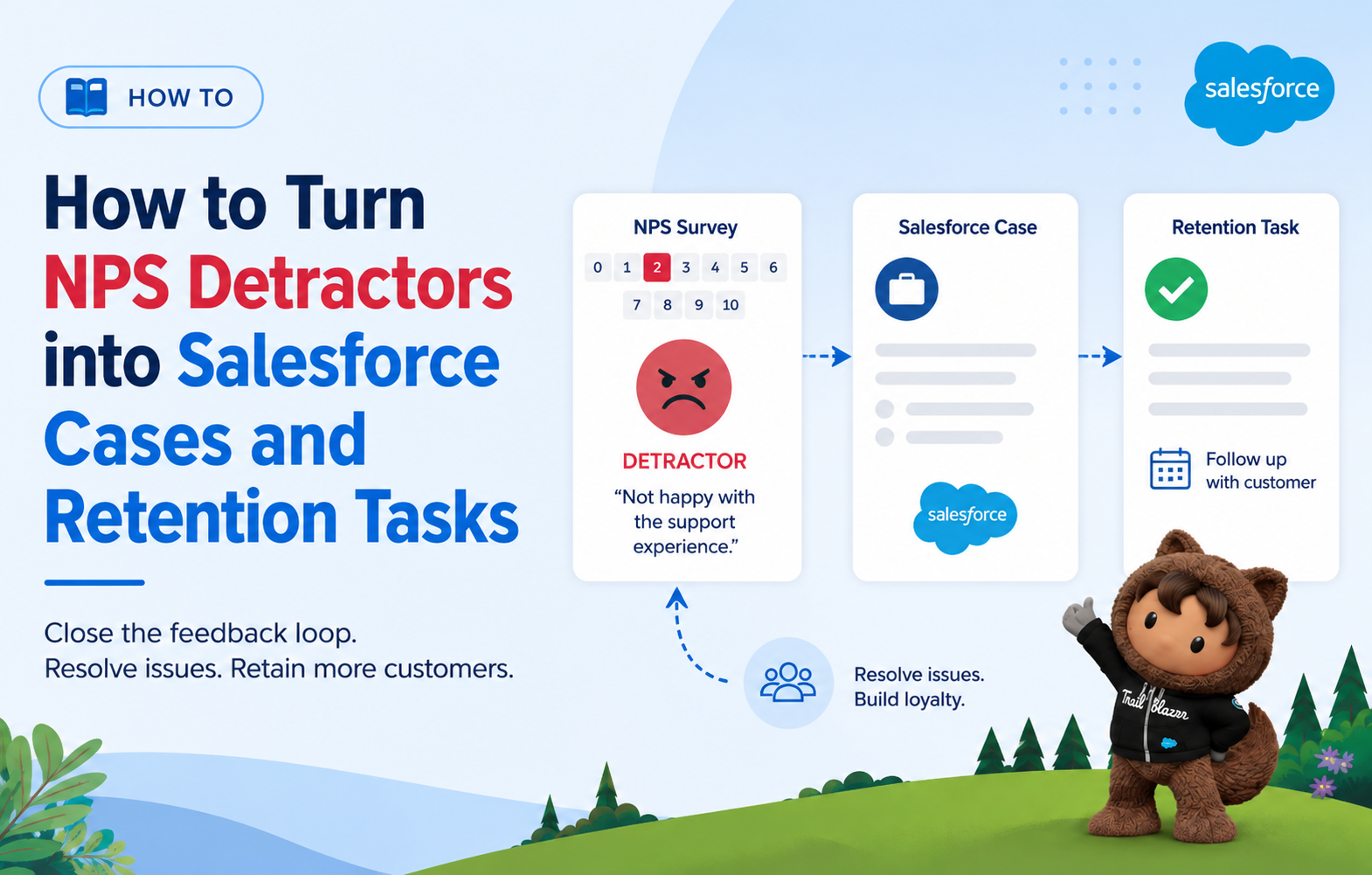
Survey the customers an agent served at the moment the case closes, and keep the answer on that case and its account. A short effort score question works well because it shows whether the AI made things easier or simply closed the case. SurveyVista writes each response to the relevant record at submission, and Record Lifecycle Maps can trigger the survey automatically when a case closes, so the customer result sits beside the agent’s action without an export or sync. - What should a CX budget review include for AI initiatives?
Give each AI initiative one row with four columns: the outcome promised at funding, the operational measure, the customer measure from the same customers, and the decision you made because of what they said. That last column shows leaders what the program actually changed. We call this discipline compounding the learning, and our telescope post explains it. SurveyVista keeps the customer column inside your Salesforce org, and you can schedule a call to build yours with our team.
More Like This



Rajesh Unadkat 
Founder and CEO
Rajesh is the visionary leader at the helm of SurveyVista. With a profound vision for the transformative potential of survey solutions, he founded the company in 2020. Rajesh's unwavering commitment to harnessing the power of data-driven insights has led to SurveyVista's rapid evolution as an industry leader.
Connect with Rajesh on LinkedIn to stay updated on the latest insights into the world of survey solutions for customer and employee experience management.