share: 


Most companies say they are serious about customer feedback.
They deploy surveys.
They track NPS.
They build dashboards.
They review reports.
Executives see quarterly summaries.
Teams discuss trends in meetings.
Action items get noted in follow-up slides.
Meanwhile, the customers who took the time to give feedback hear nothing back. Problems they reported persist. Opportunities they signaled go unnoticed.
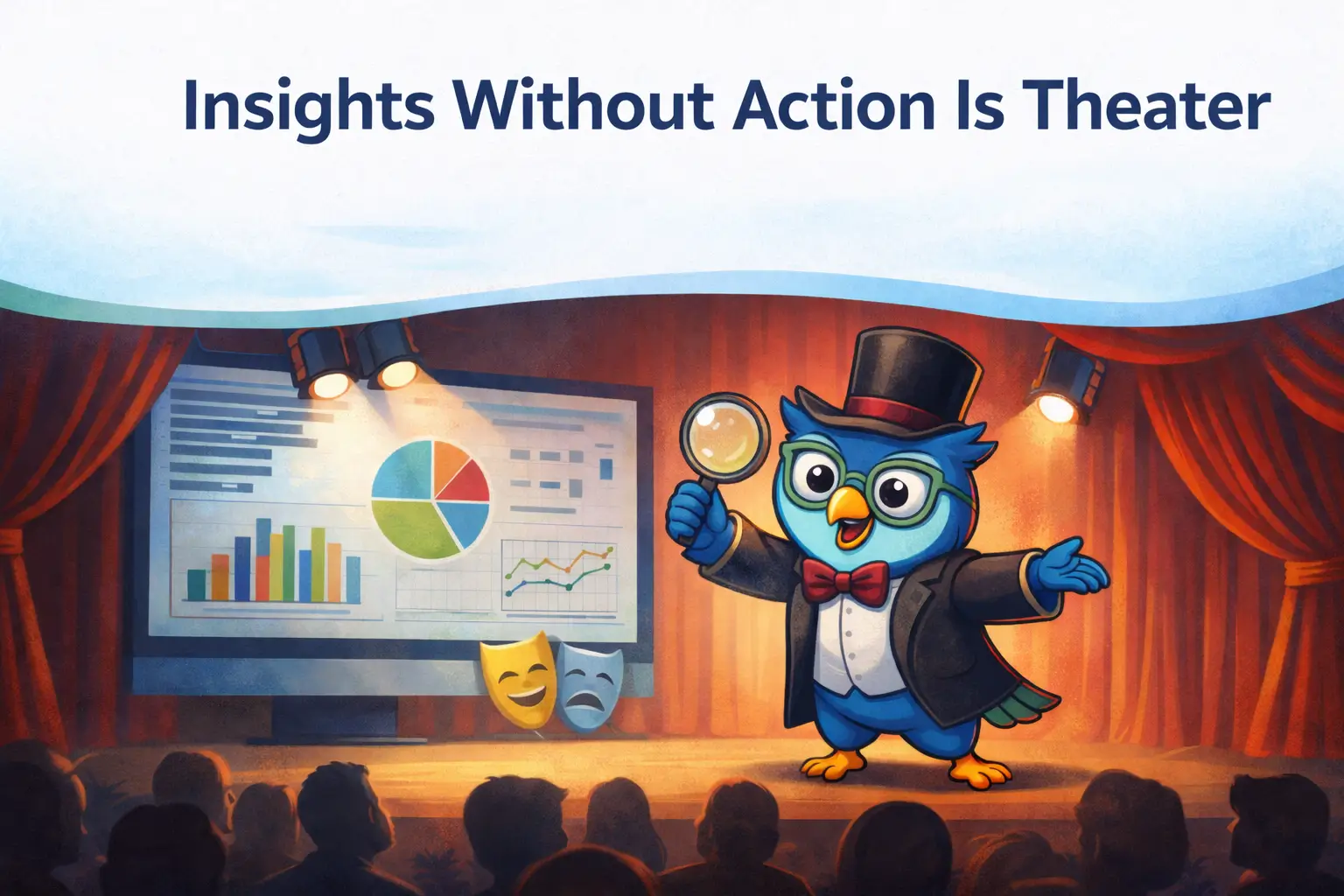
Most feedback programs are a performance with the audience, your customers, left feeling like it was all an act.
Because insights without action is theater.
The Real Cost of Feedback Theater
Companies spend millions collecting customer feedback.
They invest in:
- Feedback platforms
- Integration maintenance
- Data analysis
- Reporting dashboards
- Quarterly reviews
All of this activity creates the appearance of customer focus.
But ask a simple question:
Where does value get created?
Not in the dashboard. Not in the report. Not in the review
Value is created when feedback is acted on:
- A customer saved from churning
- A support issue resolved immediately generates positive word of mouth
- A broken process fixed before it affects more customers
- A product suggestion implemented before competitors notice
- An upsell closed while interest is fresh
Outcomes generate revenue and improve performance. Everything else consumes budget.
Customers Don’t Give Feedback for Your Dashboard
When a customer gives feedback, they’re not interested in your analytics.
They want a conversation.
They expect you to:
- listen
- understand
- respond
- improve something
If nothing happens, the message they receive is simple: feedback doesn’t matter.
Research consistently shows: 95% of unhappy customers never complain, they simply leave.
Those who do share feedback are offering you a gift. They’re telling you what’s wrong before they churn. Ignoring that signal guarantees one thing: Next time they won’t bother telling you. They’ll just leave quietly. And they’ll tell others your feedback requests were hollow.
A feedback program either builds trust or destroys it.
Dashboards Don’t Create Alignment
Dashboards are seductive. They provide visibility without commitment.
But dashboards answer the wrong questions.
What happened?
They rarely answer:
What should we do about it?
Consider common dashboard insights:
“NPS dropped five points.”
Which customers drove the decline?
Which accounts are at risk?
Who owns the recovery?
“Satisfaction trending downward.”
What caused it?
What fix is required?
Who is implementing it?
“Response rates are declining.”
Why?
What changed?
Who is investigating?
Dashboards identify symptoms. They don’t prescribe treatment. And they don’t take action, so nothing changes.
The Gaps Where Customers Disappear
Between intelligence, action and results lie dangerous gaps where customer relationships quietly erode.
Four specific gaps cause most feedback programs to fail:
The Time Gap
Feedback collected in external tools must be exported, synced, or integrated into CRM systems.
That delay matters. Minutes turn into hours. Hours turn into days.
Meanwhile:
- the unhappy customer calls a competitor
- the expansion opportunity loses momentum
- the unresolved complaint becomes resentment
By the time feedback reaches Salesforce, the moment to act may already be gone.
The Context Gap
Feedback without customer context is nearly useless.
A detractor score from a $2M strategic account means something very different than a detractor score from a trial user.
But external feedback systems often lack critical context:
- account value
- lifecycle stage
- renewal timing
- product usage
- support history
Without context, teams hesitate to act because they don’t know how serious the signal is.
The Ownership Gap
Feedback appears in a dashboard. But dashboards don’t assign responsibility or initiate action.
Sales thinks Customer Success should handle it. Customer Success assumes Support owns it. Support believes the account manager should respond.
Meanwhile the customer waits. And eventually leaves.
The Capability Gap
Even when someone decides to act, the process is painful.
They must:
- export data
- open another system
- log a note
- create a task
- update the CRM record
The friction of action becomes greater than the friction of doing nothing. So nothing happens.
The Completeness Test
If you want to know whether your feedback program drives action, ask five simple questions.
- What percentage of feedback responses trigger immediate action?
- How long does it take between a negative score and someone contacting that customer?
- Can your team act on feedback without leaving Salesforce?
- Do customers receive confirmation that their feedback was heard?
- Can you trace revenue saved or generated to specific feedback responses?
If the answer to any of these is unclear, your feedback program is likely operating as a reporting system, not an operational one.
How to Turn Feedback Into Action
Fixing feedback theater requires three fundamental changes.
Step 1: Align Teams Around Customer Signals
Customer feedback should not belong to a single department.
Marketing collects feedback.
Sales hears objections.
Customer Success sees churn risk.
Support receives complaints.
But when these signals remain isolated, alignment becomes impossible. Instead, organizations must define shared feedback signals that matter across teams.
For example:
- detractor scores indicating churn risk
- expansion interest signals
- product frustration patterns
- onboarding success indicators
These signals must be visible to everyone responsible for revenue and retention.
Alignment begins with shared awareness.
Step 2: Centralize Feedback in Your CRM
Feedback only becomes operational when it lives inside the system where decisions happen.
For most organizations, that system is Salesforce.
Centralizing feedback inside the CRM ensures:
- customer context is preserved
- account ownership is clear
- lifecycle timing is visible
- revenue impact can be assessed immediately
Instead of feedback sitting in external dashboards, it becomes part of the customer record. Native feedback is “AI-Ready”: structured, high-quality data that Salesforce’s Einstein and Agentforce AI can actually use to generate reliable intelligence.
Now feedback can influence:
- opportunity forecasts
- renewal strategies
- product prioritization
- success planning
Centralization eliminates the context gap and the ownership gap simultaneously.
Step 3: Automate Action Through Workflows
The final step is turning feedback signals into automated workflows.
Feedback should not sit waiting for someone to notice it. Responses should trigger immediate, context specific action.
AI-Ready data move data beyond simple ‘if/then’ logic. CRM can now use AI to analyze sentiment and intent, triggering complex, intelligent workflows that were previously impossible.
Examples include:
AI-driven account rescue: Detractor scores triggering personalized, AI-generated outreach for CSMs.
Intelligent routing: Feature requests automatically categorized by AI and routed to the specific product squad.
Predictive advocacy: Compliments triggering referral or advocacy programs.
High-value risk escalation: Churn risk signals escalating a prioritized “Retention Brief” to leadership.
Automation ensures that feedback becomes operational immediately. Customers see response quickly. Teams know what to do straight away. And leadership measure outcomes, not activities.
From Insights to Outcomes
When feedback triggers action, the entire dynamic changes.
Feedback becomes:
- an early warning system for churn
- a discovery engine for product improvement
- a pipeline generator for expansion opportunities
- a coordination system for GTM teams
The difference between insight and outcome is action. Feedback becomes revenue impact.
More Like This

Rajesh Unadkat 
Founder and CEO
Rajesh is the visionary leader at the helm of SurveyVista. With a profound vision for the transformative potential of survey solutions, he founded the company in 2020. Rajesh's unwavering commitment to harnessing the power of data-driven insights has led to SurveyVista's rapid evolution as an industry leader.
Connect with Rajesh on LinkedIn to stay updated on the latest insights into the world of survey solutions for customer and employee experience management.