
share: 


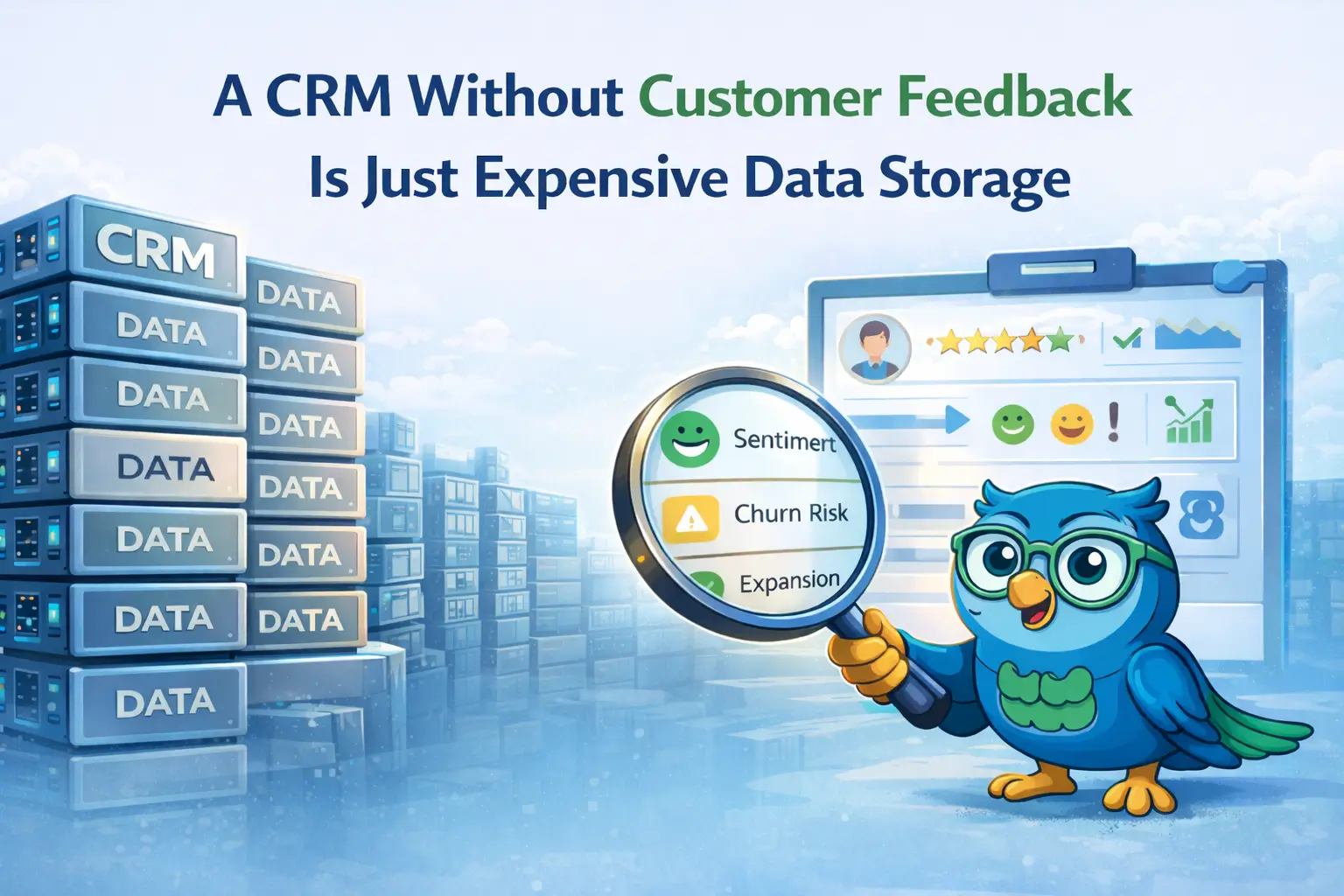
Companies have spent decades and billions of dollars on CRM systems.
They promised a single view of the customer.
They promised better decisions.
They promised stronger relationships.
But in most companies, CRM has quietly become something else.
A very expensive database.
It stores records.
It tracks activities.
It logs opportunities.
But it rarely tells you what your customers are actually thinking. Because the most important customer signal of all — customer feedback — usually lives somewhere else.
In survey platforms.
In feedback tools.
In spreadsheets exported from dashboards.
So the system that claims to manage customer relationships is missing the one thing that defines them:
The customer’s voice.
Without that, your CRM isn’t managing relationships. It’s storing history. And history doesn’t save accounts, uncover revenue, or fix broken experiences. Only action does.
A CRM Without Feedback Can’t Manage Customers
CRM platforms were supposed to deliver a 360° customer view. But that promise breaks the moment feedback lives outside the system.
Sales sees pipeline.
Support sees tickets.
Customer success sees renewals.
But the voice of the customer sits somewhere else entirely. Which means the most important signals never reach the place decisions are made. So teams operate with partial intelligence.
Sales walks into renewal calls blind to dissatisfaction signals. Customer success tries to save accounts without knowing the product complaints submitted last week. Executives review dashboards that measure sentiment but don’t connect to action.
When feedback is disconnected from CRM, the system stops being a management tool. It becomes storage.
Feedback Is What Turns CRM Into Strategy
Customer feedback only creates value when it triggers action.
A detractor score should launch a save play.
A feature request should inform product priorities.
A positive experience should trigger an advocacy motion.
That only happens when feedback lives where work happens. Inside CRM. When feedback becomes part of the customer record, something powerful happens. Insights stop being something you review. They become something you act on.
And that’s the moment your CRM stops being a database and becomes what it was always supposed to be: A customer management system.
The Real Question
Ask yourself one simple question:
When a customer shares feedback, what happens next?
If the answer is:
- It ends up in a dashboard
- It gets reviewed in a report
- It gets exported to a spreadsheet
Then your CRM isn’t managing customers. It’s storing data about them.
But when feedback lives inside your CRM, every signal can trigger action — saving accounts, capturing revenue, fixing processes, and preventing risk. That’s the difference between customer data and customer intelligence.
And it’s why companies that treat feedback as operational intelligence — not reporting data — turn their CRM from storage into strategy.
How to Fix It
If your CRM is acting like expensive data storage, the problem isn’t the CRM.
It’s where customer feedback lives.
Most organizations built their feedback programs outside their operational systems. Surveys live in one platform. Feedback analysis happens somewhere else. Insights eventually get exported into dashboards or spreadsheets.
That architecture guarantees one outcome:
Feedback becomes something you review instead of something you act on.
Fixing it requires a different approach.
-
Move Feedback Into the System Where Work Happens
Customer feedback should not live in a separate platform that periodically syncs data back to CRM.
The system responsible for managing customer relationships should also contain the signals that shape those relationships.
When feedback lives directly inside CRM:
- Every response enriches the customer record
- Customer history and feedback exist in one place
- Teams see feedback in the context of revenue, support, and product usage
- AI and analytics can see the full picture of the customer
Without this context, feedback is just sentiment data. With context, it becomes customer intelligence.
-
Replace Reporting Workflows With Operational Workflows
Most feedback programs were designed to generate reports. That model worked when feedback was used for quarterly reviews and executive dashboards.
But customer signals move faster than reporting cycles.
Instead of asking:
“What does the report say?”
Organizations should design feedback programs that trigger operational actions like:
- Retention outreach when satisfaction drops
- Revenue opportunities when expansion signals appear
- Product insights when feature demand emerges
- Process improvements when recurring friction appears
When feedback triggers workflows instead of reports, the organization moves from analysis to action.
-
Eliminate the Feedback-to-Action Gap
The biggest failure point in most feedback programs is the gap between insight and action.
Feedback arrives.
Someone reviews it.
Someone decides what to do.Days or weeks pass. By the time someone responds, the opportunity is gone.
The most effective feedback systems eliminate that delay by ensuring signals trigger immediate responses.
That might mean:
- Customer success teams receiving instant context-rich alerts
- Account owners being notified when strategic customers express risk
- Product teams automatically capturing feature demand signals
- Operations teams seeing recurring process breakdowns as they happen
Speed matters because customer feedback is time-sensitive intelligence.
-
Design Feedback as Customer Intelligence, Not Surveys
Many companies still think of feedback as a survey program.
But surveys are just one way of capturing signals.
Customer intelligence should come from multiple touchpoints across the customer journey:
- onboarding feedback
- product experience signals
- support interactions
- renewal and expansion conversations
- ongoing relationship health checks
When these signals are captured consistently and tied directly to the customer record, they create a continuous intelligence stream instead of isolated feedback events.
The Goal Isn’t More Feedback. It’s Action.
Companies don’t need more surveys.
They need feedback architecture that connects customer signals directly to the teams responsible for acting on them.
When feedback lives outside CRM, it becomes data.
When feedback lives inside CRM, it becomes intelligence.
And intelligence is what turns a CRM from a database into a system that actually helps you manage customer relationships.
Stop Collecting Feedback. Start Acting On It.
Most companies are collecting feedback.
Very few are actually using it to drive results.
The 2026 Feedback Foundations Guide explains why traditional feedback programs fail—and how modern organizations are turning customer signals into revenue, retention, and operational improvements.
If you want to move beyond dashboards and reports, this guide shows you how.
More Like This

Rajesh Unadkat 
Founder and CEO
Rajesh is the visionary leader at the helm of SurveyVista. With a profound vision for the transformative potential of survey solutions, he founded the company in 2020. Rajesh's unwavering commitment to harnessing the power of data-driven insights has led to SurveyVista's rapid evolution as an industry leader.
Connect with Rajesh on LinkedIn to stay updated on the latest insights into the world of survey solutions for customer and employee experience management.