share: 


Most businesses collect customer feedback. Fewer have a structured customer feedback management process that connects responses to decisions. The gap between those two states is where customer churn quietly builds.
A customer feedback management system is not just a survey tool. It is the full cycle of collecting, analysing, routing, acting on, and closing the loop on what customers tell you. Every stage matters. Skipping any one of them reduces the value of all the others.
According to McKinsey’s personalization research, companies that act on customer signals and deliver relevant experiences consistently see a 5 to 15 percent revenue lift. The foundation of that is a working customer feedback management process. This guide covers how to build one. SurveyVista supports the full cycle natively inside Salesforce.
What Is Customer Feedback Management?
Customer feedback management is the structured process of gathering customer input, making sense of it, and using it to improve the business. It covers everything from the moment a customer feedback survey goes out to the moment a product change gets communicated back to the customer who suggested it.
It is different from simply running surveys. Surveys are one customer feedback collection method. Customer feedback management is the operating system that determines what happens to those responses after they come in.
Without a defined customer feedback process, feedback accumulates in inboxes and dashboards. It gets reviewed occasionally, acted on inconsistently, and never communicated back to customers. That cycle erodes trust and reduces future response rates. Visit our from-feedback-to-action overview to see how SurveyVista structures this end-to-end inside Salesforce.
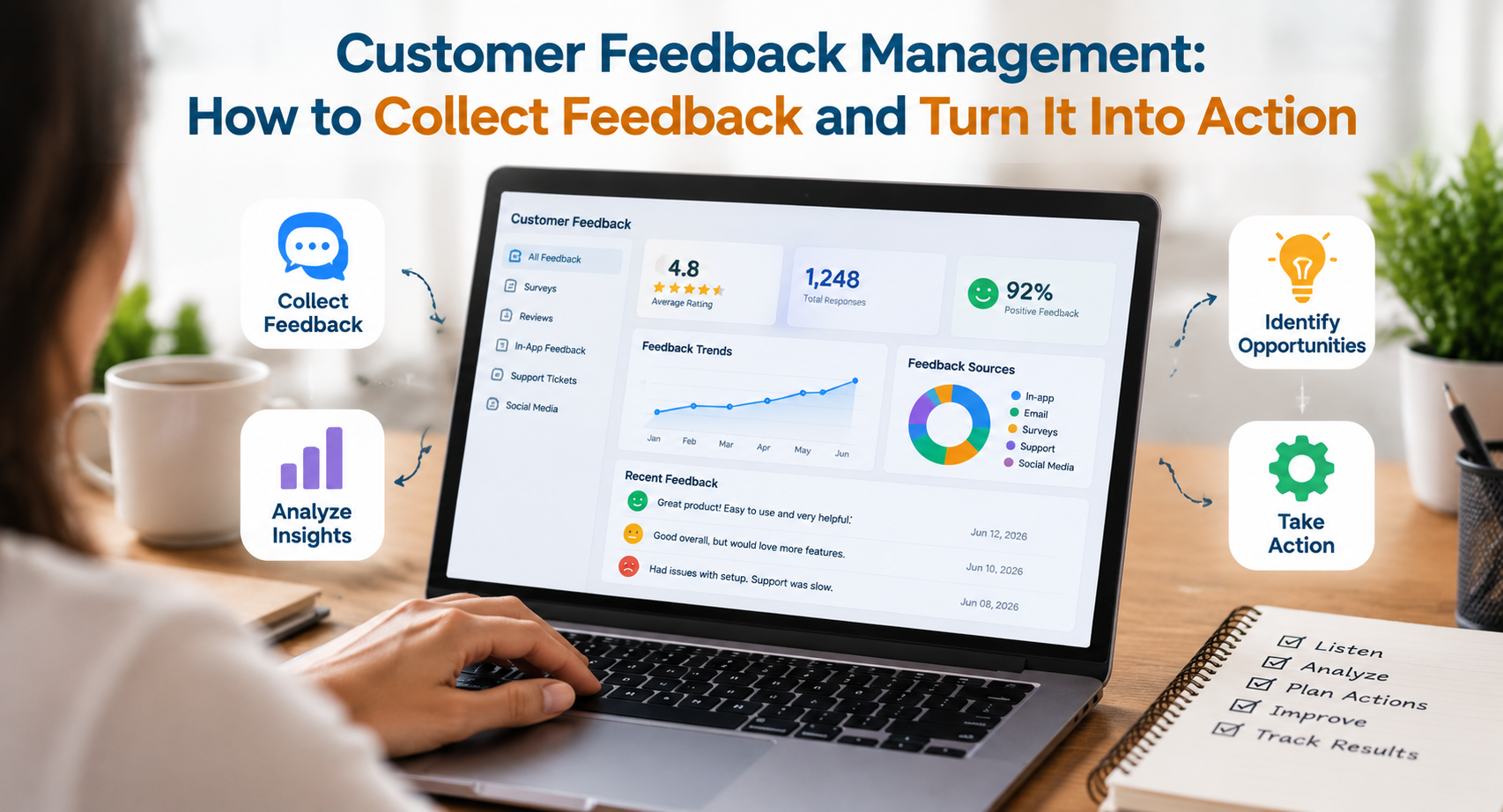
The Customer Feedback Management Process: Five Stages
A working customer feedback process follows five stages. Each one has a clear owner, a defined output, and a handoff to the next.
| Stage | What Happens | Key Tool or Method | Owner |
|---|---|---|---|
| Collection | Surveys, support logs, reviews gathered | NPS, CSAT, CES surveys | CX / Support |
| Analysis | Responses categorised and scored | Sentiment analysis, tagging | CX / Product |
| Routing | Feedback sent to the relevant team | Score-based automation | Ops / CX |
| Action | Changes made based on patterns | Roadmap, process updates | Product / CS |
| Closure | Customers told what changed | Email, in-app notification | CX / Marketing |
Collection is usually handled well. Routing and Closure break down most often. Both require automation to run consistently, and both are frequently skipped, which is why customer feedback management programmes stall.
How to Collect Customer Feedback Effectively
Effective customer feedback collection starts with matching the method to the moment. The right customer feedback methods depend on what just happened in the customer relationship.
Surveys at Key Touchpoints
CSAT surveys after support interactions, CES surveys after onboarding, and quarterly NPS surveys for active accounts are the three most widely used customer feedback survey types in B2B. Each is short, tied to a specific moment, and produces data that is easy to trend over time.
SurveyVista supports all three natively inside Salesforce. Surveys trigger automatically based on CRM record events, like case closures, onboarding milestones, contract renewal dates, without any manual scheduling. Browse survey templates to see what a ready-to-use customer feedback survey looks like before building from scratch.
Passive Feedback Channels
Support tickets, live chat logs, and online reviews capture concerns without requiring any customer effort. Reviewing them alongside survey data produces a more complete picture of the customer feedback collection cycle.
According to Gartner’s customer experience research, by 2025, 60% of organisations with voice of customer feedback programmes were supplementing traditional surveys with voice and text interaction analysis. Passive data is no longer optional, as it fills the gaps that surveys miss.
Customer Feedback Analysis: From Raw Responses to Actionable Insight
Raw feedback data does not drive decisions. Customer feedback analysis does. The goal is to move from individual responses to patterns that are actionable at a business level.
Structured vs Unstructured Feedback
CSAT, NPS, and CES produce clear metrics that trend over time. Open-text comments and support transcripts carry more context but require more effort to analyse.
Use both. Scores tell you how customers feel. Open text tells you why. Together they form the foundation of useful customer feedback analysis.
AI Customer Feedback Analysis
Manual analysis does not scale beyond a few hundred responses per week. AI customer feedback analysis uses natural language processing to categorise open-text responses, detect sentiment shifts, and surface emerging patterns across thousands of responses in real time.
According to Gartner’s sentiment analysis research, organisations using sentiment analysis tools are 25% more likely to retain customers. Brands using AI customer feedback analysis have reported up to 40% improvements in CX metrics including CSAT and NPS. For teams with high feedback volume, AI analysis is now a core part of any serious customer feedback management system.
The SurveyVista knowledge base covers how to set up automated response categorisation inside Salesforce.
Routing Feedback to the Right Team and Acting on It
Analysis without action is just reporting. Systematic routing (getting the right response to the right team fast enough) is the step most customer feedback management processes skip.
Score-Based Routing
A low NPS score from a key account should reach the account manager within hours, not the following week. A CSAT score below a set threshold after a support interaction should create a follow-up task immediately. These are not manual processes; instead, they are workflow rules tied to score thresholds.
SurveyVista routes responses automatically inside Salesforce. A detractor score creates a task. A product complaint tags the relevant product team. No manual handoff, no delay. Explore the CX and Customer Success solution and the revenue and sales solution to see how each team receives and acts on voice of customer feedback in real time.
Prioritising What to Fix
Not all feedback warrants equal attention. Customer feedback best practices recommend prioritising issues by two dimensions: frequency and financial impact. A complaint that appears in 5% of responses from high-value accounts carries more weight than a complaint appearing in 20% of responses from trial users.
This kind of segmented analysis is only practical when customer feedback collection data lives inside the CRM alongside account, contract, and usage data. SurveyVista’s native Salesforce architecture makes this possible without any manual merging of datasets. See how customer case studies show this in practice across different industries.
Closing the Loop: Why This Step Determines Long-Term Programme Health
Closing the loop means telling customers what changed as a result of their feedback. It is the step that most teams skip, and it is the reason response rates decline over time.
Customers who never see evidence that their feedback changed anything stop providing it. Those who see a tangible outcome, like a product improvement, a process change, an acknowledgement, are significantly more likely to respond again and to respond honestly.
SurveyVista automates personalised follow-ups based on response scores. Low scores trigger an immediate acknowledgement. Broader pattern changes go out as templated updates triggered inside Salesforce. The product management solution shows how product teams build this closure step into their release communication workflow.
What to Look for in a Customer Feedback Management System
The right customer feedback software depends on where your business is in the customer feedback management journey. Early-stage programmes need simplicity. Mature programmes need automation, segmentation, and CRM integration.
The core capabilities to evaluate:
- Survey types: NPS, CSAT, CES, and custom question sets
- Trigger automation: event-based dispatch tied to CRM record changes
- Segmentation: filter responses by account, tier, or any CRM field
- Closure automation: follow-up messaging triggered by response outcome
SurveyVista is 100% native to Salesforce. All of these capabilities operate inside the CRM, with no third-party sync, no integration maintenance, and no risk of data leaving the Salesforce environment. Explore why native Salesforce integration matters for teams scaling a customer feedback management system beyond a single team or product line.
Key Takeaways
- Customer feedback management is the full cycle from collection to closure, not just running surveys.
- The stages that most commonly break down are routing and closure. Both require automation to work consistently at scale.
- Combining structured survey data with passive feedback channels produces a more complete picture of the customer feedback process.
- AI customer feedback analysis scales open-text analysis beyond what manual review can handle and improves retention outcomes.
- Customer feedback best practices prioritise issues by frequency and financial impact, not by volume alone.
- Closing the loop with customers is the single most effective way to sustain response rates over time.
FAQs About Customer Feedback Management
What is a customer feedback management system?
A customer feedback management system governs how customer feedback collection, analysis, routing, and action are handled across a business. It goes beyond a survey tool, since it defines who receives each type of feedback, how quickly, and what action is expected. An effective system connects survey data directly to the CRM records where that action happens.
What are the best customer feedback methods for B2B businesses?
The three core customer feedback methods in B2B are CSAT (post-interaction), NPS (quarterly), and CES (after onboarding or feature adoption). Each measures something different. Running all three as part of a customer feedback strategy covers account health across the full customer lifecycle.
What is the voice of customer feedback and how is it different from a standard survey?
A standard survey captures a single moment. Voice of customer feedback is a continuous programme across channels, journey stages, and customer types. It includes surveys, support interactions, and passive review data. The goal is an ongoing, organisation-wide view of what customers need and where the experience falls short.
How does SurveyVista support a full customer feedback management process?
SurveyVista is fully native to Salesforce. When CRM events occur, customer feedback surveys are triggered, responses are automatically directed according to score thresholds, suppression rules stop excessive contact, and follow-ups ensure the loop is closed without any manual intervention. The whole customer feedback process can be carried out on a large scale without the need to add more staff.
Ready to build a customer feedback management process that runs from collection to closure automatically? Book a demo with SurveyVista and see how voice of the customer programmes operate natively inside Salesforce without additional tools or integrations.
More Like This


Rajesh Unadkat 
Founder and CEO
Rajesh is the visionary leader at the helm of SurveyVista. With a profound vision for the transformative potential of survey solutions, he founded the company in 2020. Rajesh's unwavering commitment to harnessing the power of data-driven insights has led to SurveyVista's rapid evolution as an industry leader.
Connect with Rajesh on LinkedIn to stay updated on the latest insights into the world of survey solutions for customer and employee experience management.