share: 


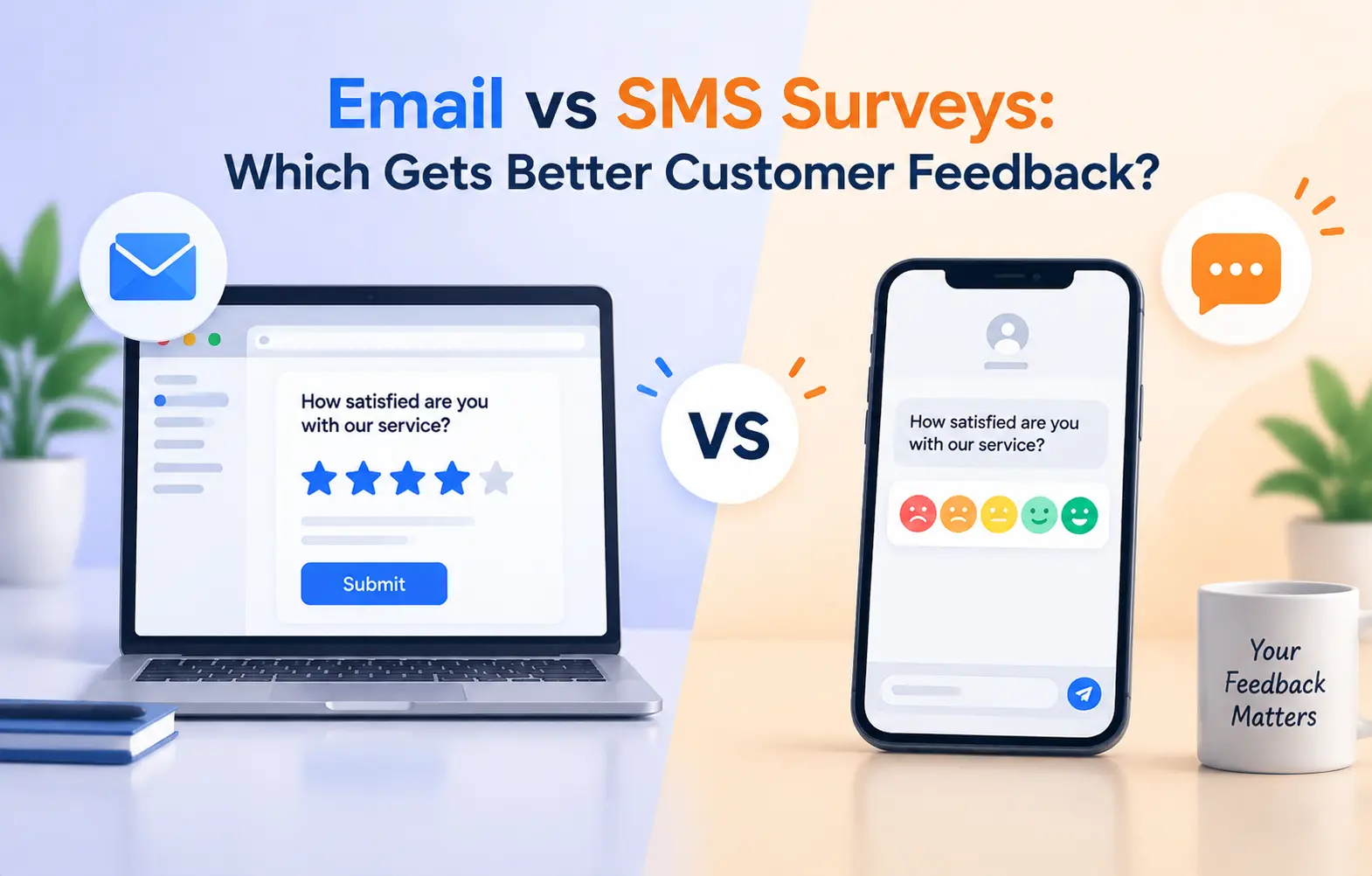
SMS surveys get faster responses; email surveys get richer, more detailed answers. This distinction shapes every decision a CX team makes about channel choice. The best way to collect customer feedback depends on question count. Consent status and customer preference matter too.
Most teams treat this as one either-or decision, which creates real problems. Sending every survey through one channel ignores how differently customers behave. A rushed customer at checkout wants a one-tap text, not an email. A frustrated customer with a complex issue wants space to explain.
This guide breaks down where each channel wins. Most mature programs use both channels for different customer satisfaction survey methods.
Key Takeaways
- 87% of consumers check texts within 15 minutes per EZTexting’s 2026 report.
- Email still leads as the preferred channel for polls and surveys specifically.
- Average email open rates sit at 35.63% per Mailchimp data.
- SMS opt-in reached 89% of US consumers, up from 66% in 2021.
- Using both channels together typically outperforms either one used alone.
What Is an Email Survey?
An email survey is a feedback request delivered through a customer’s inbox. It links to a multi-question form, embedded rating, or survey page. Email surveys work best when questions need explanation or detail.
Email supports longer surveys with conditional logic and branching between sections. Branded templates, order details, and service context fit inside the email. Mailchimp’s benchmark data reports a 35.63% average open rate across industries. Click rates average 2.62%, the share that actually engages further.
Email survey response rates tend to run lower than SMS on speed. The trade-off is richer, more detailed feedback per completed response.
What Is an SMS Survey?
An SMS survey is a feedback request delivered as a text message. It typically contains one rating question and one optional open-ended follow-up. SMS surveys work best when the feedback window is short and immediate.
The EZTexting 2026 report surveyed 959 US consumers on texting habits. The key findings for survey and feedback use:
- 87% of consumers check a new text within 15 minutes of receiving it.
- 89% have opted into business texts, up from 66% in 2021.
- 70% expect a business to respond within 1 hour of a message.
- Email still leads SMS as the preferred channel for polls and surveys.
That last finding matters most for this comparison, and it deserves unpacking. SMS dominates almost every category EZTexting measured: reminders, alerts, delivery updates, confirmations. Polls and surveys are the one category where email still wins.
A text message reads as urgent, immediate, and brief by design. A survey often needs several questions, rating scales, or space to explain. Cramming that into a text thread feels mismatched with normal SMS use.
Frequency tolerance plays a role here too. EZTexting’s data shows 40% of consumers unsubscribe due to frequency alone. A multi-question survey by text risks feeling like that unwanted volume. Email, by contrast, is where consumers already expect longer-form requests to land.
SMS wins on speed; email wins on format fit for structured feedback.
SMS vs Email: Side-by-Side Comparison for Surveys
| Factor | Email survey | SMS survey |
| Speed to open | Hours to days | Minutes (87% within 15 minutes) |
| Response depth | Multi-question, open-ended, detailed | One question, brief, scored |
| Cost per send | Lower per message | Higher per message |
| Best for | CSAT, NPS with comments, product feedback | Quick CSAT, post-appointment, post-service |
| Consent needs | Opt-in required, unsubscribe link | Strict opt-in, opt-out language, quiet hours |
| Preferred for surveys | Yes | No, SMS trails email for polls/surveys |
Email Survey Response Rate vs SMS Survey Response Rate
Email survey response rates and SMS survey response rates serve different purposes. Comparing them directly can be misleading without accounting for survey length.
| Factor | Email survey response rate | SMS survey response rate |
| Typical question count | Five or more questions per survey | One scaled question, optional follow-up |
| Completion rate pattern | Lower, since length reduces completion | Higher, since brevity increases completion |
| Depth per response | High, includes open-ended explanation | Low, usually just a score |
| What one response reveals | The exact reason behind a rating | That a customer is unhappy, not why |
| Best measured by | Actionable detail per completed response | Speed to signal, not depth |
Customer Feedback Collection Methods: When to Use Which Channel
Each customer satisfaction survey method fits a different moment in the journey.
Use email surveys for:
- Post-purchase feedback with product-specific questions and open-ended comments.
- Quarterly NPS or relationship-health surveys requiring multiple scaled questions.
- B2B feedback where the respondent expects a formal, branded communication.
- Service evaluations asking about multiple dimensions like quality, speed, and professionalism.
Use SMS surveys for:
- Post-appointment or post-visit CSAT checks sent within minutes of service.
- One-question NPS scores captured while the experience is still fresh.
- Delivery confirmation feedback where timing matters more than depth or detail.
- Service recovery triggers where a fast low-score alert prevents public complaints.
How to Increase Survey Response Rate on Both Channels
Response rates on both channels improve with the same core principles applied. Length, timing, and relevance matter more than which channel delivers the survey.
Keep it short. One to three questions for SMS surveys on mobile devices. Five to ten questions maximum for email surveys requesting detailed feedback.
Send it at the right moment. A post-service survey within 30 minutes outperforms one sent next week. Timing the send to the experience is the strongest response rate driver.
Explain why you are asking. A one-line purpose statement increases completion measurably. “We use this to improve your next visit” outperforms no context.
Close the loop visibly. Customers who see their prior feedback acted upon respond more next cycle. Silence after feedback collection trains customers to stop responding.
SMS and Email Marketing for Surveys: Using Both Channels Together
SMS and email marketing work best as complementary channels, not competing ones. A practical two-channel sequence looks like this:
- SMS first: Send one scaled question (CSAT or NPS) within minutes of the service event. Capture the score while the experience is still fresh.
- Email second: If the SMS score is low, trigger a follow-up email. The email gives the customer space to explain what specifically went wrong.
- Route internally: Low scores from either channel create a Case or Task. The CSM sees the score and comment together on one record.
This sequence captures SMS speed and email depth in one workflow. SurveyVista’s multi-channel distribution supports both channels from one Salesforce builder. Scores from both channels land on the same Contact or Account record.
How this works inside SurveyVista, step by step:
- Build the survey once. Create the question set in SurveyVista’s builder, with CSAT or NPS scoring.
- Choose the channel per send. Select email, SMS, or both when configuring distribution, manually or via Flow.
- Trigger the send from a record event. A Case closure or appointment completion can fire the survey either way.
- Response arrives from either channel. A customer answers by email or text, whichever method they received.
- Response mapping runs regardless of channel. The answer maps to the same Contact or Account field either way.
- Reporting shows both channels together. A single Salesforce report displays SMS and email responses side by side.
Where Native Salesforce Survey Tools Fit In
Both email and SMS surveys become more actionable inside a CRM-connected system. Scores on a Contact or Account record sit next to renewal data. That context turns a raw number into a retention or expansion signal.
Omnisend’s 2025 email marketing statistics report that automated email campaigns produce 29% of all email marketing revenue. Automated survey emails, triggered by CRM events, follow the same performance pattern. Surveys sent from a record event outperform manual, batch-sent survey campaigns consistently.
SurveyVista’s feedback management tool distributes surveys via email, SMS, and chat. Community pages and public URLs are also supported from one builder. Every response maps back to a Salesforce record on submission automatically. No export step, no separate dashboard disconnected from the account record.
For teams evaluating customer feedback management software, the channel question is secondary. The primary question is whether response data lands where the team works.
Frequently Asked Questions
Do SMS and email surveys require different legal consent?
Yes, generally. SMS falls under stricter telecom consent rules like TCPA in the US. Email operates mainly under CAN-SPAM, with different opt-in and unsubscribe requirements. Confirm specifics with legal counsel before launching either channel.
Can customers respond to a survey anonymously on either channel?
SMS ties every response to a phone number, making full anonymity difficult. Email surveys can use an anonymous link with no identifying data attached. Choose the channel based on whether attribution matters for follow-up.
Does language translation work differently for SMS versus email surveys?
Yes. SMS character limits constrain longer languages like German or French significantly. Email has no such constraint, so translated questions display without truncation risk.
How long should a team wait before treating a non-response as final?
Most programs wait 24 to 48 hours before considering a channel unsuccessful. A single follow-up on the second channel is reasonable. Repeated attempts risk feeling intrusive.
Does industry type affect which channel should be prioritized?
Yes. Appointment-based businesses like healthcare and salons lean toward SMS for speed. B2B and enterprise service providers lean toward email for formality and detail.
More Like This


Rajesh Unadkat 
Founder and CEO
Rajesh is the visionary leader at the helm of SurveyVista. With a profound vision for the transformative potential of survey solutions, he founded the company in 2020. Rajesh's unwavering commitment to harnessing the power of data-driven insights has led to SurveyVista's rapid evolution as an industry leader.
Connect with Rajesh on LinkedIn to stay updated on the latest insights into the world of survey solutions for customer and employee experience management.