
share: 


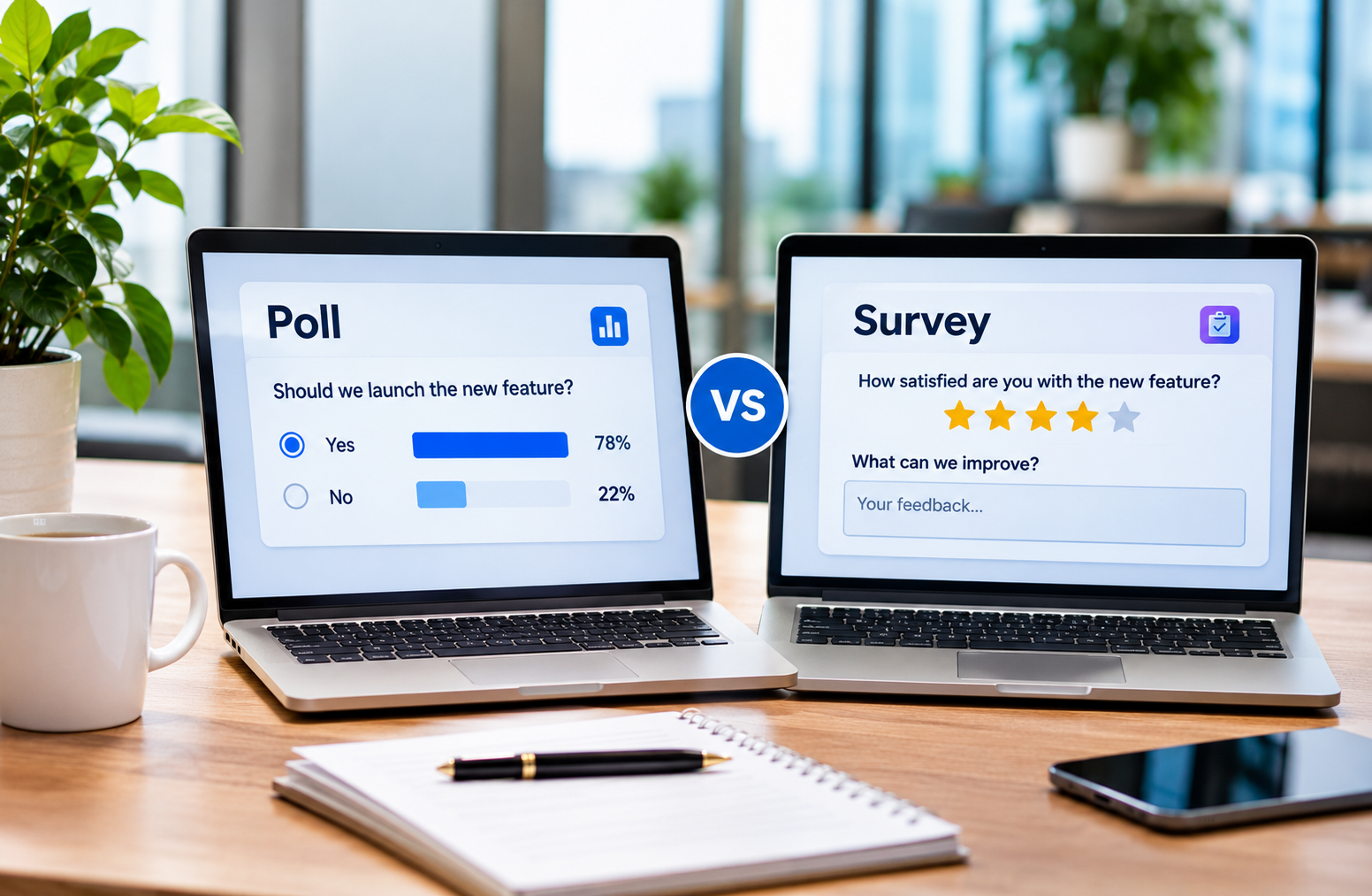
A poll asks a quick question to understand what people think. A survey uses several connected questions to collect more detailed and structured feedback. This is the simple idea behind poll vs survey.
Polls are quick and easy to answer. You often see them on social media, news websites, online communities, and articles. Surveys take more time and help businesses understand customer satisfaction, employee engagement, product preferences, and other topics in greater detail.
Both methods collect feedback, but they serve different purposes. The difference between poll and survey comes down to length, structure, data depth, and how the results are used.
This guide covers the poll definition, public opinion polls, surveys, the key differences between both formats, accuracy, use cases, and a real world example.
What Is a Poll?
A poll is a single question or a short group of related questions used to collect a quick opinion from a group of people.
That is the basic poll definition. A poll gives you a quick view of what people think about one specific topic. It usually uses simple formats such as:
- Yes or no questions
- Multiple choice questions
- Single choice questions
- Rating scales
For example, a brand may ask, “Which logo do you prefer?” A webinar host may ask, “How would you rate this session?” A product team may ask, “Which feature should we launch next?”
These questions can give a team useful feedback in a short time.
Polls work well when you need a quick view of customer opinion or audience sentiment. A poll and quiz builder can help businesses create and share these quick feedback experiences across different channels.
Polls can also support audience engagement. A company can add a question to its website, social media page, email, or event screen and give people an easy way to share their opinions.
What Is a Public Opinion Poll?
A public opinion poll definition describes a poll designed to understand the views of a larger population.
Public opinion polls measure how voters, consumers, residents, or other groups feel about a specific issue, candidate, policy, or topic. Election polls are one of the most familiar examples.
Public opinion polling can cover topics such as:
- Election preferences
- Government policies
- Consumer behavior
- Social issues
- Public services
- Current events
Researchers collect responses from a sample of people and use the results to understand the wider population. This makes sample quality and research methods important parts of the process.
Professional polling also follows research standards. The American Association for Public Opinion Research Code of Professional Ethics and Practices provides standards for conducting and reporting public opinion and survey research.
AAPOR’s updated 2026 code also states that AI generated or synthetic responses should be identified clearly and should not be presented as human research participants. This is becoming increasingly relevant as AI tools enter the survey research process.
What Is a Survey?
A survey is a structured set of questions designed to collect detailed information from respondents.
Unlike a simple poll, a survey can combine several question types, including:
- Multiple choice questions
- Rating scales
- Yes or no questions
- Ranking questions
- Open text questions
- Demographic questions
This structure allows a business to explore several parts of the same topic.
For example, a company may run a customer satisfaction survey covering product quality, customer service, delivery, and overall experience. An HR team may use an employee engagement survey to understand workplace satisfaction, communication, management, and team culture.
Surveys can also help businesses track metrics such as NPS and CSAT over time. Since each respondent can answer several related questions, businesses can compare results by region, customer type, department, job role, or other audience segments.
Good survey design also plays an important role in response quality. SurveyVista’s survey design principles explain how question order, wording, and survey length can influence the respondent experience.
Poll vs Survey: The Core Differences
So, how do polls and surveys differ? The key differences come down to length, structure, data depth, purpose, and analysis. The table below compares both formats side by side, so you can see which one fits your feedback goals better:
| Factor | Poll | Survey |
| Length | Usually 1 question | Multiple questions |
| Question types | Choice, yes or no, rating | Choice, rating, open text, ranking, and more |
| Time to complete | A few seconds | A few minutes |
| Data depth | Quick and directional | Detailed and structured |
| Best for | Quick opinions and pulse checks | Research and decision making |
| Analysis | Basic percentage results | Segmentation, trends, and statistics |
| Main goal | Understand what people think | Understand what people think and why |
A poll gives you a quick snapshot of an audience. A survey gives you a broader view with more context.
For example, a poll can tell you that most customers prefer one product design. A survey can ask why they prefer it and then compare those responses across customer groups.
That is the practical difference between poll and survey. A poll focuses on a quick answer, while a survey provides more information around the topic.
How Accurate Are Polls and Surveys?
How accurate are polls and surveys? Accuracy depends on several factors, including sample size, sampling method, question wording, response quality, and how closely the respondents represent the target audience.
The format itself does not determine accuracy. A well designed poll can provide useful results, while a poorly designed survey can produce weak data.
Sample Size and Margin of Error
Sample size is one important factor in research accuracy. A larger, properly selected sample generally provides a more stable estimate of a population.
For example, a quick poll with 50 respondents can provide a useful view of customer sentiment. A research survey with 1,000 carefully selected respondents can provide stronger evidence when the results need to represent a larger population.
Pew Research Center notes that a typical US election poll with about 1,000 respondents has a margin of sampling error of around plus or minus 3 percentage points. Pew also explains that sampling error is only one source of uncertainty. Question wording, response patterns, and other research factors can affect results as well.
This helps explain how accurate polls and surveys can be in practice. A larger sample can reduce sampling error, but sample size alone does not guarantee a reliable result.
Who Responds Also Matters
The people who answer a poll or survey can have a major effect on the results.
If the respondents represent the target population well, the findings can provide a stronger picture of that audience. Researchers can use sampling methods and weighting to improve representation.
Pew Research Center reported that 2020 US election polls had the largest national polling error in 40 years. Nonresponse was identified as one important factor because the people who answered polls differed in meaningful ways from those who did not.
AAPOR also recommends reporting details such as the sampling method, number of completed interviews, precision of the results, data collection method, and study limitations. These details help readers understand how much confidence they should place in the findings.
For business use, the practical approach is simple. Use a poll when you need a quick signal about a trend or preference. Use a well designed survey when you need detailed feedback, audience segmentation, or stronger evidence for an important decision.
When to Use a Poll vs a Survey
Choosing between a poll and survey starts with your goal.
Use a Poll When:
- You need one quick data point
- You want a fast view of audience sentiment
- You have two to five clear answer options
- You want to measure a simple preference
- You need feedback during a live event or session
- You want to encourage quick audience engagement
For example, a product team can ask, “Which feature should we launch next?” A webinar host can ask, “How would you rate this session?” Both questions have a clear purpose and require a quick response.
Use a Survey When:
- You want to understand the reasons behind an opinion
- You want to track a metric over time
- You need detailed customer feedback
- You want to compare different audience segments
- You need several data points from each respondent
- You are making an important decision based on the results
A customer satisfaction survey can cover product quality, delivery, support, value, and overall experience in one feedback process.
SurveyVista’s survey and feedback use cases include CSAT, NPS, CES, employee engagement, product feedback, and sales qualification. These use cases show how surveys can support different business goals.
How to Choose Between a Poll and Survey
The survey vs poll decision becomes easier when you focus on the type of answer you need.
- If you need one quick answer, choose a poll.
- If you want to understand several connected aspects of a topic, choose a survey.
- If you want to measure a simple preference, a poll can provide the answer quickly.
- If you want to understand why people have that preference, a survey can provide more useful context.
You can also use both formats together. A poll can identify a trend, while a survey can explore that trend in greater detail.
How to Create a Better Poll
A short poll can provide useful feedback when the question is clear and easy to answer.
Follow these simple practices:
- Ask one clear question.
- Keep the answer choices easy to understand.
- Give respondents enough options to describe their opinion.
- Keep the question relevant to the audience.
- Share the result when appropriate.
Avoid combining several ideas into one question. If you need more information, use a short survey after the initial poll.
This keeps the first interaction quick while giving you a clear path toward deeper research.
How to Create a Better Survey
A survey can collect more information, so each question should have a clear purpose.
Start with a specific research goal. Then build questions around that goal.
Keep the wording simple. Ask one thing at a time. Use consistent rating scales and make answer choices easy to understand.
Survey length also matters. Our survey design guide provides practical guidance for creating surveys that are easier to complete and support better response rates.
A simple survey structure can look like this:
- Start with an easy question.
- Move into the main topic.
- Group related questions together.
- Add deeper questions when needed.
- Finish with an optional open text question.
Survey logic can also show relevant questions based on earlier answers. This helps create a more focused experience for each respondent.
Real World Example: Poll vs Survey in Action
Consider a mid size healthcare company that wants to understand how patients experience a new appointment booking process.
The company starts with a one question poll sent through a post visit text message:
“How easy was it to book your appointment?”
Patients rate the experience from 1 to 5.
Within a week, the average score is 2.8 out of 5. The result gives the company a clear signal that the booking experience needs closer attention.
The company then sends a short survey to the same patient group.
The survey asks about:
- Booking channel
- Waiting time
- Staff helpfulness
- Overall experience
- Additional feedback
The survey provides more context. The results show that many lower scores come from patients who book by phone during peak hours, while the online booking process receives stronger feedback.
The poll identified the area that needed attention. The survey provided more detail about the reason behind the result.
SurveyVista’s case study with Ariane Systems provides another example of structured feedback supporting customer satisfaction efforts across customer interactions, departments, and regions.
Final Takeaway
The poll vs survey decision comes down to the type of insight you need.
A poll gives you a fast answer to a focused question. A survey gives you a deeper view through several connected questions.
Choose a poll when speed, simplicity, and quick engagement matter. Choose a survey when you need detailed feedback, segmentation, trend analysis, or a better understanding of why people feel a certain way.
Many teams can use both together. A poll can spot a trend, while a survey can explain it. This approach turns a quick opinion into more useful feedback that a team can use for better decisions.
FAQ
What Is the Main Difference Between a Poll and a Survey?
A poll asks one focused question to get a quick opinion. A survey asks multiple connected questions to collect detailed and structured information.
Polls usually take seconds to complete. Surveys can take several minutes and provide more data for segmentation and trend analysis.
Can a Poll Be Part of a Survey?
Yes. A survey can start with a poll style question, such as a rating or yes or no question, before moving into more detailed questions.
A poll can therefore work as one question inside a larger survey.
Which Is More Accurate, a Poll or a Survey?
Accuracy depends on research design rather than the format name.
Sample size, sampling method, question wording, response quality, and representation all affect the result. A properly designed survey with a representative sample can provide strong evidence for detailed research.
A focused poll can also provide useful results when the goal is to understand a quick preference or sentiment.
How Many Questions Does a Poll Have Compared to a Survey?
A poll usually has one question. Some polls use two or three closely related questions.
A survey can include five questions or more. Some detailed surveys may include 50 or more questions depending on the research goal.
Is a Quiz the Same Thing as a Poll?
Not quite. A quiz usually tests knowledge and has a correct answer. A poll collects opinions or preferences, so there is usually no right or wrong response.
A platform such as SurveyVista can support polls, quizzes, and surveys within the same Salesforce environment.
More Like This



Rajesh Unadkat 
Founder and CEO
Rajesh is the visionary leader at the helm of SurveyVista. With a profound vision for the transformative potential of survey solutions, he founded the company in 2020. Rajesh's unwavering commitment to harnessing the power of data-driven insights has led to SurveyVista's rapid evolution as an industry leader.
Connect with Rajesh on LinkedIn to stay updated on the latest insights into the world of survey solutions for customer and employee experience management.