share: 


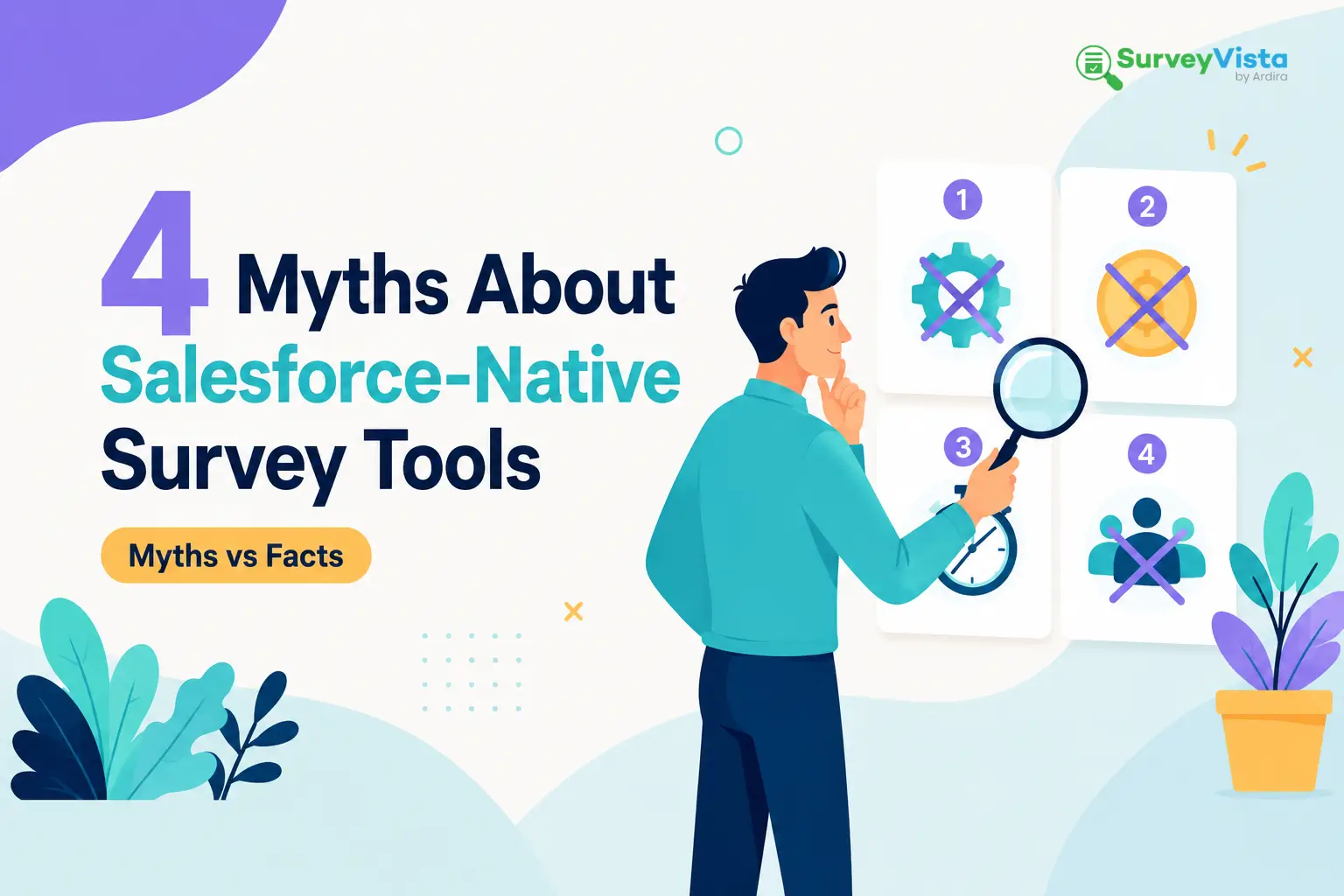
If you’ve spent any time researching Salesforce survey tools this year, you’ve probably read one of the dozen or so “Best Salesforce Survey Tools” roundups currently floating around. They’re a useful starting point. But unfortunately , in a few specific places, out of date. These gaps tend to repeat the same four myths about what a truly Salesforce-native tool can and can’t do.
Here’s what’s actually true in 2026.
Myth #1: “Native tools can’t do real AI analysis on open-text feedback”
The assumption behind this one is reasonable on the surface. AI analysis is compute-heavy, so surely it has to run on some external platform, with your feedback data shipped out to get it.
That’s no longer the case. SurveyVista runs full AI-powered sentiment analysis on open-text responses — thematic clustering, key-phrase extraction, and entity-level analytics — via Agentforce, natively inside the customer’s own Salesforce org. For teams that already run AWS as part of their stack, the same analysis can also run via AWS Comprehend . Either path avoids a pattern connector-based tools force on you: a separate AI vendor bolted on after the fact, with its own contract, its own security review, and its own copy of your feedback data to govern.
This matters more than it sounds like. Every connector-based tool that offers “AI analysis” is, by definition, processing your customer feedback somewhere outside your CRM, through a vendor picked for you. For teams with data residency requirements, health or financial data in the mix, or a security team that has to vet every vendor with data access, the difference between “here’s the AI vendor we chose for you” and “here’s an option that fits the stack you already run” is not a minor detail.
We recently walked through this live in the first episode of Voice of SurveyVista, where we talked about sentiment classification, confidence scores, entity/topic extraction, and word-cloud themes, all generated natively inside Salesforce. Watch the demo.
Myth #2: “Salesforce-native means you’re stuck with email-only surveys”
This is the most common gap in current comparisons: the idea that going native trades away channel reach — no SMS, no WhatsApp, nothing beyond a Salesforce email template.
Also outdated. SurveyVista supports two-way SMS and two-way WhatsApp conversations, delivered through providers like Twilio and WhatsApp Business , alongside channels like email, chat, QR code, and web forms.
What is worth understanding regardless of which tool you’re evaluating? No survey vendor owns its own telecom infrastructure. Every SMS and WhatsApp channel in this category, including the ones marketed as “omnichannel,” is delivered through the same category of third-party carrier APIs underneath. That’s not a knock on any reviewer; it’s just how SMS and WhatsApp work at the infrastructure level. The real question isn’t “does this vendor have proprietary messaging tech” (none do). It’s whether the rest of your survey data, logic, and reporting stay inside Salesforce or get shipped to a second system to make that channel work.
Myth #3: “Native tools are for small, simple programs — not real scale”
The implicit assumption in a lot of comparison content is that "Salesforce-native" is a starter-tier category or fine for a basic NPS program, but not built for teams running feedback at enterprise orgs.
450+ global customers including enterprise orgs running production survey programs on SurveyVista. This list includes Marriott , Bosch , TEDx , and many more. Scale and native architecture aren’t in tension. If anything, the case gets stronger as programs grow. More response volume means more surface area for a sync delay or a data-mapping break to cause real damage, which is exactly the failure mode native architecture removes, and helps innovative startups to enterprise orgs grow their businesses.
Myth #4: “Native tools can’t reach customers in-app or in-product”
This myth shows up less as an explicit claim and more as an omission. Most comparison articles from our extensive research list SurveyVista’s channels as email and SMS, full stop, without mentioning in-app at all.
That’s an incomplete and false statement. SurveyVista supports in-app surveys embedded directly in customer portals and product UI, alongside website forms and on-site feedback buttons. This means that users can capture feedback at the moment someone’s actually using the product, not just after the fact over email or text.
Combined with the earlier points, the channel picture looks like this: email, web, SMS, WhatsApp, and in-app — all native, all triggered from Salesforce events, all mapping straight back to the record that triggered them. That’s not a “narrower than third-party platforms” story. It’s the same channel breadth, without the second vendor needed.
The actual trade-off worth evaluating
None of this means connector-based tools are wrong for every team — they’re not. Some programs genuinely need channel breadth or research-grade statistical modeling that goes beyond what any Salesforce-native tool is built for.
But “native” and “capable” aren’t opposites, and treating them that way leads teams to accept a second vendor, a second data store, and a sync delay they didn’t actually need to take on. The real question isn’t AI vs. no AI, or email vs. omnichannel. It’s much simpler than that.
For a full side-by-side breakdown, including architecture, AI, channels, signal unification, and where a connector-based tool is actually the better fit, see our SurveyVista vs. Connector-Based Salesforce Survey Tools comparison resource
Do you want your customer feedback living where the rest of your customer data already lives or one integration away from it?
That’s the question and architecture that we built SurveyVista around: Collect Better, Understand Deeper, Act Smarter — direct, indirect, and inferred signals, all inside Salesforce. No integration. No sync delays. No data leaving Salesforce.
FAQ
- Does a Salesforce-native survey tool support AI analysis on open-text feedback? Yes. SurveyVista runs sentiment, thematic clustering, and entity-level analysis on open-text responses natively via Agentforce, or via AWS Comprehend for teams already running AWS — without sending feedback data to a separate AI vendor.
- Can Salesforce-native survey tools send SMS and WhatsApp surveys? Yes. SurveyVista supports two-way SMS and two-way WhatsApp conversations through providers like Twilio and WhatsApp Business, in addition to email and web. No survey vendor — native or connector-based — operates its own telecom infrastructure; all of them route through third-party carrier APIs.
- Do Salesforce-native survey tools support in-app or in-product surveys? Yes. SurveyVista supports in-app surveys embedded in customer portals and product UI, plus website forms and on-site feedback buttons, alongside email, web, SMS, and WhatsApp.
- Are Salesforce-native survey tools only suitable for small or simple feedback programs? No. SurveyVista runs production feedback programs for 450+ customers, including many global enterprise orgs. Native architecture scales with volume rather than working against it — more response volume means more benefit from having no sync delay or data-mapping gap between the survey and the CRM record it maps to.
- What does “Salesforce-native” mean for a survey tool? A Salesforce-native survey tool stores and processes all survey data — creation, distribution, responses, and reporting — inside the customer’s own Salesforce org, using native Salesforce objects, rather than syncing data from a separate external platform via an API connector.
More Like This



Rajesh Unadkat 
Founder and CEO
Rajesh is the visionary leader at the helm of SurveyVista. With a profound vision for the transformative potential of survey solutions, he founded the company in 2020. Rajesh's unwavering commitment to harnessing the power of data-driven insights has led to SurveyVista's rapid evolution as an industry leader.
Connect with Rajesh on LinkedIn to stay updated on the latest insights into the world of survey solutions for customer and employee experience management.