share: 


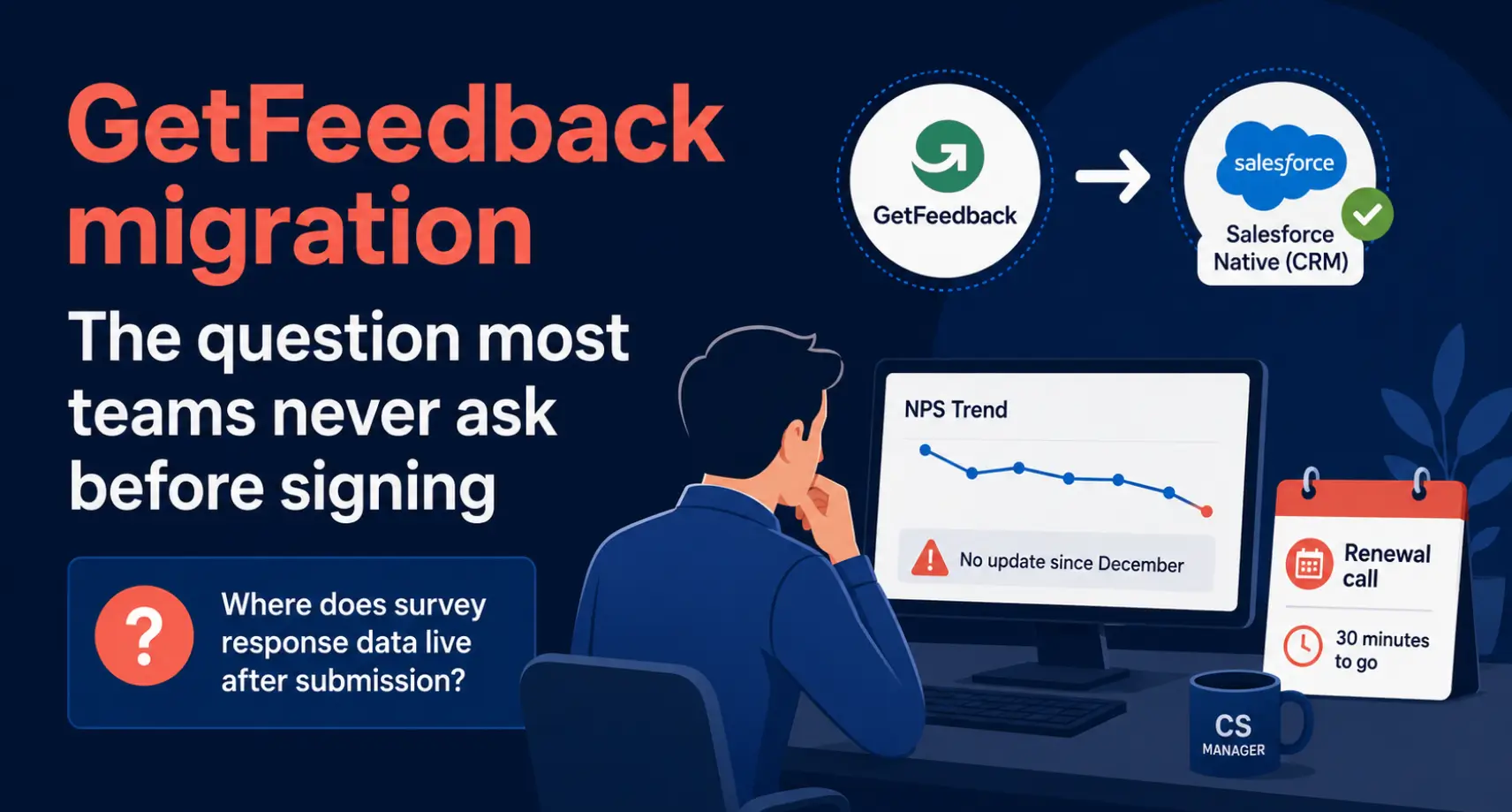
It is mid-February 2027. A renewal call is thirty minutes away. The CS manager pulls up the account in Salesforce to check the NPS trend and finds that the NPS has not moved in 8 weeks. Not because the customer is stable. Because the data stopped updating in December, and nobody caught it until now.
The migration finished on time. The surveys are live. But one question nobody asked is now sitting in the middle of a renewal conversation.
Most teams replacing GetFeedback are already moving. Vendor conversations have happened. Some contracts are signed. The deadline is not the problem anymore.
The problem is quieter. It does not show up in an implementation plan. It does not announce itself when something goes wrong. It shows up weeks later, in a moment exactly like the one above.
The question is: where does survey response data actually live after a respondent submits?
What “Salesforce Integration” Really Means for Your Feedback Data
Most GetFeedback replacement platforms say they work with Salesforce. That is true. What it means underneath is where teams get caught out.
A platform that integrates with Salesforce collects data from external servers and syncs it back on a schedule. Two systems. Two security perimeters. Data moves between them on a cadence nobody monitors until something breaks.
A Salesforce-native platform stores every response as a Salesforce object the moment it is submitted. No external server. No sync. No lag.
When data lives outside Salesforce and syncs back on a schedule, two things break quietly:
- Health scores stop reflecting reality. Delays in the sync mean a customer trending toward churn in December looks stable in January. The at-risk account gets treated as routine.
- Automations stop firing. When the sync skips or the data structure shifts, Salesforce flows stop without any error or alert. The action just never happens.
Bain and Company research shows that companies running consistent NPS programs grow revenue at 2x than their competitors. Consistent is the key word. A break in data continuity means the trend that took two years to build has to start over.
How a GetFeedback Migration Affects Renewal Season
January and February are peak renewal months for most enterprise software businesses. The data behind those conversations — NPS scores, CSAT trends, customer health signals — is what CS teams use to know which accounts are at risk before walking into a call.
Almost 83% of data migrations either fail or run over budget and timeline. The failures are rarely dramatic. They are a slow accumulation of things that stopped working, that nobody traced back to the migration until the damage was already done.
The teams entering 2027 in the strongest position are not the ones that moved fastest. They are the ones who asked the right questions before signing, validated their data architecture before going live, and chose a replacement that kept their feedback program intact rather than just replacing one tool with another.
The Right Questions to Ask Any GetFeedback Replacement Vendor
If the contract is not signed yet, these questions determine everything. If it is already signed, ask them now while there is still time to validate before going fully live.
- Where does response data live the moment a respondent submits? Is it inside your Salesforce org as a native object, or on an external server that syncs back?
This single answer determines compliance & security exposure, automation resilience, AI readiness, and data continuity. - Do existing Salesforce permission sets and sharing rules apply automatically? A native platform inherits your org’s security model. A non-native platform needs parallel configuration and doubles governance overhead.
- What happens to historical GetFeedback data? Two or three years of NPS trends do not automatically migrate. Get the data migration plan in writing, including format, timeline, and who owns the work.
- Does the platform require OAuth tokens or external API endpoints? Given Salesforce’s Spring 26 restrictions on Connected App creation, any platform relying on external connectors carries more maintenance risk than it did a year ago.
Conclusion
On July 23, Rajesh Unadkat and Shonnah Hughes are running a free session for CX leaders and Salesforce admins working through this decision. Here is what the session covers:
- What breaks in Salesforce when GetFeedback goes offline, and what to audit before it happens
- Where the compliance exposure sits when feedback data moves outside Salesforce
- How to evaluate any GetFeedback replacement without getting steered by a demo
- A migration checklist that every attendee takes away and can use the same day
More Like This



Rajesh Unadkat 
Founder and CEO
Rajesh is the visionary leader at the helm of SurveyVista. With a profound vision for the transformative potential of survey solutions, he founded the company in 2020. Rajesh's unwavering commitment to harnessing the power of data-driven insights has led to SurveyVista's rapid evolution as an industry leader.
Connect with Rajesh on LinkedIn to stay updated on the latest insights into the world of survey solutions for customer and employee experience management.