share: 


Most survey programs do not fail because the questions are wrong. They fail because the survey never really arrives. It lands in an inbox, competes with forty other unread emails, and gets quietly ignored by the very customers whose feedback would have mattered most.
The team interprets the silence as satisfaction. The churn data tells a different story three months later.
Why Email Is the Wrong Channel for Customer Surveys
There is significant energy in the customer feedback industry around survey design. Question type, scale, wording, order, length. These are legitimate concerns. A poorly designed survey produces unreliable data. But the focus on survey design has created a blind spot around something more fundamental: the percentage of customers who actually open the survey in the first place.
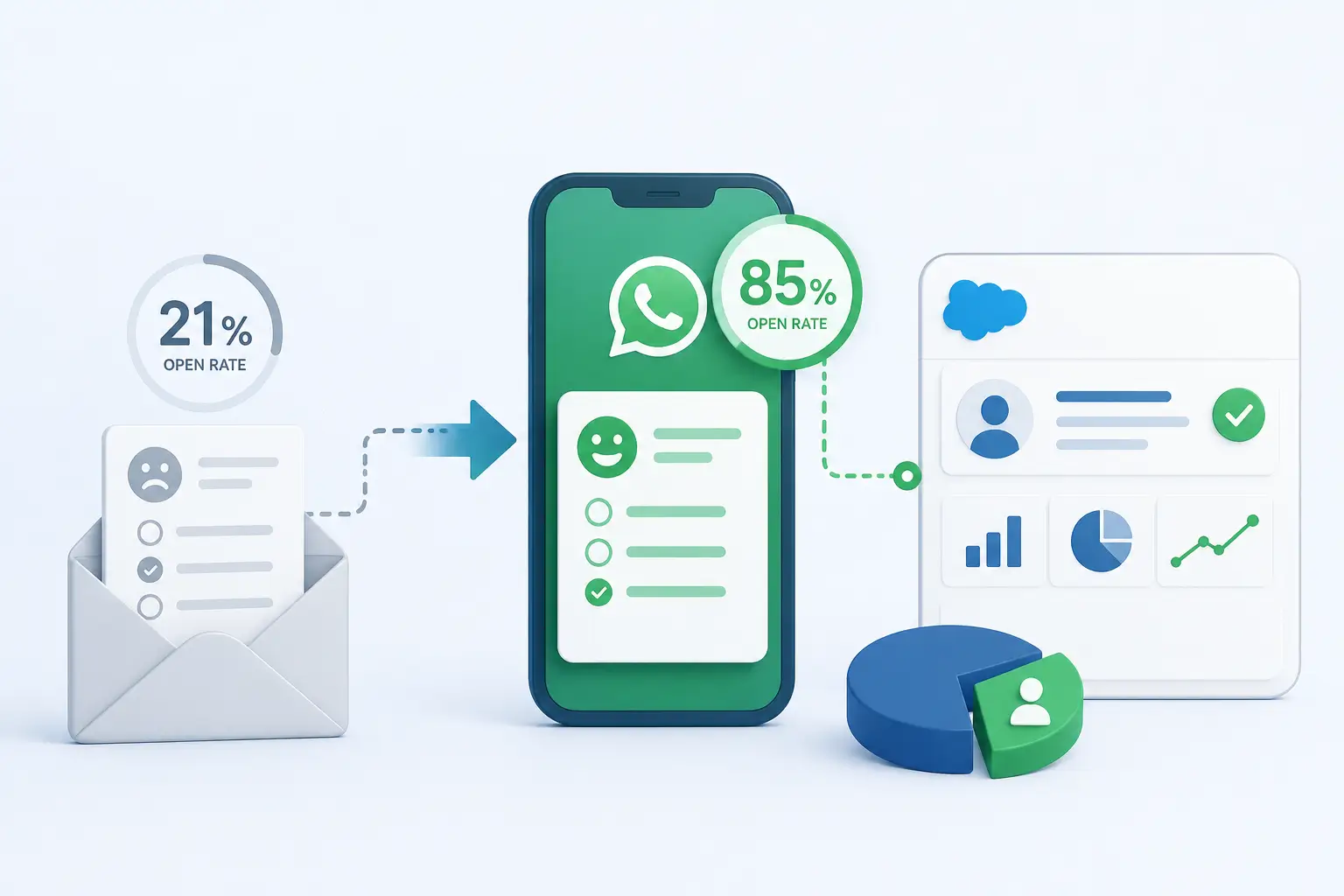
Average email open rates sit at around 21.5% across industries. For transactional survey emails specifically, that number is often lower. Which means before a single respondent reads the first question, roughly four out of five recipients have already moved on.
The feedback program that appears healthy, the one with hundreds of responses, clean dashboards, and a stable NPS trend, is being built on a fraction of the actual customer base. The 79% who never opened the email are not neutral. Research consistently shows that customers who have had a negative experience are less likely to respond to feedback requests, not more. They disengage. They leave quietly. And the survey program, by virtue of who it does and does not reach, systematically underrepresents the customers most at risk of churning.
This is the foundational problem with email-based survey delivery. Not the questions. The channel.
WhatsApp vs Email for Surveys: Why the Gap Matters
Email became the standard survey delivery channel for practical reasons. It was universal, cheap, trackable, and easy to automate. In the early days of digital feedback collection, it was the best available option.
The inbox has changed substantially since then. The average professional now receives over 120 emails per day. Promotional and transactional email has multiplied to the point where filtering, archiving, and ignoring have become an automatic behaviour. A survey request, however well-intentioned, competes against everything else a recipient considers more urgent.
WhatsApp operates in a fundamentally different attention environment. Messages arrive in a channel people use for personal communication. The psychological contract around that channel differs from that of email, and the numbers reflect it. WhatsApp message open rates consistently exceed 85%. Response rates follow proportionally.
There is a timing dimension to this as well. When a survey arrives on WhatsApp shortly after a customer experience, it lands while the memory is still vivid and the emotion is still present. The response tends to be more detailed and more actionable. The same survey arriving via email two or three days later catches a hazier version of that same experience. The insight has already started to decay before anyone reads it.
The Email Surveys Are Not Reaching Your Customers
A concrete example makes the scale of this clearer.
Consider a customer success team managing 500 accounts, running CSAT surveys after every closed support case. At a 21% open rate, roughly 395 customers out of every 500 are not providing feedback. Some of those are genuinely indifferent. But a meaningful portion are customers who had a frustrating experience, received the survey, and did not open it. The CS team has no signal that anything is wrong. The account looks stable.
The 2023 Salesforce State of the Connected Customer report found that 88% of customers say the experience a company provides matters as much as its products or services. A feedback program that structurally fails to reach most customers is not measuring experience. It is measuring the experience of the subset engaged enough to open a survey email, which is a specific and unrepresentative group.
The accounts most likely to churn are statistically the least likely to respond to email-based surveys. A feedback program designed to surface at-risk accounts is, by its channel choice, systematically undersampling them.
Switching to WhatsApp for sending surveys does not just improve volume. It changes the composition of who responds. It surfaces the signal that email was quietly filtering out.
Why Survey Response Data Goes Missing In Salesforce
The channel is half the problem. The data pipeline is the other half.
Most enterprise teams running feedback programs through external platforms, whether that is SurveyMonkey, GetFeedback, Typeform, Qualtrics, or any other tool that lives outside Salesforce, depend on a sync process to return that data to their CRM. A periodic job runs, responses are exported, a mapping layer translates the external data model into Salesforce fields, and a copy of the response lands on a record somewhere in the org.
When this works cleanly, there is still a delay. A response submitted on Saturday may not appear on the relevant Salesforce record until Monday afternoon, after the sync has run and the mapping has resolved correctly. When it works partially, open-text responses may arrive without associated scores, or scores may land on a contact record without reaching the account, or a response triggered by a specific case closure maps to the wrong record because the contact had multiple open cases and the integration used an ambiguous identifier.
When it fails silently, no one knows until someone checks. In a busy CX team managing hundreds of accounts, that check does not always happen at the right time.
Gartner research estimates the average annual cost of poor data quality at $12.9 million per organisation. Survey data that exists in an external system and does not make it cleanly into the CRM is a specific, measurable, and largely invisible contributor to that figure. The insight was there. The customer provided it. The architecture failed to deliver it to the person who needed to act on it.
Native vs Integrated: How Salesforce Survey Tools Actually Differ
The solution to the data pipeline problem is not a better integration. It is removing the integration entirely.
A survey platform built natively on Salesforce does not copy data into the CRM after the fact. It creates data inside the CRM at the moment of submission. A customer response is not sent to an external server and then synced back. It is created as a Salesforce object, linked directly to the record that triggered the survey, visible immediately to every team member with access to that record.
The downstream consequences of this architectural difference are significant and compound over time.
Salesforce Flow can trigger an automated action the moment a response arrives, not after a sync completes. A low NPS score can create a follow-up task for the account owner, update a customer health score, and alert a renewal manager within seconds of submission. The window for acting on feedback is no longer constrained by how often a sync job runs or whether it ran successfully.
Every Salesforce tool already in use, like reports, dashboards, AI features, list views, and alert rules, works on survey data without additional configuration, because survey data is native Salesforce data. A dashboard combining case history, opportunity data, and survey responses is a standard Salesforce report, not a cross-system integration project.
For organisations in healthcare, financial services, or any regulated environment, the compliance posture is inherited automatically. Salesforce holds SOC 2, ISO 27001, HIPAA, and GDPR certifications. A natively built survey platform inherits all of those certifications without requiring a separate vendor assessment, data transfer agreement, or additional security review.
How SurveyVista Captures Survey Responses Natively in Salesforce
SurveyVista is a 100% native Salesforce survey and feedback platform. Every survey, every response, and every form is created, stored, and managed entirely within the Salesforce org. There is no external database, no integration layer, and no sync dependency.
Distribution is handled through Salesforce Flow. Any record event in Salesforce can trigger a survey automatically. A case closes, an opportunity moves to Closed Won, a contract reaches a 90-day renewal window, and the appropriate survey reaches the appropriate customer without a manual step. The platform supports over 35 question types, pre-fills fields from existing Salesforce record data, and applies conditional logic based on what Salesforce already knows about each respondent.
More than 450 organisations run feedback programs on SurveyVista, including Marriott, eBay, UNICEF, YMCA, and TEDx. The 4.96-star rating with 222+ Salesforce AppExchange reviews reflects what enterprise teams find when survey data infrastructure works reliably and without manual intervention.
How to Deliver WhatsApp Surveys Inside Salesforce with WatBox
SurveyVista has partnered with WatBox, a native WhatsApp communication platform built inside Salesforce, to bring survey delivery into WhatsApp without anything leaving the org.
Here is what the experience looks like end to end:
- A Salesforce record event triggers the survey automatically
- WatBox sends a WhatsApp message to the customer
- The survey form opens directly inside the WhatsApp conversation
- The customer completes the survey without leaving WhatsApp
- The response writes back to the Salesforce record instantly
No redirect. No external form. No browser. Just a familiar WhatsApp conversation that happens to be a survey.
And because both SurveyVista and WatBox are native to Salesforce, the trigger, the delivery, the response, and any automated follow-up action all happen inside the same org. Nothing is proxied through a third-party server, and nothing needs to sync.
Frequently Asked Questions
Q: Why does the survey delivery channel affect customer feedback quality?
A: The channel determines which customers respond, not just how many. Email open rates average 21.5% across industries, meaning the majority of survey recipients never see the first question. Customers who have had negative experiences are statistically less likely to engage with email-based surveys, so programs relying on email tend to undersample the customers most at risk. Higher-engagement channels like WhatsApp, where open rates consistently exceed 85%, produce a more representative sample and capture responses while the experience is still recent and specific.
Q: What is the difference between a Salesforce-native survey tool and a Salesforce-integrated survey tool?
A: A Salesforce-native survey tool stores response data as Salesforce objects inside the org at the moment of submission. A Salesforce-integrated tool stores data in an external database and periodically syncs a copy to Salesforce. The practical differences are reliability, speed, and governance. Native data is available immediately, subject to existing Salesforce security and compliance frameworks, and does not depend on a sync process completing correctly. Automated actions in Salesforce can fire the moment a response arrives rather than after a scheduled job runs.
Q: Can SurveyVista send surveys over WhatsApp?
A: Yes. SurveyVista has partnered with WatBox, a Salesforce-native WhatsApp communication platform, to deliver surveys directly within WhatsApp. The survey form opens inside the WhatsApp conversation itself rather than redirecting to an external link. Customers complete the survey without leaving WhatsApp, and every response writes back to the relevant Salesforce record instantly. The integration is live and available to SurveyVista customers today.
Q: How does SurveyVista automate survey distribution inside Salesforce?
A: SurveyVista uses Salesforce Flow to trigger survey distribution based on record events. When a case closes, an opportunity stage changes, or during a contract milestone, any event that triggers a Salesforce Flow can trigger a SurveyVista survey. No custom code is required. The entire distribution logic is configured and managed inside Salesforce.
SurveyVista uses Salesforce Flow to trigger survey distribution based on record events. A case closure, an opportunity stage change, a contract milestone, any event that can trigger a Salesforce Flow can trigger a SurveyVista survey. No custom code is required. The entire distribution logic is configured and managed inside Salesforce.
Q: How does SurveyVista handle compliance requirements for regulated industries?
A: Because SurveyVista is native to Salesforce, it inherits Salesforce’s compliance certifications automatically. These include SOC 2, ISO 27001, HIPAA, and GDPR. Survey response data never leaves the Salesforce org, which eliminates the need for a separate vendor security assessment, data processing agreement, or additional access controls.
More Like This




Rajesh Unadkat 
Founder and CEO
Rajesh is the visionary leader at the helm of SurveyVista. With a profound vision for the transformative potential of survey solutions, he founded the company in 2020. Rajesh's unwavering commitment to harnessing the power of data-driven insights has led to SurveyVista's rapid evolution as an industry leader.
Connect with Rajesh on LinkedIn to stay updated on the latest insights into the world of survey solutions for customer and employee experience management.