
share: 


Looking for examples? Jump to 50+ qualitative survey question examples.
Qualitative survey questions form the backbone of meaningful customer feedback. Unlike their quantitative counterparts, these questions unlock the stories, emotions, and motivations behind customer behaviors—insights that numbers alone can’t capture. For customer experience professionals and marketers using SurveyVista’s Salesforce-native platform, mastering qualitative questions transforms ordinary feedback into actionable intelligence that drives growth and retention.
What Are Qualitative Survey Questions?
Qualitative survey questions focus on gathering descriptive, open-ended responses rather than numerical data. They explore the “how” and “why” of customer experiences, providing context and depth to your feedback collection efforts. When integrated with Salesforce through a platform like SurveyVista, these responses become powerful drivers of customer-centric improvements.
Qualitative vs. Quantitative Questions
Quantitative questions measure “how many” or “how much.” Qualitative questions reveal the reasons and emotions behind those numbers. Most good surveys use both: a rating question to track over time, followed by an open question that explains the score.
| Qualitative questions | Quantitative questions | |
|---|---|---|
| Purpose | Understand why and how | Measure how many or how much |
| Format | Open-ended text answers | Rating scales, multiple choice, yes/no |
| Example | “What stood out to you about our customer service?” | “On a scale of 1–10, how satisfied are you with our customer service?” |
| Analysis | Themes, sentiment and quotes | Averages, percentages and trends |
| Best for | Discovering new issues and ideas | Tracking performance over time |
Types of Qualitative Survey Questions for Customer Experience
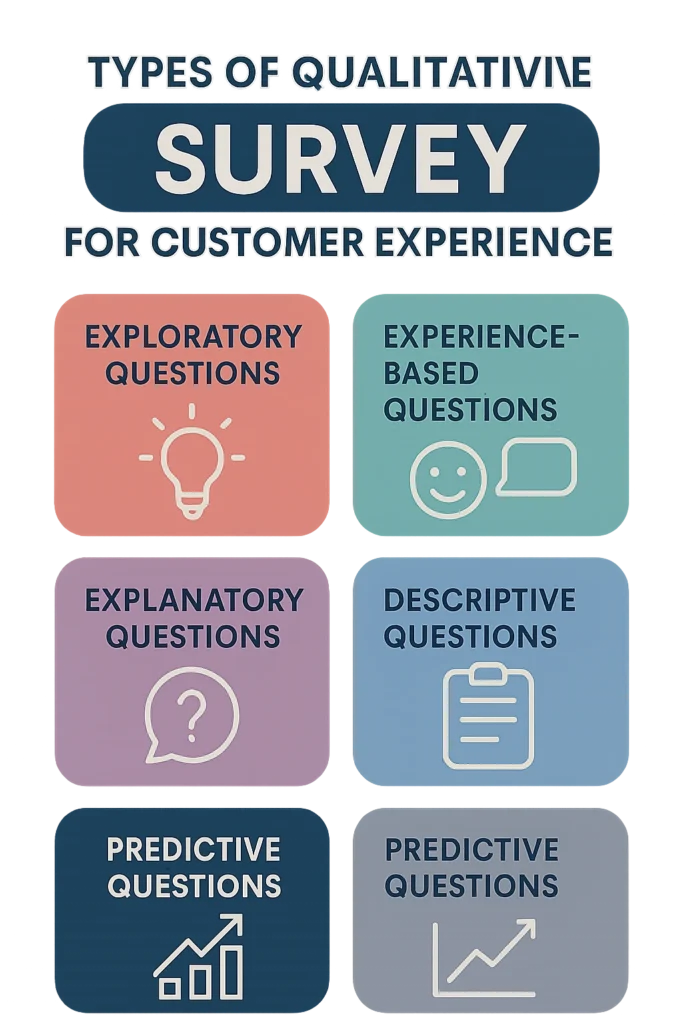
Exploratory Questions
These questions work best when you’re investigating new territory or seeking fresh perspectives:
- “What challenges do you face when using our product in your daily workflow?”
- “How would you describe your ideal experience with our service?”
Experience-Based Questions
These questions capture detailed accounts of customer interactions:
- “Walk us through your most recent experience with our support team.”
- “What emotions did you experience during the onboarding process?”
Explanatory Questions
These questions help uncover causality and motivation:
- “What factors influenced your decision to choose our solution over competitors?”
- “What led to your decision about whether to keep using our service?”
Descriptive Questions
These questions gather specific details about current states and behaviors:
- “How often do you use our product’s advanced features in a typical week?”
- “Which specific features do you rely on most for your core tasks?”
Predictive Questions
These questions explore future intentions and anticipated needs:
- “What would need to change for you to use our platform more widely in the next six months?”
- “What features would need to exist for you to recommend us to your team?”
How to Write Good Qualitative Survey Questions
Key Principles for Question Design
- Keep questions open-ended – Avoid yes/no formats that limit response depth
- Maintain neutrality – Remove leading language that might bias responses
- Focus on specificity – Target precise aspects of the customer experience
- Consider context – Align questions with the customer journey stage
Common Pitfalls to Avoid
- Asking double-barreled questions that address multiple issues simultaneously
- Using technical jargon unfamiliar to respondents
- Creating overly broad questions that generate vague responses
- Imposing assumptions that limit response options
Using Qualitative Feedback in Salesforce
When qualitative responses are stored with your customer records, every team can use them. With SurveyVista, open-ended answers sit alongside NPS and CSAT scores on the contact, account or case, so you can track how sentiment changes over the customer lifecycle and spot at-risk accounts early. Marketing gains real customer language for messaging, product teams find unmet needs, and customer success sees the reasons behind every score.
50+ Qualitative Survey Question Examples
For Product Experience
- “What features of our product do you find most valuable to your work?”
- “How has our product changed the way you accomplish tasks?”
- “What aspects of our product could be improved to better serve your needs?”
- “Describe a situation where our product exceeded your expectations.”
- “What functionality do you wish our product offered?”
For Customer Service Evaluation
- “How would you describe your recent interaction with our support team?”
- “What could our representatives have done differently to improve your experience?”
- “What aspects of our support process worked well for you?”
- “How did you feel about the time it took us to respond?”
- “What emotions did you experience during your support interaction?”
For Brand Perception
- “What three words would you use to describe our company?”
- “How do you perceive our brand compared to competitors?”
- “What values do you associate with our organization?”
- “How has your perception of our company changed over time?”
- “What would make you more likely to recommend us to colleagues?”
For Implementation and Onboarding
- “What challenges did you face during implementation?”
- “How prepared did you feel after completing onboarding?”
- “What additional resources would have improved your onboarding experience?”
- “How did the implementation process compare to your expectations?”
- “What aspects of getting started were most confusing?”
For Strategic Decision-Making
- “How might changes in your industry affect your use of our solution?”
- “What business problems are you still struggling to solve?”
- “How do you measure the value our solution provides to your organization?”
- “What would cause you to consider alternative solutions?”
- “How does our product fit into your long-term business strategy?”
For Employee Feedback
- “What do you enjoy most about working here?”
- “What is one thing that would make your job easier?”
- “How would you describe our team culture to a friend?”
- “What support do you need from your manager that you aren’t getting?”
- “What would make you more likely to stay with the company long term?”
For Product Research and UX
- “Walk us through the last time you used our product. What were you trying to do?”
- “What did you expect to happen when you clicked that button?”
- “What almost stopped you from completing your task?”
- “How would you explain our product to a colleague?”
- “What do you use instead when our product doesn’t do what you need?”
For Education and Training
- “What part of this course was most useful to you?”
- “Which topic would you like explained differently?”
- “How have you applied what you learned so far?”
- “What made it harder to keep up with the material?”
- “What would improve your learning experience next time?”
For Healthcare and Patient Experience
- “How would you describe your most recent visit?”
- “What could our staff have done to make you feel more comfortable?”
- “What questions did you still have after your appointment?”
- “What was the hardest part of scheduling your care?”
- “What would you tell a friend who is considering our clinic?”
For Churn and Cancellation
- “What led you to cancel your account?”
- “What were you hoping our product would do that it didn’t?”
- “What could we have done to keep you as a customer?”
- “What will you use instead?”
- “What would bring you back in the future?”
How to Analyze Qualitative Survey Responses
Open-ended answers are only useful once you turn them into themes you can count and act on. A simple process:
- Read a sample first. Read 30–50 responses before you decide on categories, so the themes come from your customers rather than your assumptions.
- Build a coding frame. List the themes you see, such as pricing, ease of use or support speed, with a one-line definition of each.
- Tag every response. Assign one or more themes to each answer, plus a sentiment (positive, neutral or negative).
- Count and compare. See which themes come up most, and compare them across segments such as plan, region or NPS group.
- Pull representative quotes. Pick a few quotes for each major theme to share with the teams who need to act.
- Use AI to scale. For large volumes, AI can tag themes and sentiment automatically. Check a sample by hand to make sure the tags are accurate. Learn more in our guide to AI survey analysis.
Analyzing Qualitative Responses in SurveyVista
From Feedback to Action
SurveyVista’s Salesforce-native platform transforms qualitative responses into actionable insights through:
- Sentiment analysis that categorizes emotional tone
- Theme identification that groups similar responses
- Priority scoring that highlights urgent issues
- Trend tracking that monitors changes over time
Closing the Feedback Loop
The true value of qualitative questions emerges when insights drive action:
- Collect feedback through targeted qualitative questions
- Analyze responses within SurveyVista’s Salesforce environment
- Distribute insights to relevant departments
- Implement changes based on customer input
- Communicate improvements back to customers
- Measure impact through follow-up surveys
Building a Customer-Centric Organization with Qualitative Insights
Qualitative survey questions provide the context and depth needed to truly understand your customers. When integrated with Salesforce through SurveyVista, these insights become a powerful engine for customer-centric growth. By mastering the art of asking meaningful questions, you’ll uncover the stories behind the numbers and transform feedback into lasting improvements that drive retention and loyalty.
Ready to enhance your qualitative feedback strategy? SurveyVista’s Salesforce-native platform makes it easy to collect, analyze, and act on customer insights across every touchpoint. Contact us today to learn how our solution can help your organization become truly customer-centric.
Frequently Asked Questions
How do qualitative survey questions differ from quantitative questions?
Qualitative questions gather descriptive, open-ended responses exploring the “how” and “why” behind customer experiences, while quantitative questions collect numerical data measuring “how many” or “how much.” Qualitative questions reveal stories and emotions that numbers alone can’t capture.
How many qualitative questions should I include in my survey?
Include 3-5 qualitative questions in a typical survey to prevent respondent fatigue. For in-depth research, you might include more, but always balance the need for rich insights with respect for your respondents’ time and attention span.
How can I analyze qualitative survey responses efficiently?
SurveyVista’s Salesforce-native platform offers sentiment analysis, theme identification, and trend tracking tools that transform open-ended responses into actionable insights. This automation helps categorize feedback and identify patterns without manual coding of every response.
Can qualitative survey data integrate with my existing Salesforce data?
Yes, SurveyVista’s platform connects qualitative responses directly to customer profiles in Salesforce, creating a comprehensive view of each relationship. This integration enables tracking sentiment changes across the customer lifecycle and identifying patterns based on customer segments.
What’s the best way to follow up on qualitative feedback?
After analyzing qualitative feedback, distribute insights to relevant departments, implement changes based on customer input, communicate improvements back to customers, and measure impact through follow-up surveys. This closes the feedback loop and demonstrates that you value customer input.
More Like This



Rajesh Unadkat 
Founder and CEO
Rajesh is the visionary leader at the helm of SurveyVista. With a profound vision for the transformative potential of survey solutions, he founded the company in 2020. Rajesh's unwavering commitment to harnessing the power of data-driven insights has led to SurveyVista's rapid evolution as an industry leader.
Connect with Rajesh on LinkedIn to stay updated on the latest insights into the world of survey solutions for customer and employee experience management.