
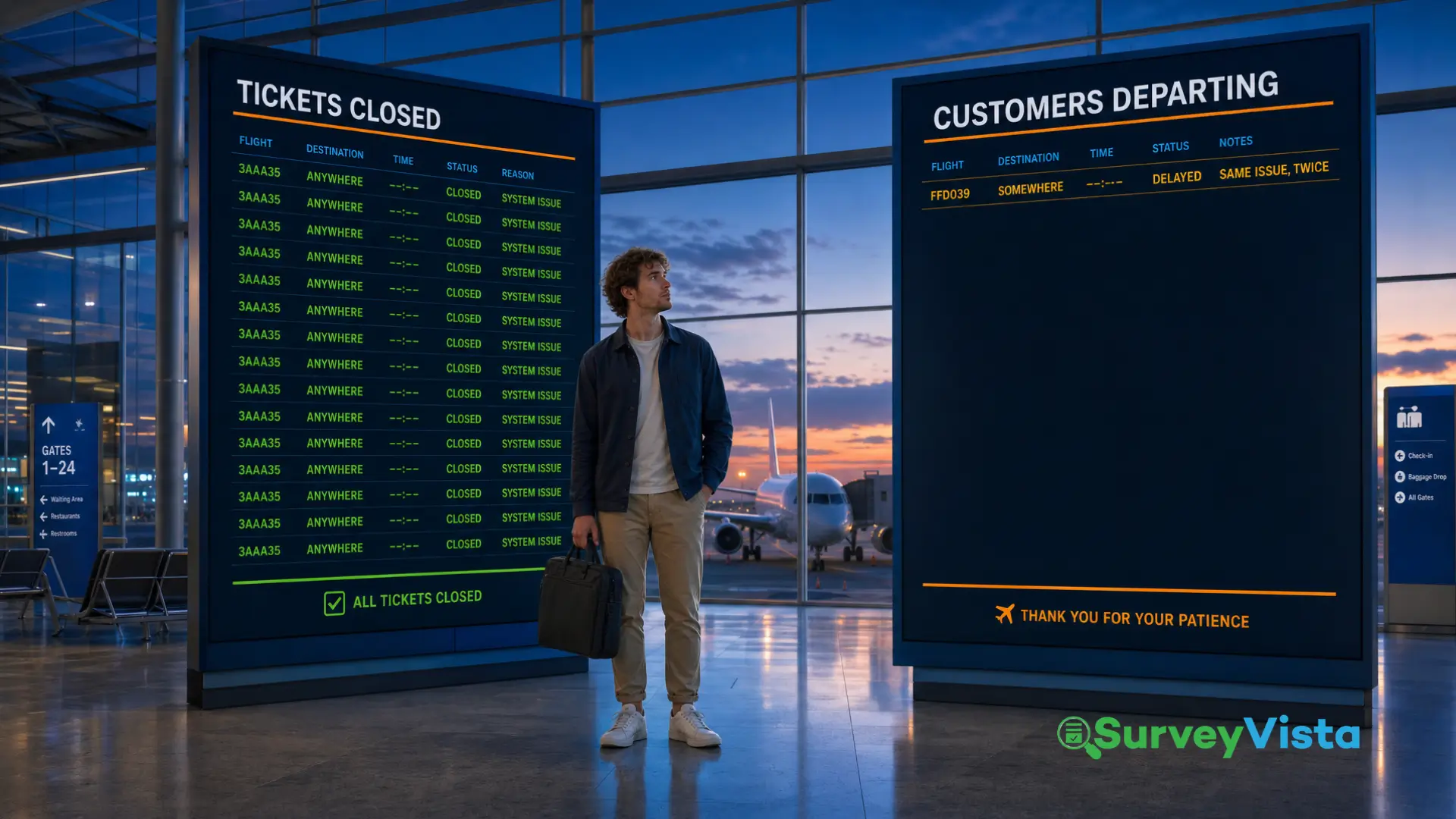
share: 


Your dashboard shows how fast each complaint was closed, but it does not show whether the customer had to complain again.
Customer success and customer experience leaders can close that gap by tracking repeat complaints next to time to close, and this article gives six steps to start.
Key takeaways
- A complaint closed in an hour can still cost you the account, because closing the ticket and fixing its cause are two different jobs.
- Time to close tells you how fast your team stopped working on a problem, and nothing about whether the problem stopped.
- Customer complaints reached record levels in 2026 while AI made them faster to close, which makes it easier than ever to close a complaint without learning from it.
- When a customer has to contact you twice, the system failed, and someone outside the service team needs to own the cause by name.
What is the most expensive lesson a customer complaint ever taught your company? I think about JetBlue in April of this year. A customer complained publicly about a sudden $230 fare increase, and JetBlue replied by suggesting they clear cookies or book in incognito mode.
The exchange spread widely, fed a national argument about surveillance pricing, drew questions from lawmakers and was followed by a proposed class action. JetBlue denies using personal data to set fares, and the airline said the reply was a mistake by an individual customer service crew member.
In my conversations with customer success and customer experience leaders, I often hear the same thing. Many know exactly how fast their complaints close. They are far less sure what any of those complaints changed. I do not blame them, because speed is the number most of them are asked to report.
What the JetBlue reply really exposed
Riccardo Pasto at Forrester wrote a really interesting read of the episode. He argues that the real subject was complaint management, with cookies and pricing as the backdrop, and that a high-risk moment was handled like a routine interaction. He also points out that the largest costs of a complaint never reach the dashboard, because they show up as churn, brand damage and burned-out employees.
I want to take this a step further. JetBlue described the reply as one person’s mistake, and I have no reason to doubt it. It is also the answer most of us would reach for. I started my career as an engineer, and the habit that has stayed with me through every team and company I have built is root cause analysis. An individual mistake is where an RCA starts, and it is never where one ends. The useful questions are why that reply was available to send, who owns the cause and what changed afterward. Many service teams never reach those questions, because the ticket is already closed.
How does a complaint closed in an hour still cost you the account?
Imagine a service team that is measured on time to close. A customer complains about an error on an invoice, and a rep corrects it within the hour. Weeks later, the same invoice error draws another complaint, and a different rep closes it well within SLA.
I can relate to that. Earlier in my career, I led teams where a closed ticket felt like a finished job, and nobody in this story did anything wrong. Both reps hit their targets, the dashboard is green, and the weekly report says service is having a good month. The cause sits with billing, which the service team does not run, and nobody sees the pattern because every individual ticket looks like a success.
The account owner is usually the last to know. Two closed cases look like good service in the account history, so the customer success manager walks into the renewal conversation with a healthy score and a customer who has explained the same problem twice. Time to close tells you how quickly your team stopped working on the problem. It tells you nothing about whether the problem stopped.
What should you measure besides time to close?
Shep Hyken put a price on all of this in a January column. He argues that when customers contact you twice about the same issue, the fault lies with the company and the customer is not to blame. He recommends tracking how often the first resolution fails, how many times customers return for the same problem, and how long the final resolution takes. He describes great service as “fixing problems once, not apologizing for them twice.”
Hyken is being polite, and I would go further. The second contact measures your service team, and the pattern behind it measures your whole company. Your service team can apologize for billing, but it cannot fix billing. Somebody outside service has to own the cause, and that somebody needs a name.
Many service teams already track first contact resolution, which asks whether an issue was handled in one interaction. Repeat complaint rate asks a harder question. It is the share of complaints in a period that concern a problem the same customer has already raised, and it is the number I would put next to time to close on every service dashboard.
Complaints are at a record high, and AI is closing them faster
Two things make that number urgent right now. The American Customer Satisfaction Index reported in May that customer complaints had reached record levels after surging 16% in the first quarter of 2026. More complaints are arriving, and more of them are being answered by AI.
I am a technologist at heart, and I like what AI does for service, so read this as a caution from a fan. An agent can answer that invoice complaint in seconds. It can also close the ticket sooner than any person has a chance to notice that the same complaint keeps arriving. I have no data showing that complaints closed by AI come back more often, and I will not pretend otherwise. My concern is narrower. If speed is the only thing you measure, AI will make you excellent at the one thing you measure, and the cause will stay just as invisible as it was.
Customers want both the speed and a way out. In a Gartner survey of 3,566 customers conducted in February and March of 2026, 50% said their interactions are easier when companies use generative AI, and 87% said the option to reach a human is essential. A complaint is usually when that option matters.
What a real fix looks like
My own company learned this from a customer. They told us they were running the same feedback survey across different program locations and could not easily report by location. We could have answered the question and moved on, and the ticket would have closed on time. We asked them to help define and design the fix instead. The result was survey links, which let you create multiple named links for one survey, hand each one out where it is needed and report against each name. The customer took part in the design, so the feature fit how they actually worked. Another customer wanted to be sure the person answering was the person we had sent the survey to, and that request became Secure Access, which supports a unique random code per recipient, a unique random code per survey or a personalized code for a recipient.
Where I would start with your service team
If I were sitting with your service and success leaders this week, these are the six things I would ask them to do. None of them requires new technology, although a few require an uncomfortable meeting.
- List your top five complaint types. Hyken’s Moment of Misery Grid is a simple way to do it, because it ranks complaints by how often your team hears them.
- Name an owner outside the service team for each type.
- Track the repeat rate for each type alongside the time to close.
- Ask the customer at close whether the issue was fully resolved, and compare the answer with the ticket status.
- Record what changed last quarter because of a complaint.
- Tell customers what changed .
For teams that run service in a Salesforce org, two of these steps are ordinary Salesforce practices. You can flag repeat Cases, and you can assign a root-cause owner for each complaint type, with no extra product required.
I will use my own company as an example, because it is the one I know best. At SurveyVista, a survey can go out automatically when a Case closes, asking whether the issue was actually resolved, and Advanced Notifications can alert the owner by email or in Slack when an answer is negative. HELM AG asks for a rating the moment a finance service case closes, and every response is attached to the relevant record inside Salesforce.
A support case is an Indirect signal. A customer’s own answer to whether the issue was resolved is a Direct signal, and you need both to know whether closed means fixed.
Put a second number next to time to close
JetBlue’s reply took seconds to send, and people like me are still writing about it. Speed was never the problem, and nobody should slow down a good answer. Your service team is not the problem either, because they are doing exactly what the dashboard asks of them. I am asking for a second number next to the first one. Report how fast you closed, and report what you fixed so that the complaint never returns. If your team can produce only the first number, you are running a very efficient apology department.
Pick the complaint type your team closes fastest. Ask who outside service owns its cause and what changed last quarter because of it. If nobody can answer, you have found the place where your next lost account is most likely to start, and you can do something about it this week.
Frequently asked questions
- Why can a complaint that closes quickly still cost you the account?
Closing a ticket and fixing its cause are two different jobs. A rep can correct an invoice within the hour while the billing fault behind it stays in place, so the same customer complains again weeks later. Riccardo Pasto at Forrester notes that the largest costs of a complaint show up as churn, brand damage and burned-out employees, none of which reach a service dashboard. Time to close reports how fast your team stopped working, and the renewal conversation reports the rest.
- What is repeat complaint rate, and how is it different from first contact resolution?
Repeat complaint rate is the share of complaints in a period that concern a problem the same customer has already raised. First contact resolution asks whether an issue was handled in one interaction, so a ticket can pass that test and still come back a month later. Shep Hyken recommends tracking how often the first resolution fails and how many times customers return for the same problem. Put repeat complaint rate next to time to close for each complaint type.
- How do you track repeat complaints in Salesforce?
Two steps need nothing beyond your Salesforce org. You can flag a Case as a repeat when the same contact raises the same complaint type again, and you can assign a root-cause owner outside service for each type. SurveyVista adds the customer’s own view by sending a short question when a Case closes, asking whether the issue was actually resolved. The answer lands on the relevant record, where you can compare it with the Case status.
- Does AI make repeat complaints more likely?
There is no data showing that complaints closed by AI come back more often. The risk is narrower. An AI agent can answer a complaint in seconds, sooner than any person can notice that the same complaint keeps arriving. In a 2026 Gartner survey, 87% of customers said the option to reach a human is essential when companies use generative AI. SurveyVista’s Advanced Notifications can alert the Case owner when a customer says an issue was not resolved, so a person sees the pattern.
- How do you know a closed Case is actually fixed?
Ask the customer. A support case shows what your team did, and the customer’s answer shows whether it worked. HELM AG asks for a rating the moment a finance service case closes, and every response is attached to the case and customer inside Salesforce, according to its case study. As a 100% Salesforce-native platform, SurveyVista keeps that answer on the relevant record beside the Case, so the account owner sees both ahead of the renewal conversation.
To talk through what your closed complaints are changing, book a call with our team.
More Like This


Rajesh Unadkat 
Founder and CEO
Rajesh is the visionary leader at the helm of SurveyVista. With a profound vision for the transformative potential of survey solutions, he founded the company in 2020. Rajesh's unwavering commitment to harnessing the power of data-driven insights has led to SurveyVista's rapid evolution as an industry leader.
Connect with Rajesh on LinkedIn to stay updated on the latest insights into the world of survey solutions for customer and employee experience management.