
share: 


Running a sales promotion in manufacturing is a different challenge than most industries face. There is no direct path to the end consumer. Everything moves through distributors, dealers, workshops, and trade partners, each with their own priorities and limited bandwidth.
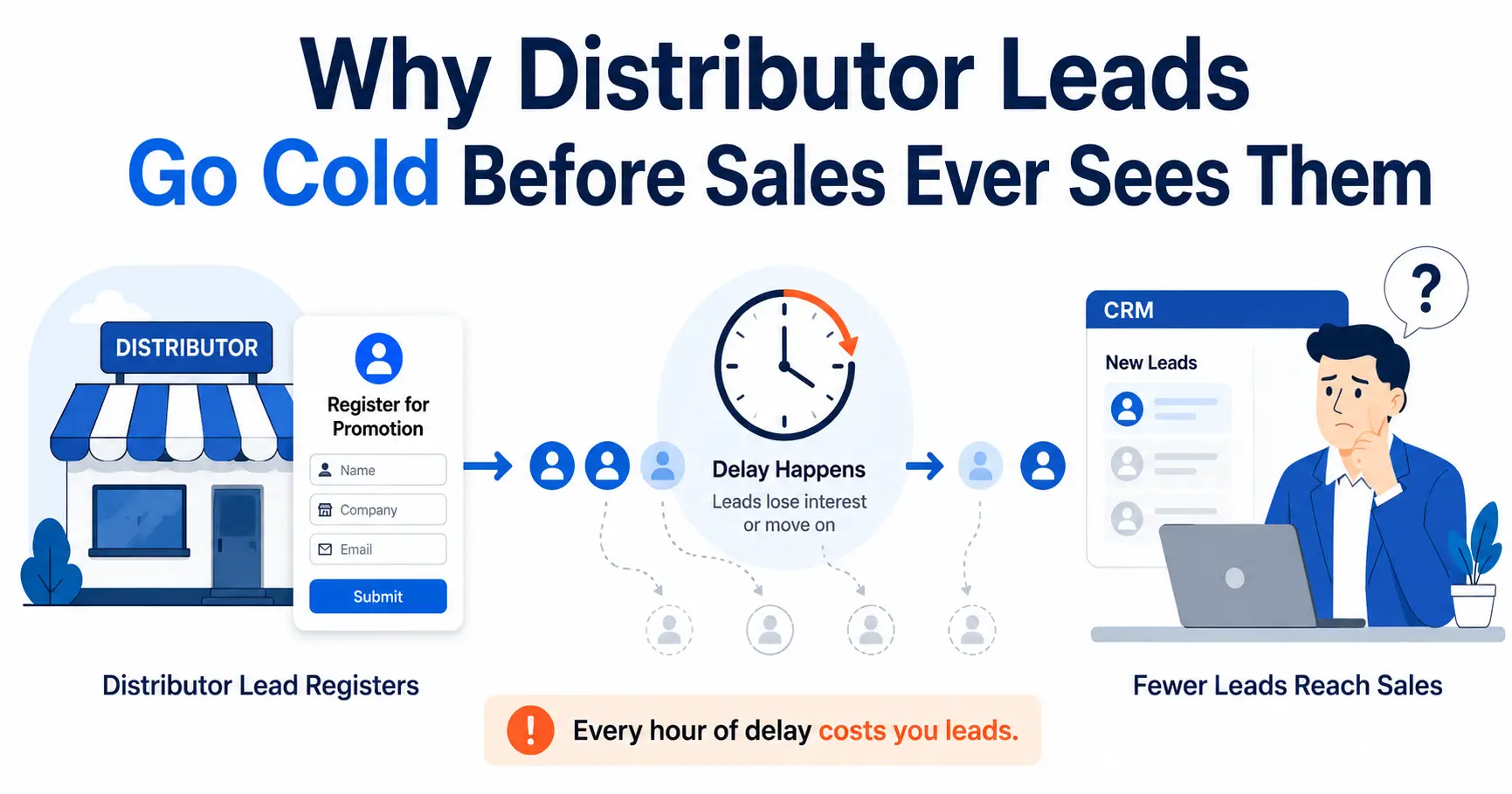
Getting them to register for a promotion is one challenge. What happens after that registration is where most campaigns quietly fall apart.
The Window Is Shorter Than Most Teams Realise
Research from Harvard Business Review found that the likelihood of qualifying a lead drops by over 80% after the first five minutes. Companies that follow up within an hour are seven times more likely to have a meaningful conversation than those who wait longer.
For manufacturing teams running distributor promotions, that window matters more than most. A trade partner who registers for a rebate program is interested in that moment. An hour later they are onto the next thing. A day later the moment is gone.
Speed of follow-up is not a process detail. It is a revenue variable.
How the Gap Forms in the First Place
Most teams are not slow because they are disorganised. They are slow because the infrastructure underneath their campaigns was not built for speed.
Here is what the typical process looks like.
A distributor fills out a registration form on a campaign landing page. That form has no direct connection to the CRM. The response sits somewhere until someone on the operations team pulls it, cleans it, and manually enters it into Salesforce. By the time the sales team sees it, two to three days have passed.
Across one campaign, that is manageable. Across four or five running simultaneously, it becomes a significant drain on time and a consistent source of data errors.
The Salesforce State of Marketing Report found that 72% of marketing teams cite disconnected data and tools as their biggest barrier to understanding customers. In manufacturing, where the customer relationship is already mediated through a distributor layer, that disconnection compounds at every stage of a campaign.
Three Signs the Process Is the Problem
There are a few patterns that tend to show up in manufacturing teams dealing with this challenge.
Leads are reaching sales days after registration. When the gap between a distributor signing up and a sales rep following up is measured in days rather than hours, a meaningful percentage of those leads have already lost interest or moved on.
Every campaign is rebuilt from scratch. When there is no shared campaign infrastructure, each new promotion requires the same manual setup. The same forms, the same spreadsheets, the same process. More campaigns mean more of the same work, not a more efficient operation.
Data quality varies campaign to campaign. When different promotions capture different fields with no standardised structure, records arrive incomplete or inconsistent. Sales teams spend time reconciling data rather than acting on it.
These are not isolated problems. They are symptoms of campaign infrastructure that was never designed to scale.
What a More Connected Process Looks Like
The manufacturing teams solving this problem are not necessarily using more tools. They are using fewer, better connected ones.
The core shift is straightforward. Campaign registration forms connect directly to the CRM, so leads arrive the moment someone submits, not after a manual processing step. Sales teams get real-time visibility. Follow-up happens the same day.
In practice, that means a few specific things.
Registrations flow directly into Salesforce as lead records. No export, no spreadsheet, no manual entry. The data is in the CRM the moment it is submitted, mapped to the right fields for that campaign.
Forms adapt based on who is filling them in. But what makes this different is that the journey is driven by data already sitting in Salesforce. A distributor registering for a rebate program sees different questions than a workshop signing up for a training incentive, because the CRM already knows who they are. Conditional logic handles the rest, keeping forms concise while capturing everything the sales team needs.
Campaign performance is visible in real time. When registrations flow directly into Salesforce, campaign managers can monitor how a promotion is performing while it is still live rather than waiting for a post-campaign report. Adjustments can be made while there is still time to act on them.
New campaigns launch without IT involvement. Marketing teams can build, configure, and deploy campaign forms independently. That removes the back-and-forth that slows down campaign timelines and gives teams more control over their own promotional calendar.
For teams managing this inside Salesforce, SurveyVista connects campaign registrations directly to Salesforce leads natively, with no external sync or middleware required.
A Simple Audit Before the Next Campaign
Before the next promotion launches, it is worth asking three questions about the last one.
- How long did it take for a registration to reach the sales team?
- How complete was the data when it arrived?
- And how many leads were followed up within 24 hours?
Most teams that go through this exercise find the gap is larger than expected. That audit is also the foundation for knowing exactly what needs to change before the next campaign cycle begins.
Frequently Asked Questions
Q: Why do distributor leads lose momentum so quickly in manufacturing promotions?
A: Distributors and trade partners operate with competing priorities and limited time. When follow-up is delayed, their attention moves on, and in a channel-driven industry like manufacturing, that window is even harder to recover once it closes.
Q: What causes slow lead follow-up in most manufacturing campaigns?
A: The most common cause is a disconnected process between the campaign form and the CRM. When registrations are not automatically routed into Salesforce, they require manual processing before sales can act. That delay, combined with inconsistent data, means leads are often stale before anyone follows up.
Q: How do conditional logic forms improve registration rates in manufacturing?
A: Forms that adapt based on previous answers and existing CRM data feel shorter and more relevant to the person filling them in. When irrelevant questions are removed, friction drops and completion rates improve.
Q: What does Salesforce-native lead capture mean for manufacturing marketing teams?
A: A Salesforce-native form tool stores registrations directly inside Salesforce as lead records the moment they are submitted. There is no external server, no API sync, and no manual processing step. Sales teams see leads in real time and can follow up while interest is still fresh.
Q: How quickly can a manufacturing team set up automated lead capture for a promotion?
A: With a Salesforce-native platform, a campaign form mapped to the right lead fields can be built and deployed without IT involvement, often in a single sitting. Most teams go from brief to live in hours rather than the days or weeks that custom-built solutions typically require.
More Like This



Rajesh Unadkat 
Founder and CEO
Rajesh is the visionary leader at the helm of SurveyVista. With a profound vision for the transformative potential of survey solutions, he founded the company in 2020. Rajesh's unwavering commitment to harnessing the power of data-driven insights has led to SurveyVista's rapid evolution as an industry leader.
Connect with Rajesh on LinkedIn to stay updated on the latest insights into the world of survey solutions for customer and employee experience management.