share: 


I have spent more than sixteen years building inside the Salesforce ecosystem, and I have watched some of the best CX leaders I know lose accounts they never saw coming. The feedback program collected the data. The dashboards were green. But the customer who told them exactly what was wrong three months earlier never heard back, and by the time the renewal conversation started, the decision was already made.
If you lead customer success or CX at an enterprise Salesforce org, you know this pressure from every direction right now. A Gartner survey of 321 customer service leaders published in February 2026 found that 91% face executive pressure to implement AI this year. The board wants an AI strategy. The CRO wants to know how AI is reducing churn. And the CX leader caught in the middle is asking the only question that actually matters: will this technology help me serve these customers better, or will it just add another reporting layer between their honest feedback and the action it deserves?
That question lands differently when you consider what honest feedback actually represents. The Zendesk CX Trends Report 2026 found that 56% of consumers rarely complain about a negative experience. They leave quietly, taking their lifetime value with them. The customers who do respond to your surveys are the ones still invested enough to believe something might change. Every enterprise CX leader knows the most dangerous accounts are not the ones with low scores. They are the ones that stopped responding altogether.
The organizations closing this gap are not the ones with the most AI pilots. Grant Thornton’s 2026 AI survey of 950 business leaders found that companies with fully integrated AI are nearly four times more likely to report revenue growth than those still piloting, at 58% versus 15%. The difference is whether AI is embedded into the operational system where customer decisions happen, or sitting outside it summarizing data after the fact.
Most enterprise feedback programs use AI in the wrong place
Here is the pattern I see in almost every enterprise CX program that has adopted AI. The survey closes. The data exports. AI generates a summary. A human reads the summary and decides what to do. By the time that decision reaches the customer, weeks have passed. The customer who responded honestly on day one gets a follow-up on day thirty, if they get one at all. That is not a feedback loop. That is a feedback line with a dead end.
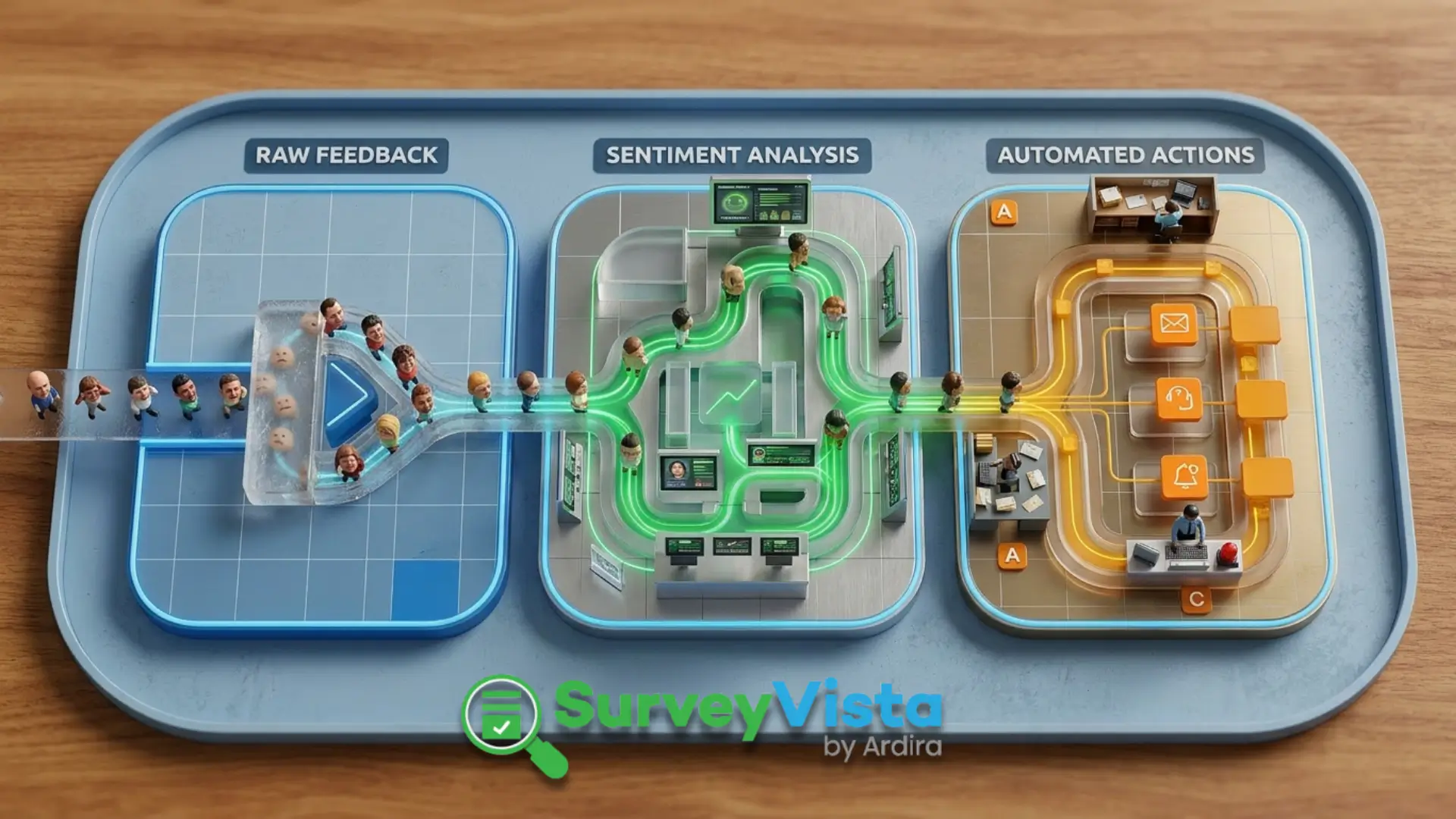
This is generative AI applied to feedback: summaries, suggested questions, reports. Useful for speed, but it does not change the workflow. A human still reviews, still decides, still acts. Operational AI works differently. It acts at the moment a response arrives. It classifies sentiment before a human reads the open-text field. When a respondent gives an ambiguous answer, it triggers a follow-up question that probes for specificity. It routes responses based on content and urgency. And it fires automated actions inside the Salesforce org, creating a case, flagging an at-risk account, or alerting a renewal manager, before the moment passes.
Deloitte’s 2026 AI report, surveying 3,235 leaders, found that 74% of organizations hope to grow revenue through AI, but only 20% are doing so today. The difference is not investment or intent. It is whether AI operates inside the system where the customer relationship lives, or outside it.
How AgentVista brings operational AI into the feedback loop
I built SurveyVista to solve the problem I watched enterprise teams struggle with for over a decade: feedback that was collected but never connected to the action it demanded. When we built AgentVista, our AI layer powered by Salesforce Agentforce, we built it on a principle. AI should act on feedback at the moment of response, inside the Salesforce org, connected to the full customer record.
Sentiment intelligence classifies every response at the moment of submission. When a customer signals frustration in an open-text field, the account record reflects it before anyone opens the individual response. Enterprise organizations running CSAT programs across large account bases, like Marriott with automated survey deployments and role-based reporting through Experience Cloud, know this difference: real-time classification is the difference between proactive retention and reactive recovery.
AI-driven conversational follow-up changes the quality of data the team works with. When a respondent gives a vague answer, AI triggers a clarifying question in real time. For organizations running feedback at global scale, like TEDx with more than 21,000 survey deployments across 180 countries through SurveyVista, getting actionable data the first time is the foundation of every decision that follows.
AI-generated survey insights synthesize response patterns across a deployment and deliver a summary the CX leader can bring to an executive review without exporting or reformatting.
And automated lifecycle feedback, triggered by Salesforce record events and Record Lifecycle Maps, ensures the right survey reaches the right customer at the right moment in the journey, with response outcomes connected to automated actions: case creation, alert routing, renewal outreach.
Two scenarios that protect enterprise revenue
The first is post-case CSAT with automated escalation. Your team runs CSAT surveys across 500 or more accounts. A response comes in below threshold. Sentiment intelligence confirms negative sentiment in the open-text field. SurveyVista automatically creates a follow-up case, assigns it to the account owner, and updates the account record with a risk indicator. You see the escalation the same day. The customer who responded honestly gets a follow-up before their frustration becomes a churn decision.
The second is a renewal survey with at-risk routing across your book of business. A renewal feedback survey deploys 90 days before contract expiration via a Record Lifecycle Map. When responses indicate dissatisfaction, the renewal manager receives an AI-generated summary of sentiment across that account’s last three survey touchpoints. The renewal conversation starts informed rather than opening with a generic check-in that signals no one has been paying attention. For the more than 80 nonprofit organizations using SurveyVista, including UNICEF and YMCA, the stakes of that conversation go beyond revenue. These are programs that serve communities.
Why Salesforce-native architecture is the difference
When Salesforce launched Agentforce Operations on April 29, 2026, it was built on the principle that AI agents need to complete work inside operational systems, not just orchestrate it. SurveyVista was built on that same principle from the beginning.
Feedback data, customer records, sentiment classification, and automated actions all live in the same Salesforce org. There is no API call to an external service, no credential handoff, and no data export. SurveyVista is the only 100% Salesforce-native Intelligence and Action Platform built this way. Your security review is already done. Your AI acts on data connected to account records, case histories, and renewal timelines.
Every survey a customer receives is an implicit promise: we are asking because we will do something with what you tell us. I built SurveyVista because I watched too many enterprise teams break that promise, not out of indifference, but because the architecture between feedback and action was never designed to move at the speed the customer deserved. When your next QBR opens and every negative response has already triggered an automated follow-up, when your renewal manager walks into a conversation with specific concerns already surfaced, and when the board asks what AI is doing for your customers and the answer is a retention number instead of a slide deck, that is the feedback loop finally working the way your customers always needed it to. That is the technology catching up to the work you have always believed in.
See how a native feedback layer fits your enterprise Salesforce org
If you are evaluating Agentforce and want to understand how operational AI works inside a Salesforce-native feedback program, schedule a call with our team.
About SurveyVista
SurveyVista is the only 100% Salesforce-native Intelligence and Action Platform that captures insights across every customer touchpoint, transforming fragmented feedback into unified intelligence to reduce churn, grow revenue, and improve productivity — inside Salesforce. Leveraging AI to embed insights directly into Salesforce workflows, SurveyVista drives automated actions that deliver measurable results.
Frequently Asked Questions
Q: What is operational AI in customer feedback and how does it differ from generative AI?
A: Operational AI acts on survey responses at the moment they arrive inside a Salesforce org. It classifies sentiment in real time, triggers follow-up questions when answers are incomplete, routes responses based on urgency, and fires automated actions like case creation or account risk updates. Generative AI creates content from feedback data after collection, such as summaries or suggested questions. The key difference is timing and action: operational AI closes the feedback loop automatically, while generative AI produces reports a human still needs to act on. Learn more in the SurveyVista feedback foundations guide.
Q: How does SurveyVista use Agentforce to close the customer feedback loop?
A: SurveyVista’s AgentVista layer, powered by Salesforce Agentforce, brings operational AI into the feedback lifecycle natively. Capabilities include sentiment intelligence at the response level, AI-driven conversational follow-up, AI-generated survey insights, response translation, and automated lifecycle feedback triggered by Record Lifecycle Maps. Because everything operates inside the Salesforce org, every action connects to existing account records and case histories without external integrations.
Q: Can SurveyVista automatically escalate negative customer feedback in Salesforce?
A: Yes. When a survey response falls below a defined threshold and sentiment intelligence confirms negative sentiment in open-text fields, SurveyVista can automatically create a follow-up case, assign it to the account owner, and update the account record with a risk indicator. This happens at the moment of response inside the Salesforce org. Marriott’s deployment demonstrates how automated survey workflows and role-based reporting work at enterprise scale.
Q: What is a Record Lifecycle Map and how does it automate survey deployment?
A: A Record Lifecycle Map defines the complete feedback journey for any Salesforce object. It determines what triggers a survey, who receives it, when it deploys, and what happens to the response. Unlike a single-event trigger such as case closure, a Record Lifecycle Map coordinates feedback across multiple milestones, from onboarding through renewal. Response outcomes connect directly to automated actions, enabling the feedback loop to close without manual intervention at each step.
Q: Why does native Salesforce architecture matter for AI-powered feedback programs?
A: When AI operates inside the Salesforce org, it acts on data already connected to the full customer record. There are no synchronization delays, no credential handoffs, and no data exports that create security risk. Automated actions carry the full context of the customer relationship. For enterprise organizations, the security review is already satisfied by existing Salesforce governance. SurveyVista is the only 100% Salesforce-native Insights and Action Platform built on this architecture.
Q: Which enterprise organizations use SurveyVista for customer feedback?
A: More than 450 organizations rely on SurveyVista, including Marriott, eBay, UNICEF, YMCA, and TEDx. The platform holds a 4.96-star rating with more than 222 reviews on the Salesforce AppExchange and serves more than 80 nonprofit organizations. To see how enterprise CX teams use native feedback to close the loop, schedule a call with our team.
More Like This


Rajesh Unadkat 
Founder and CEO
Rajesh is the visionary leader at the helm of SurveyVista. With a profound vision for the transformative potential of survey solutions, he founded the company in 2020. Rajesh's unwavering commitment to harnessing the power of data-driven insights has led to SurveyVista's rapid evolution as an industry leader.
Connect with Rajesh on LinkedIn to stay updated on the latest insights into the world of survey solutions for customer and employee experience management.