
share: 


Your Survey Tool and Salesforce Are Not Actually Talking to Each Other
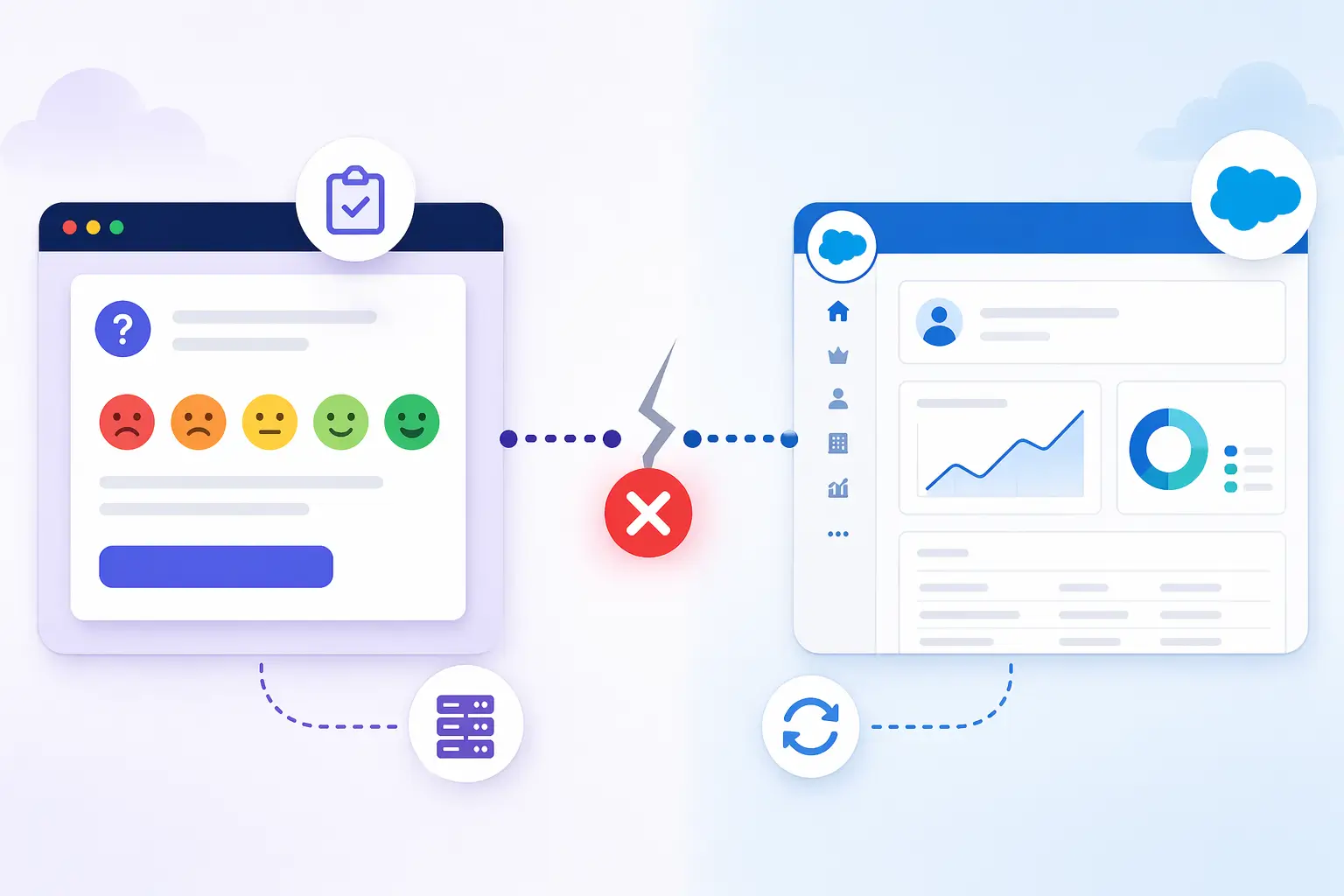
Most CS and CX teams assume their feedback platform is connected to Salesforce. Technically it is. But connected and native are two very different things, and that difference is costing teams more than they realise.
Qualtrics and SurveyMonkey both offer Salesforce integrations. Both are widely used. And both work the same way: survey responses leave through an external server, get processed outside your org, and sync back into Salesforce on a schedule.
By the time a churn signal lands in an account record, the moment to act on it may already have passed.
The Problem Both Platforms Share
Qualtrics offers a Salesforce connector that handles data mapping and bi-directional sync. SurveyMonkey has a Salesforce integration that pushes responses into standard and custom objects. Both work. But in both cases, survey responses originate on an external server before they arrive in your org.
For a CS team that depends on real-time customer signals, that creates a predictable set of problems.
A customer submits a low NPS score. It sits on an external server until the next scheduled sync. By the time it lands in Salesforce, the window to act on it has narrowed or closed. A churn risk surfaces in the survey dashboard but not in the account record where the renewal conversation is happening. Triggering a follow-up action in Salesforce requires a middleware layer someone on your team has to build and keep alive.
IBM’s report found that 53% of organizations cite poor data availability as their top barrier to getting value from Salesforce. Feedback living outside the org and syncing in on a schedule is a direct contributor to that number.
Where Qualtrics and SurveyMonkey Still Make Sense
To be fair, both platforms have a legitimate place. Just not necessarily for a Salesforce-first CS team.
Qualtrics is built for enterprise organizations running multi-domain experience programs at scale. Its analytics depth, conjoint analysis, predictive modeling, and text analysis, is best-in-class for teams with dedicated data science resources managing global programs. If that describes your org, Qualtrics delivers. If it does not, you are paying for complexity your team will never use, at enterprise pricing that typically starts above $2,500 per month.
SurveyMonkey fits teams that need fast, simple survey distribution without deep Salesforce dependency. Quick internal pulse checks, ad hoc feedback, basic NPS collection where real-time automation is not a requirement. It is easy to use and affordable. For a CS team that lives in Salesforce, it will always feel like half a solution.
What Changes When Feedback Lives Inside Salesforce
This is where the conversation shifts for CS teams.
A platform built natively on Salesforce does not connect to the org from the outside. It is constructed on Lightning components, Apex, and native objects, which means it runs inside Salesforce and survey responses land directly in Salesforce records the moment they are submitted. No external server. No sync window. No middleware to maintain.
SurveyVista is built on this architecture, and the operational difference shows up immediately in how CS teams work.
Surveys that know your customer before they answer a single question. With a non-native platform, every survey starts blank. The respondent fills in the context you already have like their role, their product tier, their recent interaction because the survey tool can’t see your CRM.
With SurveyVista inside Salesforce, that dynamic reverses. Existing Salesforce data pre-fills responses automatically – account name, contact role, product usage, last case resolution.
More importantly, the entire survey journey adapts based on what Salesforce already knows. A customer on an enterprise plan sees different questions than one on a starter tier. A contact with an open escalation gets a different flow than one with a clean support history. The survey arrives knowing who it’s talking to, which means every question is relevant, completion rates improve, and the data that comes back is richer because respondents aren’t answering questions that don’t apply to them.
Churn signals surface in real time. When a customer submits a low NPS score, it lands in the account record instantly. CSMs see it where they already work, not in a separate dashboard they have to remember to check. The gap between signal and action closes.
Automation runs through Salesforce natively. A detractor response can open a case automatically. A churn risk flag can enroll a contact in a save sequence. A strong CSAT score can queue an expansion conversation for the account owner. All of it runs through standard Salesforce Flow, with no custom connector and no external dependency. SurveyVista’s Record Lifecycle Maps handle exactly this, triggering actions across the customer journey without adding to your Flow backlog.
CSAT scores stay current. Because data lands in Salesforce in real time, analysis draws from live inputs rather than the last sync. For accounts approaching renewal, that difference is material.
Your admin owns the platform. SurveyVista is managed entirely inside Salesforce. No separate system to learn, no vendor dependency for routine changes, no integration to troubleshoot when either platform updates. Your Salesforce admin runs it the same way they run everything else in the org.
Security exposure disappears. With both Qualtrics and SurveyMonkey, customer data travels through external servers before it reaches Salesforce. That external surface is what was exploited in the Salesloft Drift breach in 2025, which compromised more than 700 organizations through third-party OAuth tokens. A platform where data never leaves the org removes that exposure entirely.
For CS teams that want to see what this looks like with a real migration story, Hire Heroes USA moved from GetFeedback to SurveyVista and came out with tighter automation and workflows their previous platform could not support.
Side-by-Side: What Matters for Salesforce CS Teams
|
Qualtrics |
SurveyMonkey |
SurveyVista |
|
|
Data location |
External server, syncs to Salesforce via bi-directional connector |
External server, pushes to Salesforce on a schedule |
Lives directly inside Salesforce org |
|
Real-time churn signals |
Delayed, depends on sync frequency |
Delayed, no event-based triggers |
Instant, lands in the account/case/contact record on submission |
|
Salesforce automation |
Possible via Salesforce Flow but requires middleware setup |
Limited, needs third-party tools or manual configuration |
Native Flow, triggers fire without any connector |
|
Health score updates |
Dependent on sync schedule, typically lagged |
No native health score support |
Real time, draws from live Salesforce data |
|
Security exposure |
Data processed on Qualtrics servers before reaching Salesforce |
Data processed on SurveyMonkey servers before reaching Salesforce |
Data never leaves the Salesforce org |
|
Best fit |
Enterprise research with dedicated analytics teams |
Simple feedback without Salesforce dependency |
CS and CX teams running on Salesforce |
The Architecture Decision Underneath the Platform Decision
Qualtrics and SurveyMonkey are not made for a CS team whose work lives in Salesforce.
When feedback data has to travel outside the org before it reaches your team, you are always one step behind. Behind on churn signals, behind on health scores, behind on the automation that should have fired before the renewal conversation got difficult.
The platform you choose is really a decision about where customer intelligence lives and how fast your team can act on it. For CS and CX teams running on Salesforce, that answer should be straightforward.
If you want to see how SurveyVista fits your specific Salesforce setup, their team is happy to walk you through it.
Frequently Asked Questions
Q: Do Qualtrics and SurveyMonkey work natively inside Salesforce?
A: Neither platform is Salesforce-native. Both sync data from external servers into Salesforce on a schedule. For CS teams that need feedback signals in real time, that lag affects health scores, churn detection, and the speed at which your team can act.
Q: Which is better for NPS and CSAT programs connected to Salesforce?
A: Both support NPS and CSAT, but neither closes the loop automatically inside Salesforce without additional middleware. A platform built natively on Salesforce handles real-time triggers, case creation, and save sequences without any external dependency.
Q: Can I automate Salesforce workflows directly from survey responses?
A: Not with Qualtrics or SurveyMonkey without building a connector. A native Salesforce platform like SurveyVista triggers cases, sequences, and alerts through Flow the moment a response is submitted, with no additional infrastructure required.
Q: Is Qualtrics worth the cost for a mid-market CS team?
A: Qualtrics is designed for enterprise organizations with dedicated analytics resources. Most mid-market CS teams do not need its depth, and the cost is hard to justify when more Salesforce-connected options exist at a fraction of the price.
Q: What should Salesforce teams ask before choosing a feedback platform?
A: Ask where data goes the moment a response is submitted. Ask whether the platform is built on Salesforce or integrated with it. Ask whether your Salesforce admin can manage it without vendor involvement and steep learning curve. Most platforms answer these vaguely. The answers determine how much friction your team carries every day.
More Like This



Rajesh Unadkat 
Founder and CEO
Rajesh is the visionary leader at the helm of SurveyVista. With a profound vision for the transformative potential of survey solutions, he founded the company in 2020. Rajesh's unwavering commitment to harnessing the power of data-driven insights has led to SurveyVista's rapid evolution as an industry leader.
Connect with Rajesh on LinkedIn to stay updated on the latest insights into the world of survey solutions for customer and employee experience management.