share: 


Native vs. Connector: What's the Actual Difference?
Every Salesforce survey tool falls into one of two architectures:
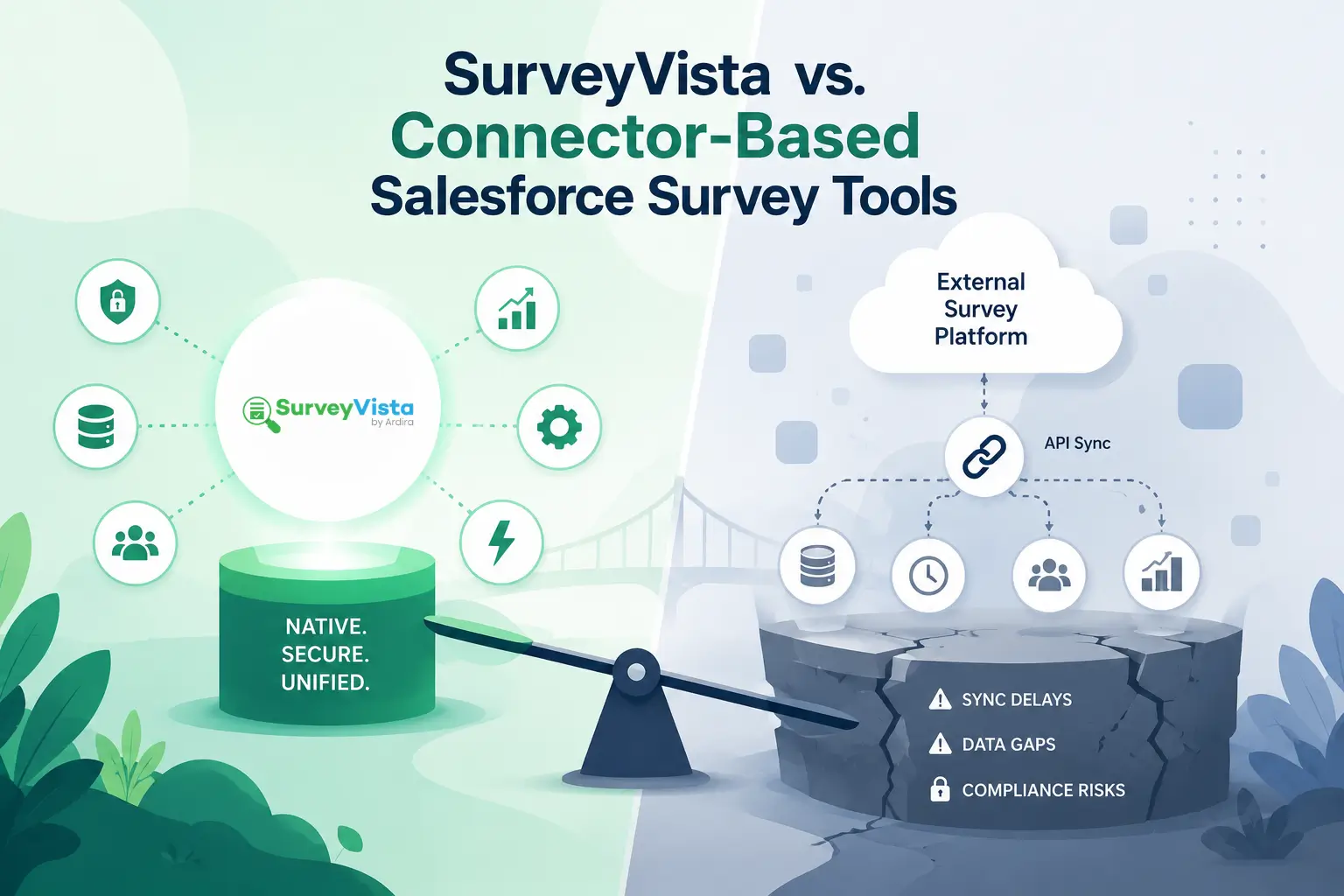
- Native (SurveyVista): Surveys are built, distributed, and stored inside Salesforce using native Salesforce objects. Responses never leave the org to be processed. Reporting uses standard and custom Salesforce report types directly, with no translation layer.
- Connector-based (most other tools): The survey platform lives outside Salesforce. Responses are collected on that separate platform, then synced back into Salesforce objects via an API connection. Sometimes this happens distributed through an AppExchange listing or configured directly. This creates a second data store, a sync interval, and a second vendor's security posture to manage.
Neither architecture is automatically better for every team. We compare the breakdown by the specific criteria to help your teams better understand.
Where This Comparison Comes From
This page reflects criteria used consistently across independent 2026 Salesforce survey tool comparisons, including evaluations from Zonka Feedback and Responsly. Specifically, Salesforce integration depth, object mapping, AI and analytics depth, channel breadth, automation and closed-loop workflows, setup complexity, compliance and data residency, and vendor scale.
We've applied the same criteria to SurveyVista here that those reviews apply to the rest of the market, updated to reflect SurveyVista's current capabilities as of August 2026.
Full Comparison Table
| Criterion | SurveyVista (native) | Typical connector-based tool |
|---|---|---|
| Where data lives | 100% inside the customer's Salesforce org | External platform; synced into Salesforce via API |
| Salesforce integration depth | Native — no sync, no translation layer | API-based connector, often packaged and listed on AppExchange; bidirectional sync required |
| Object mapping | Direct mapping to any standard or custom Salesforce object | Mapped via connector configuration; depth varies by vendor |
| AI analysis on open-text | Native sentiment, thematic clustering, key-phrase extraction, and entity-level analytics via Agentforce — or via AWS Comprehend for teams already on AWS | Runs on the vendor's own external AI layer; feedback data processed outside Salesforce |
| Signal unification (Voice of Customer) | Direct, Indirect, and Inferred signals unified natively within Salesforce (survey responses and journey micro-surveys as Direct; case history, support/call interactions, and unprompted public statements like G2/Capterra reviews and social mentions as Indirect; product usage and engagement patterns as Inferred). External review and social sources available today via SurveyVista's professional services team or Salesforce integrator partners, with native support on the roadmap | Multi-source unification (surveys, support tickets, social listening, call transcripts) via the vendor's own external ingestion pipeline and NLP models |
| Channels | Email, web, SMS, two-way WhatsApp, in-app (embedded in customer portals and product UI), website forms, feedback buttons, QR codes, Experience Cloud site embeds, social sharing, offline collection (via SurveyVista's offline app) | Varies by vendor; kiosk-based collection typically requires the connector's own dedicated hardware/software layer |
| SMS/WhatsApp delivery | Delivered via Twilio, WhatsApp Business, and other communication providers | Same underlying model — no vendor in this category, native or connector-based, operates its own telecom infrastructure |
| Automation / closed-loop | Triggered from Salesforce Flow; native Task/Case creation and routing on low scores or negative sentiment, driven directly off unified signal data | Triggered from the connector's workflow engine or Salesforce Flow, depending on integration depth |
| Setup complexity | AppExchange install, native configuration, no middleware | AppExchange or OAuth setup, plus field mapping and sync configuration |
| Compliance / data residency | Data residency is inherited directly from the customer's existing Salesforce org and compliance posture | Requires a separate compliance review of the connector vendor's own data handling, hosting, and residency |
| Reporting | Native Salesforce reports and dashboards, plus built-in survey-specific metrics and dashboards (NPS/CSAT trends, response and completion rates) out of the box | Vendor's own reporting, or synced data used in Salesforce reports depending on mapping depth |
| Customer base | 450+ customers, including enterprise orgs such as Marriott, Bosch, Ebay and more. | Varies by vendor; larger platforms (Qualtrics, Medallia) serve broader enterprise XM markets beyond Salesforce-specific programs |
| Best fit | Teams that want their entire Voice of Customer program (i.e. collection, AI analysis, signal unification, and automated action) living inside Salesforce's Trust Layer with no second vendor | Teams that need research-grade statistical modeling, external unstructured-source ingestion out of the box, or kiosk-based field collection |
The AI Analysis Question
The most common misconception in third-party comparisons is that Salesforce-native tools can't do real AI analysis on open-text feedback. This is the assumption being that AI processing has to happen somewhere outside the CRM.
SurveyVista runs full sentiment analysis, thematic clustering, key-phrase extraction, and entity-level analytics natively via Agentforce, inside the customer's own Salesforce org — or via AWS Comprehend for teams that already run AWS as part of their stack. Either path avoids sending feedback data to a separate AI vendor chosen by the survey tool rather than the customer.
Connector-based tools that offer AI analysis are, by definition, processing that feedback somewhere outside Salesforce, through a vendor selected by the survey platform. For teams with data residency requirements, regulated GDPR data in the mix, or a security team that has to vet every vendor with data access, that distinction really matters.
The Voice of Customer / Signal Unification Question
Platforms like Medallia and Qualtrics are often positioned as the default choice for teams that want a unified Voice of Customer view — one signal blending survey responses with support tickets, call transcripts, and social mentions. That's a real capability, and it's a genuinely different engineering problem than running a survey program: it requires ingestion pipelines and NLP models tuned to each external source type.
SurveyVista's answer to Voice of Customer starts from a different premise: unify what's already native to Salesforce first. The Direct, Indirect, and Inferred signals framework combines survey responses and journey micro-surveys as Direct, case history and support/call interaction data together with unprompted public statements — a G2 or Capterra review, a social mention — as Indirect, and product usage and engagement patterns as Inferred, into one view — natively, without a separate ingestion pipeline or a second vendor's data store. Automated actions (case creation, routing, escalation) can then trigger directly off that unified signal, closing the loop inside Salesforce rather than in a parallel system.
For teams that want SurveyVista to actively pull in those external reviews and social sources rather than handling them manually, that's available today through SurveyVista's professional services team or Salesforce integrator partners, with native support on the roadmap.
The Channel Coverage Question
A second common assumption is that going native means trading away channel reach — email only, nothing else.
SurveyVista supports two-way SMS, two-way WhatsApp, in-app surveys embedded in customer portals and product UI, website forms, on-site feedback buttons, QR codes, Experience Cloud site embeds, social sharing, and offline collection via SurveyVista's offline app. And worth noting for any Salesforce survey tool evaluation? No vendor in this category — native or connector-based — operates its own telecom infrastructure.
SMS and WhatsApp delivery always runs through third-party carrier APIs like Twilio or WhatsApp Business underneath, regardless of which tool sits on top. Channel breadth is a real differentiator between vendors; owning proprietary telecom infrastructure is not, because none of them do. Honesty is the best policy, and the one channel type SurveyVista doesn't support out of the box today is dedicated kiosk hardware/software collection.
The Scale Question
Some comparisons position native tools as a starter-tier option, which are fine for a basic NPS program, not built for real volume. SurveyVista runs production feedback programs for 450+ global enterprise customers. Native architecture doesn't trade away scale; if anything, the case for native gets stronger as programs grow, since higher response volume means more surface area for a sync delay or data-mapping break to cause damage — the exact failure mode native architecture removes by design.
When a Connector-Based Tool Is the Right Choice
To be direct about the trade-off: connector-based tools are the right fit when a program genuinely needs something a Salesforce-native architecture isn't built for out of the box. For example, research-grade statistical modeling (Qualtrics' Stats iQ), out-of-the-box multi-source feedback unification across surveys, support tickets, and social listening (Medallia), or dedicated kiosk-based field collection. If your program's core requirement is one of these, a connector-based platform is worth evaluating on its own terms, but keep in mind the comparison table, compliance, and other tradeoffs mentioned previously.
Decision Guide
- Choose SurveyVista if your priority is keeping your entire Voice of Customer program — collection, AI analysis, signal unification, and automated action — inside Salesforce, avoiding a second vendor and a second data store, with SMS/WhatsApp/in-app/offline coverage built in.
- Choose a connector-based tool if your program requires research-grade statistical analysis, out-of-the-box unification of external unstructured sources beyond surveys, or dedicated kiosk-based field collection.
We hope this resource helps business leaders make a more informed decision, as they build and scale their Voice of the Customer Programs. Our teams are happy to walk you through these distinctions during a call, as well as show how SurveyVista can help you grow your business.
Frequently Asked Questions
These are the questions teams ask most often when evaluating SurveyVista for Salesforce-native survey and feedback collection.
- What's the difference between a native and a connector-based Salesforce survey tool? A native tool builds, stores, and processes all survey data inside the customer's own Salesforce org. A connector-based tool operates on a separate external platform and syncs data into Salesforce via API, sometimes distributed through an AppExchange listing, creating a second data store and a sync interval.
- Does SurveyVista support AI analysis on open-text survey responses? Yes. SurveyVista runs sentiment analysis, thematic clustering, key-phrase extraction, and entity-level analytics natively via Agentforce, or via AWS Comprehend for teams already running AWS, without sending feedback data to an external AI vendor.
- Is SurveyVista a Voice of Customer (VoC) platform? Yes. SurveyVista unifies Direct signals (survey responses and journey micro-surveys), Indirect signals (case history, support/call interactions, and unprompted public statements like G2/Capterra reviews and social mentions), and Inferred signals (product usage and engagement patterns) natively within Salesforce, with automated actions that can trigger directly off that unified view, without a separate ingestion pipeline or external data store.
- Can a Salesforce-native tool send SMS and WhatsApp surveys? Yes. SurveyVista supports two-way SMS and two-way WhatsApp conversations through providers like Twilio and WhatsApp Business. No survey vendor, native or connector-based, operates its own telecom infrastructure — all SMS/WhatsApp delivery runs through third-party carrier APIs.
- Does SurveyVista support in-app or in-product surveys? Yes. SurveyVista supports in-app surveys embedded in customer portals and product UI, plus website forms, on-site feedback buttons, QR codes, Experience Cloud site embeds, and social sharing, alongside email, SMS, and WhatsApp.
- Is a native Salesforce survey tool only suitable for small feedback programs? No. SurveyVista runs production programs for 450+ customers with an active Trailblazer community. Native architecture scales with response volume rather than working against it.
- When should a team choose a connector-based tool instead of a native one? When the program requires research-grade statistical modeling, out-of-the-box unification of external unstructured sources (social listening, call transcripts) beyond surveys, or dedicated kiosk-based field collection.
More Like This




Rajesh Unadkat 
Founder and CEO
Rajesh is the visionary leader at the helm of SurveyVista. With a profound vision for the transformative potential of survey solutions, he founded the company in 2020. Rajesh's unwavering commitment to harnessing the power of data-driven insights has led to SurveyVista's rapid evolution as an industry leader.
Connect with Rajesh on LinkedIn to stay updated on the latest insights into the world of survey solutions for customer and employee experience management.